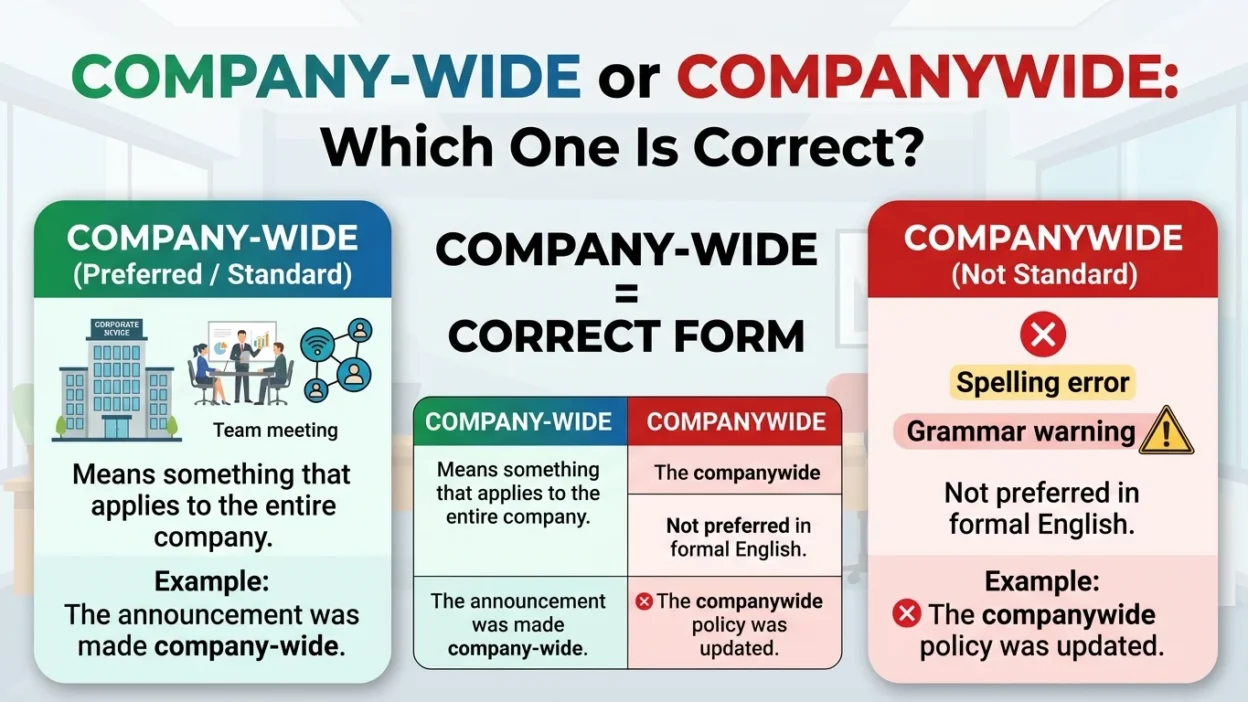
Many professionals discussing company-wide or companywide often face uncertainty about the correct spelling, making clear communication easier across business settings.
From my experience reviewing business documents and internal communication, the preferred choice depends on context, as the hyphenated version is commonly used before a noun.
While the one-word, one word form has become more accepted in modern usage. Understanding this difference helps prevent unnecessary confusion and improves overall writing quality.
Even experienced writers make mistakes because language changes over time. It helps to know exactly when to use different forms. Good writing requires proper grammar, consistent style, and careful word choice.
The term often functions as both a compound word and a compound adjective in a sentence, so paying attention to hyphenation remains important for accuracy and readability.
Within the workplace, an announcement may describe an event that affects everyone, while a policy can appear in official records.
As language evolves, the single-word spelling is becoming increasingly common, although many editors still prefer the traditional spelling in certain situations.
This is especially true when discussing trips, policies, meetings, and other activities that involve the entire organization.
Quick Answer
Both “company-wide” and “companywide” are correct.
- Company-wide is the traditional and more commonly accepted form.
- Companywide is a closed compound word that has become increasingly common in modern business writing.
- Many organizations and style guides still prefer company-wide, especially in formal communication.
If consistency matters, choose one style and use it throughout your document.
What Does Company-Wide or Companywide Mean?
The terms company-wide and companywide describe something that affects, involves, applies to, or includes an entire company rather than a specific department, team, or group.
In simple words, if an action, policy, initiative, meeting, or announcement reaches everyone in an organization, it can be described as company-wide or companywide.
Examples
- The CEO announced a company-wide restructuring plan.
- We launched a company-wide training program.
- The organization introduced companywide security policies.
- Employee feedback was collected through a company-wide survey.
- A companywide wellness initiative starts next month.
In each example, the action impacts the entire organization.
Company-Wide vs Companywide: What’s the Difference?
There is no difference in meaning between the two forms. The distinction is primarily stylistic.
| Feature | Company-Wide | Companywide |
| Meaning | Applies to the entire company | Applies to the entire company |
| Traditional Usage | More common | Less traditional |
| Formal Writing | Often preferred | Increasingly accepted |
| Business Communication | Very common | Common |
| Style Guides | Frequently recommended | Depends on guide |
| Readability | Easy to recognize | More streamlined |
Most readers will understand either version without confusion.
Why Is “Company-Wide” More Common?
English often uses hyphenated compounds before they become closed compounds.
For example:
- Decision-making → Decisionmaking
- E-mail → Email
- Website → Web site (older form)
Similarly, company-wide emerged first as a hyphenated adjective. Over time, many writers began using companywide as a single word.
Because of its longer history, the hyphenated version remains more common in corporate documents, employee handbooks, and professional writing.
When Should You Use Company-Wide?
Use company-wide when:
- Writing formal business documents
- Following traditional grammar conventions
- Creating policies and procedures
- Writing professional reports
- Maintaining consistency with established style guides
Examples
- The company-wide meeting will be held on Friday.
- Management announced a company-wide hiring freeze.
- A company-wide compliance review is underway.
- Employees received company-wide communication regarding benefits.
Many editors consider this the safest option for professional writing.
When Should You Use Companywide?
Use companywide when:
- Your organization prefers closed compound words
- You’re following an internal style guide
- Consistency across digital content is important
- You want a cleaner visual appearance
Examples
- The companywide survey achieved a high response rate.
- Companywide objectives were updated this quarter.
- The companywide recognition program improved morale.
- Leadership introduced companywide productivity standards.
This version is becoming increasingly popular in modern workplaces.
Common Business Phrases Using Company-Wide
You’ll frequently see the term paired with organizational activities and initiatives.
Popular Examples
- Company-wide announcement
- Company-wide meeting
- Company-wide policy
- Company-wide initiative
- Company-wide training
- Company-wide survey
- Company-wide strategy
- Company-wide communication
- Company-wide change
- Company-wide compliance program
- Company-wide standards
- Company-wide objectives
These phrases help indicate that something applies across the entire organization.
Common Mistakes to Avoid
Even though the phrase is simple, writers often make a few common errors.
Mistake 1: Using Multiple Versions in the Same Document
Incorrect:
- The company-wide meeting starts at 9 AM.
- Our companywide strategy will be announced afterward.
Correct:
- Use one version consistently throughout the document.
Mistake 2: Adding Unnecessary Hyphens
Incorrect:
- Company-wide-wide initiative
Correct:
- Company-wide initiative
Mistake 3: Confusing It With Department-Level Actions
Incorrect:
- The marketing team’s weekly meeting is company-wide.
Correct:
- The marketing team’s weekly meeting is departmental, not company-wide.
Mistake 4: Inconsistent Branding
Organizations often establish editorial standards. Switching between forms can make content appear less polished.
Company-Wide in Professional Writing
Business professionals frequently use the term when discussing organizational communication and strategic planning.
Examples include:
- Organizational change management
- Employee engagement programs
- Corporate training initiatives
- Enterprise-wide projects
- Company-wide objectives
- Internal communications
- Workforce development plans
Because these activities affect everyone, the phrase accurately communicates scope and impact.
American vs British English
Unlike some spelling differences between American and British English, there is no major regional distinction between company-wide and companywide.
Both American and British English speakers use both forms.
However:
- Traditional editors in both regions often favor company-wide.
- Modern business publications increasingly accept companywide.
The key factor is consistency rather than regional preference.
Related Terms and Synonyms
Depending on context, you may also encounter these related expressions:
- Organization-wide
- Enterprise-wide
- Business-wide
- Corporate-wide
- Across the organization
- Throughout the company
- Company-wide initiative
- Organization-wide policy
- Enterprise-level strategy
- Company-wide communication
These terms often serve similar purposes in business writing.
Examples in Real-World Sentences
Here are several practical examples:
- The company-wide bonus program rewarded employee performance.
- Leadership announced a company-wide sustainability initiative.
- We conducted a company-wide cybersecurity assessment.
- A companywide software upgrade improved efficiency.
- The companywide learning platform supports employee development.
- Management introduced company-wide performance standards.
- Employees participated in a company-wide engagement survey.
- The companywide communication strategy improved transparency.
These examples show how naturally both forms fit into workplace communication.
How to Choose the Best Version
If you’re unsure which version to use, follow these guidelines:
Choose Company-Wide If:
- Writing formal content
- Following AP-style preferences
- Creating HR documents
- Preparing reports or proposals
- You want the most universally accepted option
Choose Companywide If:
- Your organization already uses it
- Your style guide permits it
- You’re prioritizing modern usage
- Consistency is more important than tradition
For most professional situations, company-wide remains the safest choice.
FAQs
Is company-wide correct?
Yes. Company-wide is a correct and widely accepted term used to describe something that affects an entire organization.
Is companywide one word?
Yes. Companywide is also considered correct and is increasingly common in modern business writing.
Which is more professional: company-wide or companywide?
Most editors and business writers still prefer company-wide in formal documents, although both forms are acceptable.
Do company-wide and companywide mean the same thing?
Yes. There is no difference in meaning. The difference is purely stylistic.
Should I use a hyphen in company-wide?
Traditionally, yes. The hyphenated version remains the most widely recognized form.
Is companywide accepted in business writing?
Yes. Many organizations, websites, and corporate communications use companywide as a closed compound word.
Does American English prefer companywide?
Not specifically. Both American and British English use both forms, though company-wide is often more common.
Can I use both forms in the same document?
It’s best not to. Choose one style and remain consistent throughout your content.
Summary
The debate between company-wide or companywide is largely a matter of style rather than correctness. Both forms mean the same thing: something that applies to an entire organization. While company-wide remains the traditional and more widely preferred spelling, companywide has gained acceptance in modern business communication.
When deciding which version to use, focus on consistency, audience expectations, and any style guidelines your organization follows. For formal business writing, policies, reports, and corporate communications, company-wide is often the safest choice. If your company already uses companywide, there is no reason to change as long as usage remains consistent.
Actionable Takeaway
Before publishing any business document, check your organization’s style guide and choose either company-wide or companywide. Use the selected version consistently throughout all communications to maintain professionalism, clarity, and credibility.