If you’ve ever paused mid-sentence wondering whether to write fairing or faring, you’re not alone. These two words sound identical but carry completely different meanings, which makes them a common source of confusion in everyday writing.
The good news? Once you understand the distinction, it becomes surprisingly easy to choose the right one every time. In this guide, we’ll break it down in a simple, clear way with examples, tips, and common mistakes to avoid so you can write with confidence.
Quick Answer
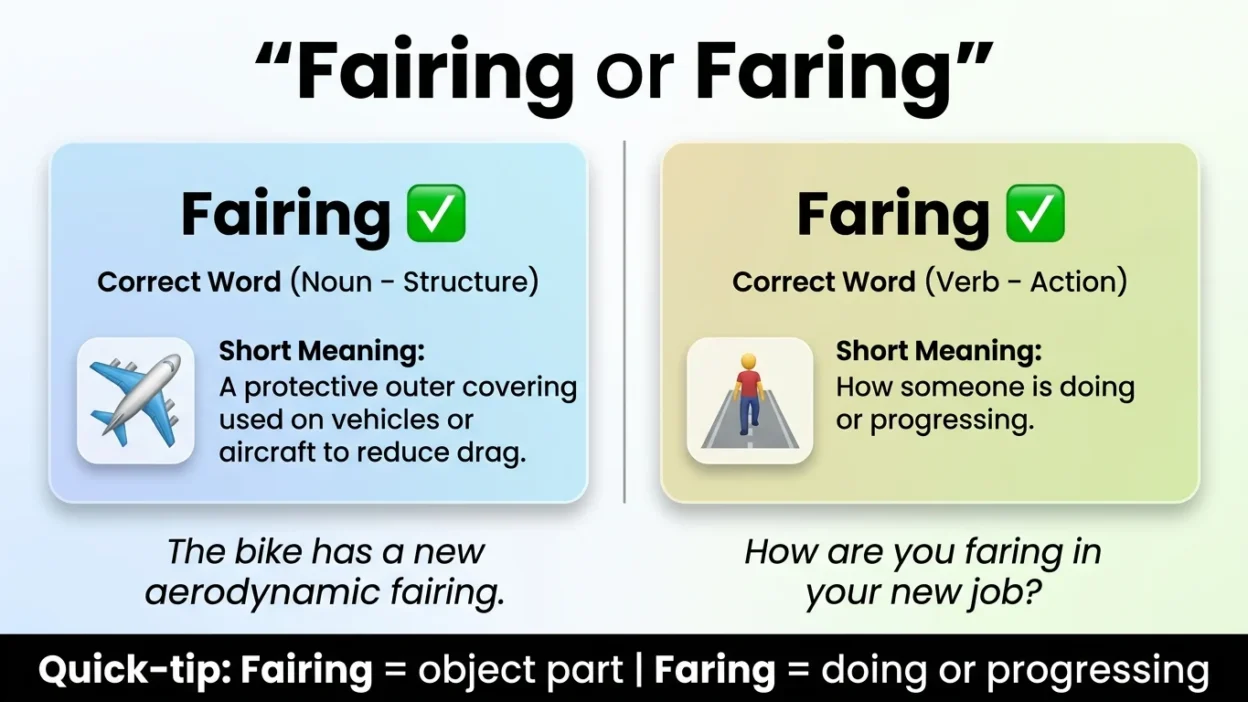
- Faring relates to how someone is doing or progressing (e.g., “How are you faring?”)
- Fairing is a noun, usually referring to a structure that improves aerodynamics (e.g., parts of motorcycles or aircraft)
What Does “Faring” Mean?
Faring comes from the verb fare, which means to get along, perform, or progress in a particular way.
It’s commonly used when asking about someone’s well-being or how something is going.
Examples of “Faring” in Sentences:
- How are you faring after your exams?
- The company is faring well despite economic challenges.
- She asked how her friend was faring in the new city.
Related LSI Keywords:
- doing well or poorly
- getting along
- coping
- managing
- progressing
In most cases, if you’re talking about performance, condition, or well-being, the correct choice is faring.
What Does “Fairing” Mean?
Fairing is a completely different word. It is a noun, often used in technical or mechanical contexts.
It refers to a structure designed to reduce air resistance (drag) or improve the appearance of something.
Examples of “Fairing” in Sentences:
- The motorcycle’s fairing improves speed and stability.
- The aircraft’s nose fairing reduces aerodynamic drag.
- He replaced the damaged fairing on his bike.
Related LSI Keywords:
- aerodynamic cover
- vehicle body panel
- drag reduction
- mechanical component
- protective casing
If you’re talking about vehicles, engineering, or design, then fairing is the correct term.
Fairing vs Faring: Side-by-Side Comparison
| Feature | Faring | Fairing |
| Part of Speech | Verb (present participle) | Noun |
| Meaning | How someone/something is doing | Aerodynamic structure or covering |
| Context | Daily conversation, well-being | Engineering, vehicles, aviation |
| Example | “How are you faring?” | “The bike has a sleek fairing.” |
| Common Confusion | Mistaken for fairing due to pronunciation | Mistaken for faring in casual writing |
Common Mistakes and How to Avoid Them
Even experienced writers mix these up because they’re homophones (words that sound the same). Here are some typical errors and how to fix them.
Mistake 1: Using “Fairing” Instead of “Faring”
❌ How are you fairing these days?
✔️ How are you faring these days?
👉 Tip: If you’re asking about someone’s condition or progress, always use faring.
Mistake 2: Using “Faring” in Technical Contexts
❌ The airplane’s nose faring reduces drag.
✔️ The airplane’s nose fairing reduces drag.
👉 Tip: If it involves a physical object or structure, use fairing.
Mistake 3: Relying Only on Sound
Since both words sound identical, relying on pronunciation alone leads to errors.
👉 Quick memory trick:
- Faring = Feeling / Functioning
- Fairing = Fabrication / Frame (structure)
Real-Life Usage Examples
Let’s look at how these words appear in everyday and professional contexts.
Everyday Conversation:
- “How are you faring in your new job?”
- “Students are faring better with online learning tools.”
Technical or Mechanical Context:
- “The car’s front fairing enhances fuel efficiency.”
- “Racing bikes use lightweight fairings for better performance.”
Using the correct word not only improves clarity but also builds credibility in both casual and professional writing.
American vs British English Differences
There is no difference between American and British English when it comes to fairing vs faring.
- Both forms are spelled the same in US and UK English
- Meanings remain identical across regions
- Usage rules do not change
So whether you’re writing for a US or UK audience, the same distinction applies.
Why This Confusion Happens
There are a few reasons why fairing and faring are often mixed up:
- They are pronounced exactly the same
- Spell-check tools may not catch the error
- “Faring” is less commonly taught explicitly
- “Fairing” looks more familiar due to the word “fair”
Understanding the context is the key to choosing correctly.
Simple Trick to Remember the Difference
Here’s an easy way to lock it in:
- If you can replace it with “doing” → use faring
- If you’re talking about a physical part → use fairing
Example:
- How are you doing? → How are you faring? ✅
- The bike part → must be fairing ✅
FAQs
1. Is “faring well” correct?
Yes, “faring well” is correct and means doing well or performing positively.
2. Can “fairing” ever be used as a verb?
No, fairing is strictly a noun in modern usage.
3. Why do people confuse fairing and faring?
Because they are homophones and sound identical when spoken.
4. Is “how are you fairing” ever correct?
No, that is incorrect. The correct phrase is “how are you faring.”
5. What industries use the word “fairing”?
It’s commonly used in:
- Automotive design
- Aerospace engineering
- Motorcycle manufacturing
6. Is “faring” formal or informal?
It works in both formal and informal contexts, depending on the sentence.
7. Can I use “faring” in professional writing?
Yes, especially when discussing performance, progress, or outcomes.
8. What’s a quick test to choose the right word?
Ask yourself: “Am I talking about progress or a physical object?” That will guide your choice instantly.
Final Summary
Understanding the difference between fairing and faring comes down to context. Faring is about how someone or something is doing, while fairing refers to a physical structure, often used in engineering or design. Even though they sound identical, their meanings are worlds apart.
Mastering this distinction helps you avoid common writing mistakes and communicate more clearly. Whether you’re writing casually or professionally, using the correct word shows attention to detail and strengthens your credibility.
Actionable Takeaway
Next time you’re unsure, pause and ask: Am I describing progress or a physical object? If it’s progress, go with faring. If it’s a structure or component, choose fairing. With this simple habit, you’ll never mix them up again.

Henry Wyatt is the administrator of RizzPeak, responsible for managing site operations, content organization, and overall performance. He ensures smooth functionality, platform security, and a user-friendly experience while supporting the site’s creative direction and maintaining consistent quality across all features and updates.