Many people confuse these words, but imitated vs intimated shows a clear difference in meaning, usage, context, and everyday communication. While imitated and intimated may look similar, their meanings are very different. When a person copied or mimicked another person’s style, behavior, or speaking habits, the correct word is imitated.
In contrast, intimated means hinted or suggested something without saying it directly. During editing work, I have often seen these terms confused because they look alike, even though they do not share the same meaning. A simple example highlights the gap between the two words.
An employee may have imitated a boss by copying how that person talked or acted. However, if the same boss intimated that layoffs were coming, the message was hinted rather than stated outright. This common mix up can lead to major changes in what a sentence says, especially when people begin swapping one word for another.
The confusion is also linked to the word intimate. Many writers recognize it as an adjective meaning close or personal, but it can also function as a verb. That is often where the misunderstanding starts. One word relates to something being shared through copying, while the other relates to stating something plainly or indirectly through a clue that is hinted or suggested.
Quick Answer
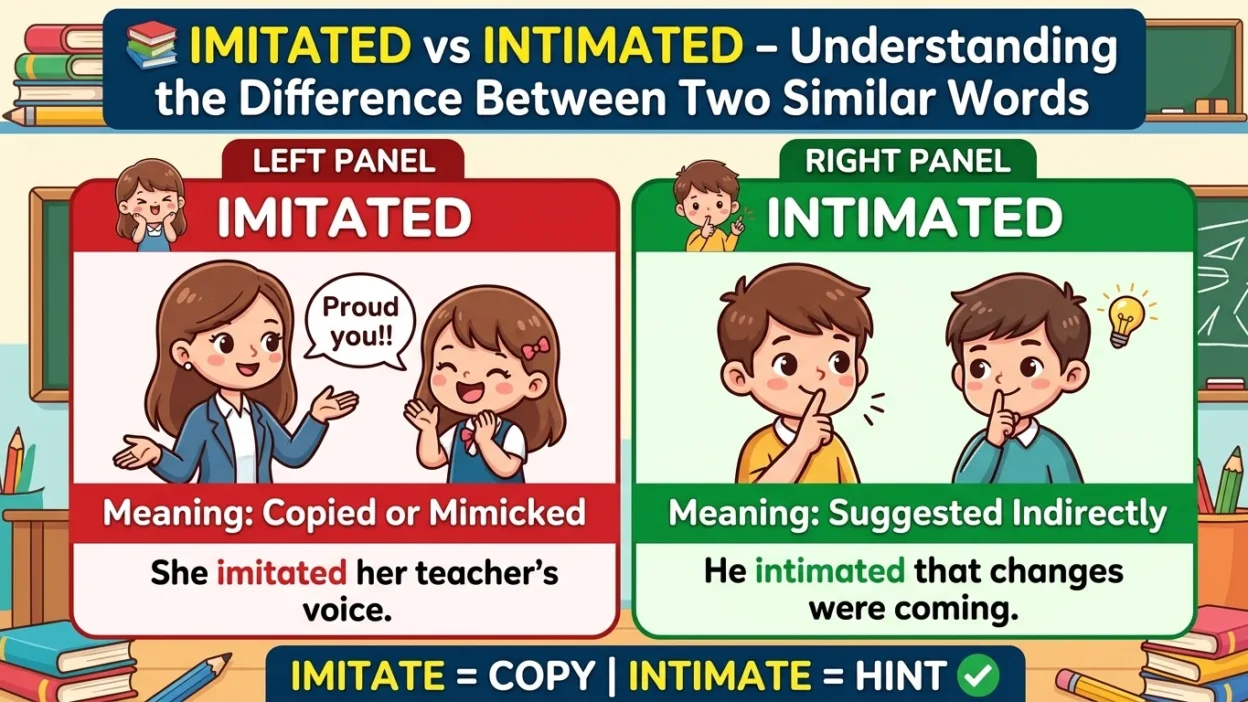
The difference between imitated and intimated is simple:
- Imitated means copied, mimicked, or reproduced someone’s actions, behavior, style, or appearance.
- Intimated means hinted, suggested indirectly, or communicated something subtly.
Example:
- She imitated her favorite singer’s voice.
- He intimated that changes were coming to the company.
If you’re talking about copying someone, use imitated. If you’re talking about hinting at something, use intimated.
What Does “Imitated” Mean?
The word imitated is the past tense of imitate. It refers to copying or reproducing something or someone.
People imitate others for various reasons:
- Learning new skills
- Showing admiration
- Practicing behavior
- Entertainment and comedy
- Artistic inspiration
Examples of Imitated
- The child imitated her mother’s gestures.
- The actor imitated the president’s speech patterns.
- Many companies have imitated the successful business model.
- The student imitated the painting technique used by the artist.
- The bird imitated human sounds surprisingly well.
Synonyms of Imitated
Some related words and phrases include:
- Copied
- Mimicked
- Replicated
- Reproduced
- Emulated
- Followed
- Modeled after
- Duplicated
These LSI keywords help reinforce the meaning of imitation and copying.
What Does “Intimated” Mean?
The word intimated is the past tense of intimate when used as a verb. In this context, it means to suggest or communicate something indirectly rather than stating it openly.
When someone intimates something, they provide a clue, hint, or subtle indication.
Examples of Intimated
- The manager intimated that a promotion might be available soon.
- She intimated her dissatisfaction without directly complaining.
- The report intimated possible financial difficulties ahead.
- He intimated that he would resign before the end of the year.
- The teacher intimated that the exam would be challenging.
Synonyms of Intimated
Common synonyms include:
- Hinted
- Suggested
- Implied
- Indicated
- Signaled
- Alluded to
- Insinuated
- Communicated indirectly
These words all involve conveying information without explicitly stating it.
Imitated vs Intimated: Key Differences
The easiest way to distinguish these words is to focus on the action involved.
| Feature | Imitated | Intimated |
| Meaning | Copied or mimicked something | Hinted or suggested indirectly |
| Part of Speech | Verb (past tense) | Verb (past tense) |
| Main Idea | Reproduction or copying | Indirect communication |
| Common Contexts | Behavior, speech, appearance, skills | Messages, warnings, opinions, intentions |
| Example | She imitated her teacher. | She intimated her concerns. |
Remember:
- Imitated = copied
- Intimated = hinted
How to Remember the Difference
A simple memory trick can help.
Imitated = Imitation
Both words share the root imit.
Think:
Imitated = Imitation = Copying
Intimated = Indirect Information
The word intimated often involves conveying information indirectly.
Think:
Intimated = Indirect Hint
This association can make the distinction easier to remember during writing or exams.
Example Sentences Comparing Imitated and Intimated
Seeing the words side by side makes the difference clearer.
Using Imitated
- The comedian imitated several famous celebrities.
- Young athletes often imitated their sports heroes.
- The software company imitated features from competitors.
Using Intimated
- The director intimated that major changes were ahead.
- She intimated her disappointment through her tone.
- The article intimated that more evidence would emerge.
Side-by-Side Comparison
- The student imitated the professor’s speaking style.
- The professor intimated that the project deadline might change.
In the first sentence, someone is copying behavior. In the second, someone is hinting at information.
Common Mistakes with Imitated and Intimated
Because these words look alike, writers often use one when they mean the other.
Mistake 1: Using Intimated Instead of Imitated
❌ The child intimated his father’s accent.
✅ The child imitated his father’s accent.
The sentence describes copying speech, not hinting at something.
Mistake 2: Using Imitated Instead of Intimated
❌ The CEO imitated that layoffs were possible.
✅ The CEO intimated that layoffs were possible.
The CEO is suggesting something indirectly, not copying anyone.
Mistake 3: Assuming Similar Spellings Mean Similar Meanings
Many English words look alike but have entirely different meanings.
Examples include:
- Affect vs Effect
- Complement vs Compliment
- Elicit vs Illicit
- Imitated vs Intimated
Always focus on context rather than spelling similarities.
When Should You Use “Imitated”?
Use imitated when discussing:
- Copying behavior
- Mimicking voices
- Reproducing styles
- Following examples
- Learning through observation
Examples
- The apprentice imitated the master’s techniques.
- Children naturally imitated the adults around them.
- The startup imitated the market leader’s strategy.
If the idea involves duplication or mimicry, imitated is the correct choice.
When Should You Use “Intimated”?
Use intimated when discussing:
- Hints
- Suggestions
- Indirect communication
- Implications
- Subtle warnings
Examples
- The lawyer intimated that a settlement was possible.
- She intimated her concerns during the meeting.
- The spokesperson intimated that further announcements would follow.
If the idea involves implying rather than directly stating something, choose intimated.
American vs British English Usage
The meanings of imitated and intimated are essentially the same in both American and British English.
American English
In American English:
- Imitated is commonly used in everyday speech and writing.
- Intimated tends to appear more often in formal, academic, legal, or professional contexts.
British English
In British English:
- Imitated is also widely used and easily understood.
- Intimated may appear slightly more frequently in formal written communication and official documents.
Despite minor differences in frequency, the definitions remain identical across both varieties of English.
Why Do People Confuse Imitated and Intimated?
Several factors contribute to confusion:
- Similar spelling patterns
- Similar pronunciation rhythm
- Shared suffix “-ated”
- Lack of familiarity with the word “intimated”
Additionally, imitated is much more common in everyday conversation, while intimated appears more frequently in formal writing. This difference in exposure can make it harder to remember the less common term.
FAQs
1. Are imitated and intimated synonyms?
No. Imitated means copied or mimicked, while intimated means hinted or suggested indirectly.
2. Can I use intimated when someone copies another person?
No. When someone copies another person’s actions or behavior, the correct word is imitated.
3. Is intimated a common English word?
Yes, but it is less common than imitated and is mostly used in formal or professional writing.
4. What is an easy way to remember imitated?
Think of imitation. If someone is copying something, use imitated.
5. What is an easy way to remember intimated?
Think of a hint or indirect suggestion. If information is implied rather than stated, use intimated.
6. Is intimated the same as implied?
They are very similar. Intimated means to imply, suggest, or communicate indirectly.
7. Can a person intimate a warning?
Yes. Someone can intimate a warning by suggesting danger without stating it directly.
8. Which word is more common in everyday conversation?
Imitated is far more common in daily speech because discussions about copying behavior occur more frequently than formal indirect communication.
Summary
Understanding imitated vs intimated is important because these words have completely different meanings despite their similar appearance. Imitated refers to copying, mimicking, or reproducing someone’s actions, behavior, style, or techniques. Intimated, on the other hand, refers to hinting, implying, or suggesting something indirectly without openly stating it.
The simplest way to remember the distinction is that imitated relates to imitation, while intimated relates to indirect communication. Whenever you’re unsure, ask yourself whether the sentence involves copying or hinting. This quick check will help you choose the correct word every time and make your writing clearer and more professional.
Actionable Takeaway
Before using either word, identify the context:
- If someone is copying or mimicking, use imitated.
- If someone is hinting or implying, use intimated.
Keeping this simple rule in mind will help you avoid one of the most common vocabulary mix-ups in English.