Have you ever paused while writing and wondered whether “infront” or “in front“ is correct? You’re not alone. This is one of the most common English spelling questions people search for online. Since both versions seem similar, many writers, students, and professionals get confused about which one should be used.
The good news is that the answer is simple. Understanding the difference can instantly improve your writing and help you avoid a common grammar mistake. In this guide, you’ll learn the correct spelling, meaning, examples, common errors, and practical tips to remember the right form every time.
Quick Answer
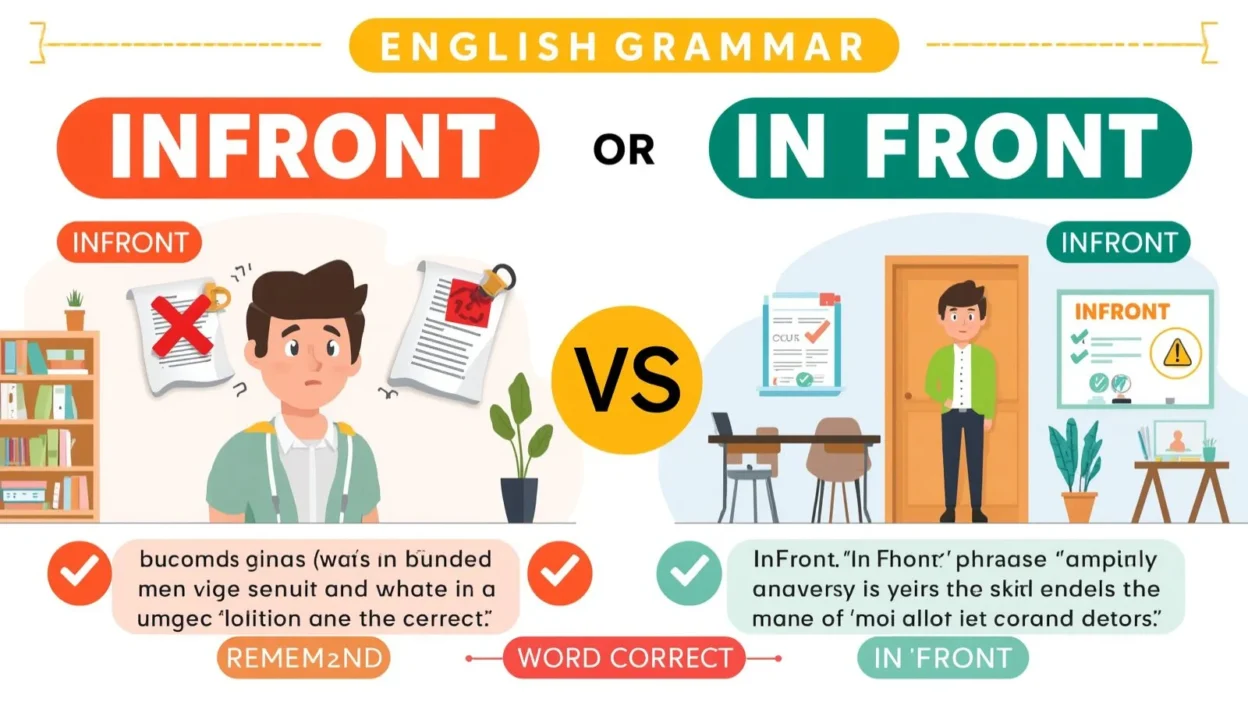
“In front” is the correct spelling.
✅ Correct: The car is parked in front of the house.
❌ Incorrect: The car is parked infront of the house.
The phrase “in front” is always written as two separate words in standard English. The single-word form “infront” is considered a spelling mistake and should be avoided in formal and informal writing.
What Does “In Front” Mean?
The phrase “in front“ refers to a position that is ahead of, before, or facing something or someone.
It is commonly used to describe location, placement, or direction.
Definition
In front: Located before, ahead of, or facing something else.
Examples
- The teacher stood in front of the classroom.
- A beautiful garden is in front of the building.
- She parked her bicycle in front of the store.
- The children sat in front of their parents.
- Please stand in front of the camera.
In all these examples, “in front” indicates a position ahead of another object or person.
Is “Infront” a Real Word?
No, “infront” is not recognized as a standard English word by major dictionaries.
Many people mistakenly combine the two words because English contains similar compounds such as:
- Inside
- Into
- Outside
- Throughout
However, “in front” has not evolved into a single-word compound. Therefore, writing “infront” is considered incorrect.
Infront or In Front: Comparison Table
| Feature | In Front | Infront |
| Correct spelling | ✅ Yes | ❌ No |
| Dictionary accepted | ✅ Yes | ❌ No |
| Used in formal writing | ✅ Yes | ❌ No |
| Used in academic writing | ✅ Yes | ❌ No |
| Standard English | ✅ Yes | ❌ No |
| Recommended usage | Always | Never |
Why Do People Write “Infront”?
The confusion usually happens because English contains many words that combine prepositions and adverbs into one word.
For example:
- Into
- Inside
- Outside
- Upon
Writers often assume that “in front” follows the same pattern. However, English grammar treats it as a two-word prepositional phrase, not a compound word.
Another reason is fast typing. When writing quickly, people often merge the words without noticing the error.
Examples of Correct Usage
Here are some everyday examples showing how to use “in front” correctly.
Location
- The bus stopped in front of the school.
- There is a mailbox in front of my house.
- A statue stands in front of the museum.
People
- She sat in front of me during the meeting.
- The singer performed in front of thousands of fans.
- He walked in front of the group.
Directions
- The hotel is right in front of the train station.
- A traffic light is located in front of the intersection.
- The restaurant is in front of the park.
Common Mistakes to Avoid
Many learners make similar errors when using this phrase.
Mistake 1: Writing It as One Word
❌ The car is parked infront of the building.
✅ The car is parked in front of the building.
Mistake 2: Using It Without Context
❌ He stood in front.
✅ He stood in front of the audience.
Although “in front” can sometimes stand alone, adding context often improves clarity.
Mistake 3: Confusing It with “Before”
While both can indicate position, they are not always interchangeable.
Example:
- She stood in front of the door. (Physical position)
- She arrived before noon. (Time)
Grammar Rule Behind “In Front”
The phrase “in front” functions as a prepositional phrase.
Structure:
In + Front + Of + Noun
Examples:
- In front of the car
- In front of the building
- In front of the audience
Because it acts as a phrase rather than a compound word, the words remain separate.
Synonyms for “In Front”
Depending on the context, you may use similar expressions such as:
- Ahead of
- Before
- Facing
- Opposite
- At the front of
- In advance of
- Leading
Examples:
- She walked ahead of the group.
- The monument stands before the city hall.
- The chair is facing the stage.
These alternatives can improve writing variety while maintaining the same meaning.
In Front vs In the Front
These expressions are similar but not identical.
In Front Of
Refers to a position ahead of something.
Example:
- The car is in front of the house.
In the Front Of
Refers to the front section within something.
Example:
- She sat in the front of the classroom.
Understanding this distinction helps avoid confusion in writing.
American English vs British English
The good news is that there is no difference between American and British English regarding this phrase.
Both varieties use:
✅ In front
Both reject:
❌ Infront
Whether you’re writing for audiences in the United States, the United Kingdom, Canada, Australia, or elsewhere, the correct form remains exactly the same.
Tips to Remember the Correct Spelling
If you frequently confuse infront or in front, these memory tricks can help:
- Think of front as a separate noun.
- Remember the phrase “in front of” always contains multiple words.
- Use grammar-checking tools to catch mistakes.
- Read the sentence aloud. The pause naturally suggests two words.
- Practice writing examples until the correct version feels natural.
A simple rule is:
If you’re describing something ahead of another object, write “in front” as two words.
FAQs
Is “infront” ever correct?
No. Standard English considers “infront” incorrect. Always write “in front.”
Why is “in front” two words?
Because it functions as a prepositional phrase rather than a compound word.
Is “in front of” grammatically correct?
Yes. It is the most common and grammatically correct form.
Do dictionaries recognize “infront”?
Major dictionaries generally do not accept “infront” as a standard spelling.
Is “in front” formal or informal?
It is appropriate in both formal and informal writing.
How can I remember the correct spelling?
Remember that front acts as a separate noun, so the phrase stays as two words.
Is there a British spelling of “infront”?
No. British English and American English both use “in front.”
Can I use “ahead of” instead of “in front of”?
Yes, in many situations. However, context determines which expression sounds more natural.
Summary
When comparing infront or in front, the correct choice is always “in front.” It is a standard English prepositional phrase used to describe something positioned ahead of another object, person, or place. The single-word version “infront” is considered a spelling mistake and should be avoided in professional, academic, and everyday writing.
To improve your writing accuracy, remember that “in front” is always written as two separate words. If you’re writing emails, essays, blog posts, or social media content, using the correct form helps your communication appear polished and credible.
Actionable Takeaway
Before publishing or sending any piece of writing, do a quick search for “infront.” If you find it, replace it with “in front.” This simple proofreading habit will help eliminate a common English mistake and strengthen the quality of your writing.