The debate around unselect or deselect often comes down to usage, as many dictionaries provide useful guidance on the difference between the two terms. Sources such as Merriam-Webster, New Oxford American Dictionary, and NOAD recognize deselect and explain its role in technology.
The dictionary defines it as a way to turn off a selected feature from a list of options within a computer menu. When you want to remove a choice that is currently active, this is the term most people use.
From my experience with software documentation, the words computer, menu, feature, and option frequently appear together when explaining how to switch settings on or off.
In these situations, deselect helps qualify the action of removing something that was previously selected. This makes an instruction easier to understand for users navigating different settings and controls.
The term unselected serves a different role because it usually describes an item that is not selected, rather than one that is no longer active anymore.
This distinction explains why unselect appears less often in standard references, while deselect remains the preferred choice for managing a selected feature from available options.
Quick Answer
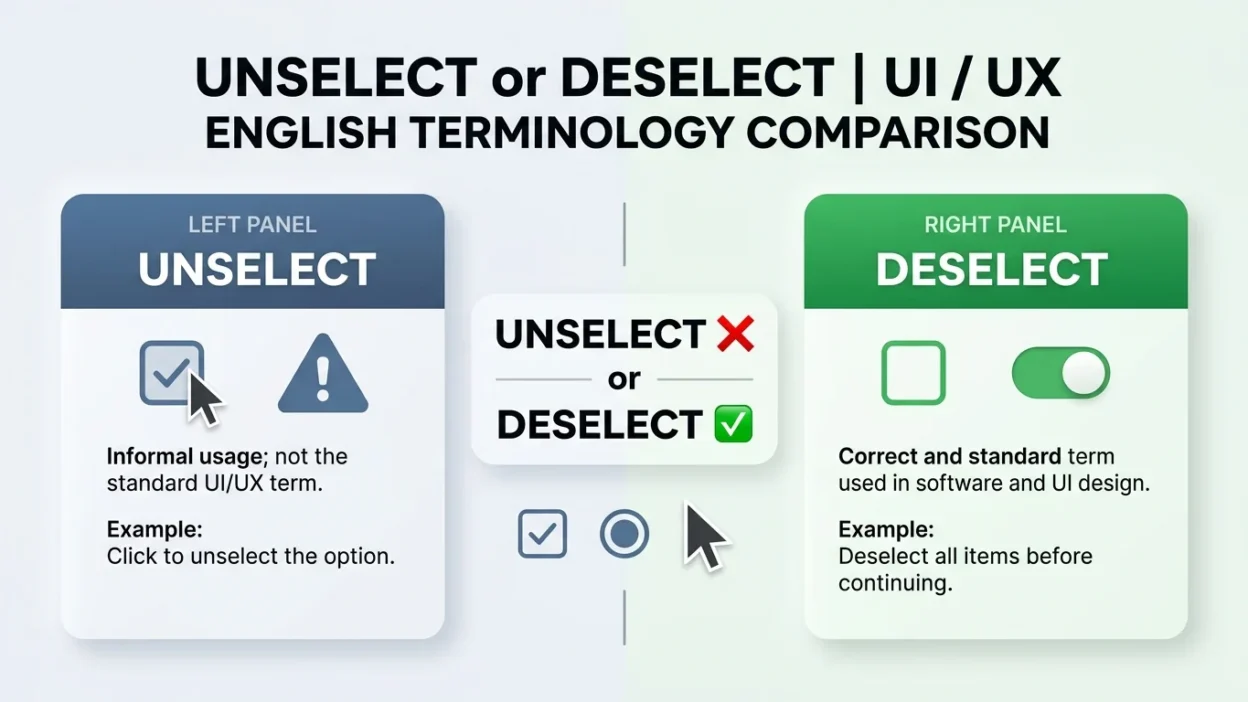
Deselect is the more widely accepted and commonly used term in English, especially in software, technology, and professional writing.
Unselect is understandable and occasionally used, but it is less common and often considered a non-standard alternative.
If you’re unsure which word to choose, deselect is usually the safer and more professional option.
What Does “Deselect” Mean?
The word deselect means to remove a selection that was previously made.
For example:
- Deselect the checkbox if you do not want email notifications.
- Click the selected item again to deselect it.
- Users can deselect multiple files by holding the Ctrl key.
In computing and technology, deselect is widely recognized and frequently appears in software instructions, user manuals, and user interface design.
What Does “Unselect” Mean?
Unselect also means to remove a selection or reverse the action of selecting something.
Examples include:
- Unselect the highlighted text before continuing.
- You can unselect the image by clicking outside the editing area.
Although many people understand the word, it is less common than deselect and may sound awkward in formal or technical writing.
Unselect or Deselect: What’s the Difference?
In most situations, there is little difference in meaning between the two terms. Both describe undoing a selection.
However, the primary distinction lies in usage and acceptance.
| Feature | Deselect | Unselect |
| Meaning | Remove a selection | Remove a selection |
| Common Usage | Very common | Less common |
| Technical Writing | Preferred | Rarely preferred |
| Software Interfaces | Frequently used | Occasionally used |
| Dictionary Recognition | Widely recognized | Less widely recognized |
| Professional Communication | Recommended | Usually avoided |
For professional writing, technical documentation, and user instructions, deselect is generally the better choice.
Why Is “Deselect” More Popular?
Several factors contribute to the popularity of deselect.
Industry Standard
Software developers, technical writers, and technology companies have adopted deselect as the standard term.
Better Consistency
Many English verbs use the prefix “de-” to indicate removal or reversal.
Examples include:
- Deactivate
- Decompress
- Decode
- Deselect
This pattern makes deselect feel natural and familiar to readers.
Wider Acceptance
Most style guides, technical manuals, and educational resources favor deselect over unselect.
Examples of Deselect in Sentences
Here are some practical examples:
- Deselect all files before creating a new folder.
- To deselect the option, click the box again.
- The software allows users to deselect multiple items at once.
- You can deselect the text by clicking elsewhere on the page.
- Deselect any filters that are no longer needed.
These examples reflect how the word is commonly used in everyday technology contexts.
Examples of Unselect in Sentences
Although less common, unselect still appears in some situations.
- Unselect the image before resizing another object.
- Users can unselect highlighted rows manually.
- Click outside the area to unselect the current selection.
- Unselect the option if it no longer applies.
While these examples are understandable, many editors would replace unselect with deselect for consistency and professionalism.
Common Mistakes People Make
When discussing unselect or deselect, several mistakes occur frequently.
Using Both Terms Interchangeably in the Same Document
Choose one term and remain consistent throughout your content. Since deselect is the preferred option, using it everywhere is often best.
Assuming Unselect Is More Correct
Some people think unselect is better because it directly reverses “select.” However, standard usage strongly favors deselect.
Ignoring Audience Expectations
Technology users are more familiar with deselect because they see it regularly in software applications and user interfaces.
Overthinking the Difference
In most cases, readers understand both words. The key is choosing the more accepted and professional term.
Is “Unselect” Incorrect?
Not necessarily.
Many English speakers use unselect, and readers generally understand its meaning. However, it is not as widely accepted as deselect in formal, technical, or professional contexts.
Think of unselect as an alternative that exists but lacks the popularity and authority of deselect.
If clarity and professionalism are important, deselect remains the stronger choice.
American vs British English
Unlike some English words that differ significantly between American and British usage, there is no major regional difference here.
Both American English and British English overwhelmingly prefer deselect.
Examples:
- American software documentation typically uses deselect.
- British technology guides also commonly use deselect.
Therefore, regardless of your audience location, deselect is usually the recommended term.
Synonyms and Related Terms
Depending on the context, you may encounter related words and phrases such as:
- Remove selection
- Clear selection
- Undo selection
- Uncheck
- Unmark
- Deactivate
- Remove highlight
- Cancel selection
- Reverse selection
- Clear selected items
These alternatives can improve readability and help avoid repetition in longer content.
When Should You Use Deselect?
Use deselect when:
- Writing software documentation
- Creating user manuals
- Developing website instructions
- Producing technical content
- Writing professional emails about software processes
- Designing user interfaces
In these situations, deselect aligns with industry standards and user expectations.
When Might You Use Unselect?
You might use unselect when:
- Following terminology already established within a project
- Matching wording used by a specific software application
- Writing informal content where strict terminology is less important
Even in these cases, many editors would still prefer deselect.
FAQs
Is deselect a real word?
Yes. Deselect is a widely accepted English word commonly used in technology, software, and professional writing.
Is unselect grammatically correct?
Unselect is understandable and used by some speakers, but it is less common and generally not preferred in formal contexts.
Which word should I use in technical documentation?
Use deselect. It is the industry-standard term and is more familiar to readers.
Do software companies use deselect or unselect?
Most software companies use deselect in interfaces, help articles, and user guides.
Is there a meaning difference between deselect and unselect?
In most situations, no. Both mean removing a previous selection.
Is deselect used in American English?
Yes. Deselect is commonly used throughout American English.
Is deselect used in British English?
Yes. British English also strongly favors deselect over unselect.
Which term sounds more professional?
Deselect generally sounds more professional because it is more widely accepted and commonly used in technical communication.
Summary
The debate over unselect or deselect is mostly a matter of usage rather than meaning. Both words describe removing a selection, but deselect has become the preferred term across software applications, technical documentation, business communication, and professional writing. It is widely recognized, easier for readers to understand, and aligns with established industry standards.
If you’re creating instructions, writing documentation, or communicating with users, choosing deselect will usually provide the clearest and most professional result. While unselect is not entirely wrong, it is less common and may appear unconventional to some readers. As a practical rule, use deselect whenever possible for consistency, clarity, and credibility.
Actionable Takeaway
When deciding between unselect or deselect, choose deselect for nearly all professional, technical, and everyday writing situations. It is the standard term that readers expect and understand most easily.