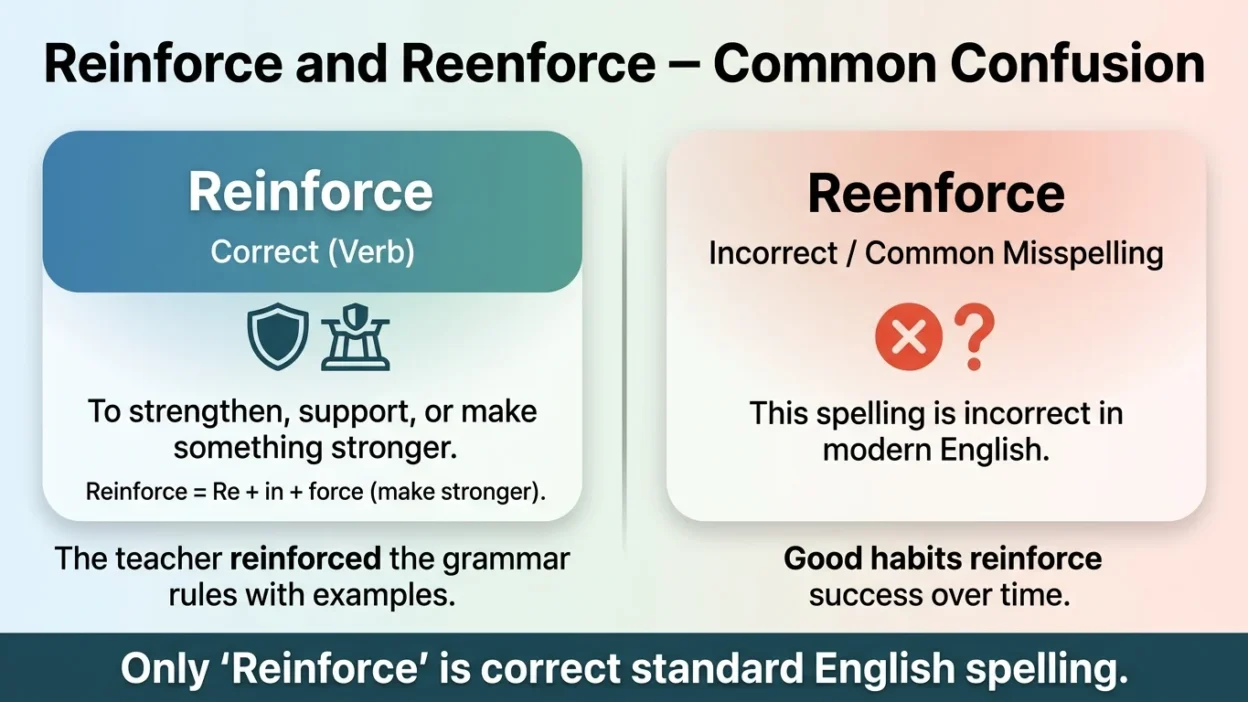
If you’ve ever paused mid-sentence wondering whether to write reinforce or reenforce, you’re not alone. These two spellings look similar, sound identical, and often confuse even experienced writers. The good news? There’s a simple, clear answer that will remove all doubt.
In this guide, you’ll learn the correct spelling, when (if ever) the alternative is used, and how to avoid common mistakes. By the end, you’ll feel confident using the right form in both casual and professional writing.
Quick Answer
- Correct modern spelling: Reinforce ✅
- Outdated/rare spelling: Reenforce ⚠️
- In almost all contexts today, “reinforce” is the standard and recommended spelling.
What Does “Reinforce” Mean?
The verb reinforce means to strengthen, support, or make something stronger physically, emotionally, or conceptually.
Common meanings:
- To add strength or stability to something
- To support an idea or belief
- To increase effectiveness or impact
Examples:
- The builders used steel bars to reinforce the concrete structure.
- Positive feedback helps reinforce good behavior.
- The teacher repeated the lesson to reinforce key concepts.
What About “Reenforce”?
Reenforce is an older, less common variant of reinforce. It appeared in historical texts but is now considered obsolete or nonstandard in modern English.
Important note:
- You might see reenforce in very old books or archives, but it’s rarely used today.
- Most dictionaries label it as archaic or variant spelling.
Reinforce vs Reenforce: Key Differences
| Feature | Reinforce | Reenforce |
| Spelling Status | Standard, correct | Archaic/obsolete |
| Usage Today | Very common | Extremely rare |
| Recommended Use | Always use this | Avoid in modern writing |
| Recognition | Universally accepted | May confuse readers |
Why Does This Confusion Happen?
The confusion between reinforce vs reenforce comes from how English evolved over time. Many words with the prefix “re-” once had alternate spellings. Over time, usage patterns standardized, and reinforce became dominant.
Key reason:
- The prefix “rein-” in reinforce relates to strengthening (not just “again,” like “re-”).
- Writers sometimes assume it should be “re-enforce,” leading to reenforce.
Common Mistakes to Avoid
Here are a few pitfalls to watch for:
1. Using “reenforce” in modern writing
❌ Incorrect: We need to reenforce the rules.
✅ Correct: We need to reinforce the rules.
2. Thinking both are equally correct
They are not. Only reinforce is widely accepted today.
3. Overthinking the prefix
Reinforce is a fixed word, not just “re + enforce.”
American vs British English
Good news there’s no difference here.
- American English: Reinforce ✔
- British English: Reinforce ✔
Both varieties use the same standard spelling, making it easy to remember.
Related Words and Synonyms (LSI Keywords)
To deepen your understanding and improve your writing, here are some related terms:
- Strengthen
- Support
- Bolster
- Fortify
- Enhance
- Solidify
- Back up
- Confirm
Example:
- His argument was strengthened (reinforced) by strong evidence.
When Should You Use “Reinforce”?
Use reinforce whenever you want to express strengthening or support.
In writing:
- Academic essays
- Professional emails
- Blog posts
- Reports
In daily conversation:
- “Let’s reinforce this habit.”
- “We need to reinforce our strategy.”
Memory Trick to Remember the Correct Spelling
Think of “reinforce” as adding strength (force).
👉 Reinforce = Rein + Force → Add strength or power
This simple trick helps lock in the correct spelling.
FAQs
1. Is “reenforce” ever correct?
It’s not incorrect historically, but it’s outdated and not recommended in modern writing.
2. Why do some people still use “reenforce”?
Mostly due to confusion with the prefix “re-” or exposure to older texts.
3. Do dictionaries include “reenforce”?
Some do, but they usually label it as archaic or variant.
4. Is “reinforce” used in formal writing?
Yes, it’s widely used in academic, professional, and casual writing.
5. How do I avoid this mistake?
Always default to reinforce it’s the safe and correct choice.
6. Does pronunciation differ?
No, both are pronounced the same, which adds to the confusion.
7. Is “reinforcement” also standard?
Yes, reinforcement is the correct noun form.
Summary
The debate over reinforce vs reenforce is simpler than it seems. While both spellings exist historically, “reinforce” is the only correct and accepted form in modern English. It’s used universally across American and British English and fits all writing contexts from casual messages to formal documents.
On the other hand, reenforce is outdated and can make your writing look incorrect or unpolished. Sticking with reinforce ensures clarity, professionalism, and accuracy every time.
Actionable Takeaway
Whenever you’re unsure, choose reinforce no exceptions needed in modern usage. To build confidence, practice using it in sentences and keep the memory trick in mind: reinforce means to add strength. Over time, it will become second nature, and you’ll never hesitate again.