Have you ever typed “messege” and wondered if it looked a bit off? You’re not alone. Many people confuse messege vs message, especially when typing quickly or relying on autocorrect. It’s a small detail, but getting it right can make a big difference in how clear and professional your writing appears.
In this guide, we’ll break down the difference in a simple, friendly way. You’ll learn the correct spelling, why the mistake happens, and how to avoid it in everyday writing whether you’re texting, emailing, or writing professionally.
Quick Answer
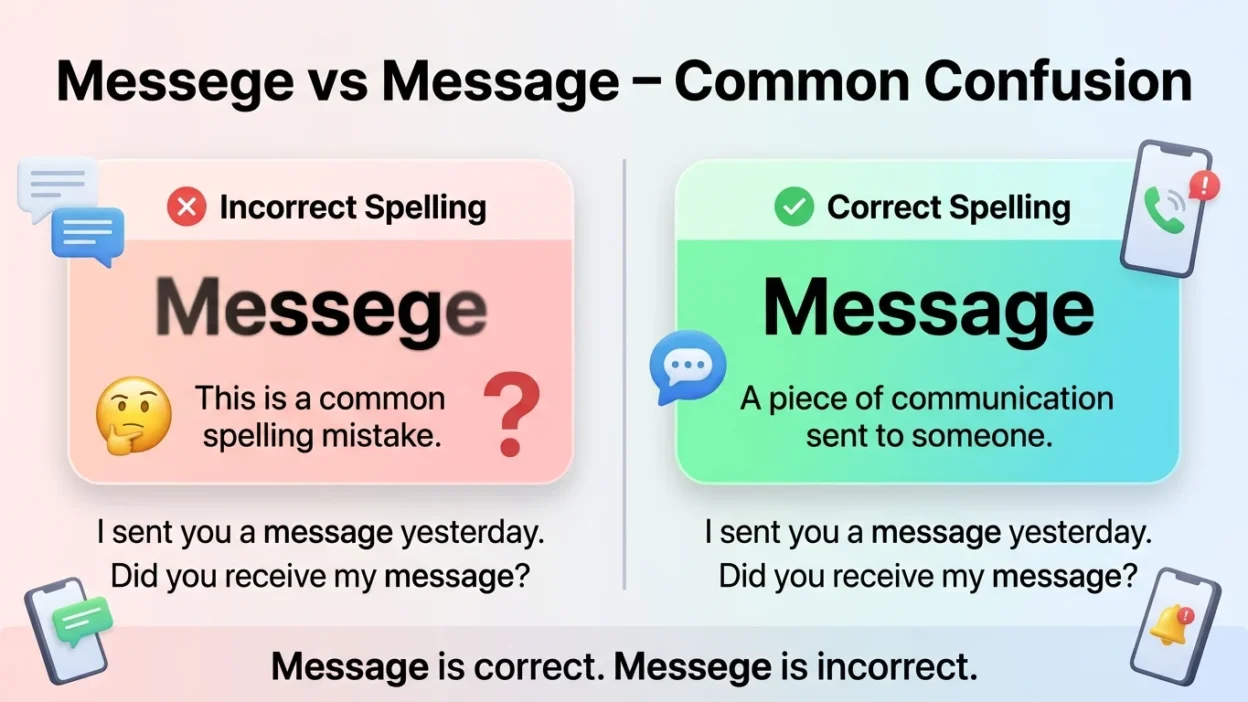
“Message” is the correct spelling.
“Messege” is a common misspelling and should be avoided in all forms of writing.
What Does “Message” Mean?
The word message refers to a piece of information sent from one person to another. It can be spoken, written, or sent digitally.
Common meanings of “message”:
- A written or spoken communication
- A text or chat sent via phone or apps
- An idea or theme conveyed through speech, writing, or media
Examples:
- I sent you a message on WhatsApp.
- Did you receive my email message?
- The movie carries a powerful message about friendship.
Why Do People Write “Messege”?
The confusion between messege vs message usually comes from pronunciation and typing habits.
Reasons for the mistake:
- The word sounds like “mes-ij,” which can mislead spelling
- Typing quickly leads to letter swaps
- Lack of familiarity with correct spelling rules
- Autocorrect not catching the error sometimes
Think of it this way: “message” has “-age” at the end, not “-ege.”
Correct Usage of “Message” in Sentences
Using the correct spelling helps your writing look polished and trustworthy.
Everyday examples:
- Please leave a message after the beep.
- I got your message loud and clear.
- She forwarded the message to her team.
Professional examples:
- Thank you for your message regarding the project update.
- I appreciate your quick response to my previous message.
Common Mistakes to Avoid
Here are some frequent errors people make when dealing with messege vs message:
- ❌ Writing “messege” instead of “message”
- ❌ Mixing up spelling in formal emails
- ❌ Ignoring spell-check suggestions
- ❌ Repeating the mistake in professional documents
Quick Tip:
If you’re unsure, remember:
👉 Message = Mess + Age (correct)
👉 Messege = Incorrect spelling
Messege vs Message: Comparison Table
| Feature | Messege ❌ | Message ✅ |
| Spelling Status | Incorrect | Correct |
| Usage | Not acceptable | Standard usage |
| Found in dictionary | No | Yes |
| Professional writing | Avoid completely | Always use |
| Example | I sent a messege ❌ | I sent a message ✅ |
American vs British English Differences
Good news there’s no difference between American and British English when it comes to message.
- 🇺🇸 American English: message
- 🇬🇧 British English: message
Both use the exact same spelling and meaning, so you don’t need to worry about regional variations here.
Related Words and Synonyms
To improve your vocabulary and writing, here are some related terms and alternatives:
Synonyms for “message”:
- Communication
- Note
- Text
- सूचना (if mixing languages casually)
- Notification
- Letter
LSI Keywords:
- correct spelling of message
- message meaning
- spelling mistakes in English
- common English errors
- message vs misspelling
- text message writing
Using these variations can make your writing richer and more engaging.
How to Remember the Correct Spelling
Sometimes a simple trick can help you remember forever.
Easy memory tips:
- Think of “age” at the end (like “village” or “package”)
- Break it into: mes + sage
- Associate it with texting apps where “message” is always spelled correctly
The more you use it correctly, the more natural it becomes.
FAQs
1. Is “messege” ever correct?
No, “messege” is always incorrect. It’s a misspelling of “message.”
2. Why do I keep typing “messege”?
It often happens due to pronunciation confusion or typing quickly without checking spelling.
3. Is “message” used in formal writing?
Yes, “message” is widely used in both formal and informal writing.
4. Does autocorrect fix “messege”?
Most of the time, yes but not always. It’s still good to double-check.
5. Are there other similar spelling mistakes?
Yes, like:
- recieve → receive
- seperate → separate
- definately → definitely
6. Can “message” be used as a verb?
Yes. Example: “I will message you later.”
7. Is “msg” a correct abbreviation?
“Msg” is informal and commonly used in texting, but avoids it in professional writing.
Final Summary
Understanding the difference between messege vs message is simple once you know the basics. “Message” is the correct spelling used in all contexts formal, informal, digital, and professional. On the other hand, “messege” is just a common typo that should be avoided.
Small spelling mistakes can affect how your writing is perceived, especially in emails, job applications, or online communication. Taking a moment to double-check your words can make your message clearer and more credible.
Actionable Takeaway
Next time you type, pause and look at the word carefully. If you see “messege,” correct it immediately to “message.” Use spell-check tools, practice writing, and keep the “-age” ending in mind. Over time, it’ll become second nature and your writing will feel more confident and polished.

Henry Wyatt is the administrator of RizzPeak, responsible for managing site operations, content organization, and overall performance. He ensures smooth functionality, platform security, and a user-friendly experience while supporting the site’s creative direction and maintaining consistent quality across all features and updates.