Have you ever come across emersion vs immersion and wondered which one is correct or if both even exist? You’re not alone. These two words sound similar, but they carry very different meanings and uses, which can easily confuse writers, students, and even professionals.
In this guide, we’ll break everything down in a simple, human way. By the end, you’ll clearly understand the difference, avoid common mistakes, and feel confident using the right term in everyday writing and conversation.
Quick Answer:
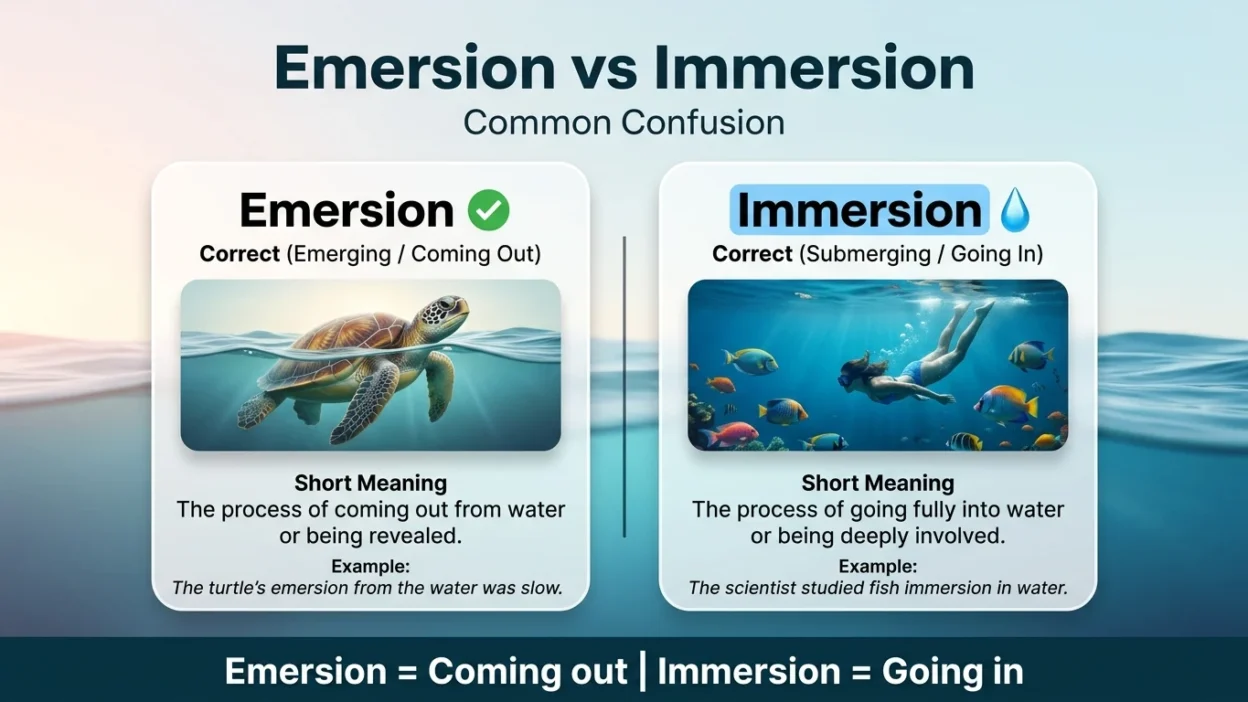
- Immersion means being deeply involved or fully absorbed in something (like learning a language or being underwater).
- Emersion means coming out of something, especially emerging from liquid or a state.
👉 In most everyday situations, immersion is the correct and commonly used word.
What Does Immersion Mean?
Immersion refers to being completely surrounded, involved, or engaged in something. It’s widely used in education, technology, and everyday language.
Common meanings of immersion:
- Being physically submerged in liquid
- Deep mental involvement (like reading or gaming)
- Intensive learning environments (language immersion programs)
Examples of immersion:
- She improved quickly through language immersion in Spain.
- The movie created total immersion, making me forget reality.
- The device is safe for water immersion.
Related keywords (LSI terms):
- deep engagement
- full involvement
- absorption
- total focus
- learning environment
What Does Emersion Mean?
Emersion is much less common and often misunderstood. It refers to the act of coming out of something, especially water.
Common meanings of emersion:
- Emerging from a liquid
- Rising or coming into view
Examples of emersion:
- The diver’s emersion was slow and controlled.
- The submarine’s emersion marked the end of the mission.
👉 Important note: In modern English, emersion is rarely used outside technical or scientific contexts.
Emersion vs Immersion: Side-by-Side Comparison
| Feature | Immersion | Emersion |
| Meaning | Going into or being surrounded | Coming out or emerging |
| Usage frequency | Very common | Rare |
| Contexts | Education, tech, daily language | Scientific, technical |
| Example | Language immersion program | Diver’s emersion |
| Tone | Modern and widely accepted | Formal or specialized |
Key Differences Explained Simply
The easiest way to remember emersion vs immersion is:
- Immersion = In (going into something)
- Emersion = Exit (coming out of something)
Think of it like this:
- You immerse yourself in water.
- You emerge (emersion) when you come back out.
Common Mistakes People Make
Even experienced writers mix these up. Here are the most common errors:
1. Using emersion instead of immersion
❌ Incorrect: I enjoyed full emersion in the course.
✅ Correct: I enjoyed full immersion in the course.
2. Assuming both words are interchangeable
They are not opposites in everyday usage. Only immersion is widely accepted.
3. Overusing rare terms
Using emersion in casual writing can sound unnatural or overly technical.
Real-Life Examples for Better Understanding
In education:
- Immersion: Students learn French by speaking it daily.
- Emersion: Rarely used in this context.
In water-related situations:
- Immersion: The phone survived water immersion.
- Emersion: The swimmer’s emersion was quick.
In technology:
- Immersion: Virtual reality creates immersive experiences.
- Emersion: Not commonly used.
American vs British English Differences
Good news there’s no major spelling difference between American and British English for these words.
However:
- Immersion is widely used in both US and UK English.
- Emersion is rare in both and mostly appears in academic or technical writing.
👉 So regardless of region, immersion is the safer and more natural choice.
When Should You Use Immersion?
Use immersion when you want to describe:
- Deep focus or engagement
- Learning through experience
- Being surrounded physically or mentally
Examples:
- immersion learning
- immersive experience
- cultural immersion
When Should You Use Emersion?
Use emersion only when:
- You are writing scientifically or technically
- You mean coming out of liquid or a state
Examples:
- aquatic emersion
- diver emersion
👉 For everyday writing, you can often replace it with “emergence” instead.
FAQs
1. Is emersion a real word?
Yes, but it’s rare and mostly used in scientific or technical contexts.
2. Which is more commonly used?
Immersion is far more common and widely accepted.
3. Can I use emersion in essays?
Only if the context specifically requires it (like science writing). Otherwise, use immersion.
4. Are emersion and immersion opposites?
Technically yes, but they are not used as everyday opposites in modern English.
5. What is immersion in education?
It’s a method where learners fully engage in a language or subject through real-life exposure.
6. Is emersion outdated?
Not outdated, but rarely used in general communication.
7. What’s a simple way to remember the difference?
- Immersion = going in
- Emersion = coming out
8. Can I replace emersion with emergence?
Yes, in most non-technical contexts, emergence is more natural.
Summary:
Understanding emersion vs immersion doesn’t have to be complicated. While both words exist, they serve very different purposes.
Immersion is the word you’ll use most often it describes deep involvement, whether in learning, experiences, or environments. It’s modern, widely accepted, and fits naturally into everyday language.
On the other hand, emersion is a niche term. It’s mainly used in scientific or technical writing to describe emerging from a liquid or state.
For most situations, using it can feel awkward or unnecessary. When in doubt, choose immersion it’s almost always the right choice.
Actionable Takeaway
- Use immersion for learning, experiences, and engagement
- Avoid emersion unless writing in a technical context
- When unsure, replace emersion with emergence
- Remember: Immersion = in, Emersion = out
Mastering this small difference can instantly improve your writing clarity and confidence.

Henry Wyatt is the administrator of RizzPeak, responsible for managing site operations, content organization, and overall performance. He ensures smooth functionality, platform security, and a user-friendly experience while supporting the site’s creative direction and maintaining consistent quality across all features and updates.