If you’ve ever paused mid-sentence wondering whether to write targetted or targeted, you’re not alone. It’s one of those small spelling choices that can quietly affect how polished and credible your writing looks especially in emails, blog posts, or professional content.
The good news? This confusion is easy to clear up. Once you understand the rule behind it, you’ll never second-guess yourself again. Let’s break it down in a simple, practical way so you can write with confidence.
Quick Answer
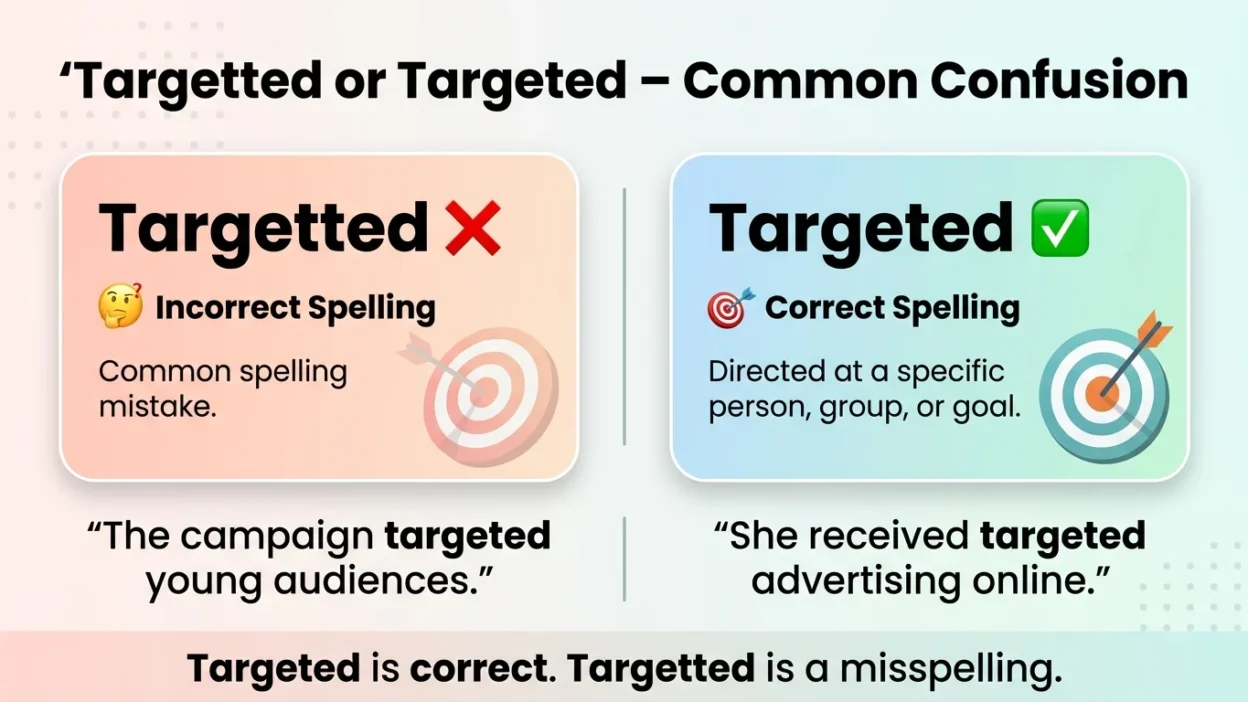
The correct spelling is targeted (with one “t” in the middle).
❌ Targetted Incorrect
✅ Targeted Correct
This applies in both American English and British English.
What Does “Targeted” Mean?
The word targeted is the past tense and past participle of “target.” It means something has been aimed at a specific group, goal, or audience.
You’ll often see it used in contexts like:
- Marketing (targeted ads)
- Communication (targeted messaging)
- Strategy (targeted approach)
- Attacks or actions (targeted effort)
Simple Definition:
Targeted = directed or focused on a particular person, group, or objective
Examples of “Targeted” in Sentences
Here are some natural, real-world examples:
- The company launched a targeted marketing campaign for young professionals.
- She made a targeted effort to improve her writing skills.
- The ads were targeted at users interested in fitness.
- They used targeted strategies to increase engagement.
- His speech was clearly targeted toward new customers.
Notice how in each case, something is focused or directed intentionally.
Why “Targetted” Is Incorrect
At first glance, targetted might seem logical especially if you’re thinking about verbs like “admit” becoming “admitted” (double “t”).
But here’s the key rule:
👉 Not all verbs double the final consonant when adding “-ed.”
“Target” does not follow the doubling rule because:
- The stress in the word is not on the final syllable
- It ends in a consonant, but the pronunciation doesn’t justify doubling
So, adding just -ed is correct → targeted
Comparison Table: Targetted vs Targeted
| Feature | Targetted ❌ | Targeted ✅ |
| Correct spelling | No | Yes |
| Used in English | No | Yes |
| Accepted globally | No | Yes |
| Professional usage | Avoid | Recommended |
| Appears in dictionaries | No | Yes |
American vs British English Differences
Here’s something interesting:
Unlike many spelling differences (like “color” vs “colour”), “targeted” stays the same in both American and British English.
So whether you’re writing for:
- US audiences
- UK readers
- International users
👉 The correct form is always targeted
No variation. No exceptions.
Common Mistakes to Avoid
Even experienced writers sometimes slip up. Here are a few mistakes to watch out for:
1. Doubling the “t” unnecessarily
❌ targetted ads
✅ targeted ads
2. Overthinking spelling rules
People often apply rules from words like “regret → regretted,” but not all verbs follow that pattern.
3. Spell-check dependence
Some tools may not flag targetted immediately, especially in informal writing. Always double-check.
4. Mixing styles in content
Using both spellings in the same article can hurt readability and SEO consistency.
Related Terms and Variations
To strengthen your vocabulary and SEO writing, here are some related terms:
- Targeting
- Target audience
- Target market
- Target-specific
- Focused approach
- Directed strategy
- Personalized content
- Niche marketing
Using these variations naturally can improve clarity and search visibility.
When to Use “Targeted” in Writing
You’ll most often use “targeted” in these contexts:
Marketing
- Targeted ads
- Targeted campaigns
- Targeted email lists
Business Strategy
- Targeted growth plans
- Targeted outreach
Communication
- Targeted messaging
- Targeted communication
Personal Development
- Targeted learning
- Targeted practice
In each case, the idea is the same: precision and focus.
Why Correct Spelling Matters
Using the correct spelling targeted is important for:
- Search engine rankings
- Professional credibility
- Reader trust
- Content clarity
Misspellings like targetted can:
- Confuse readers
- Reduce SEO effectiveness
- Make content look less reliable
Consistency in spelling is a small detail but it has a big impact.
FAQs
1. Is “targetted” ever correct?
No, targetted is not considered correct in standard English.
2. Why doesn’t “target” double the “t” like “regret”?
Because the stress in “target” is not on the final syllable, so doubling isn’t required.
3. Do British writers ever use “targetted”?
No, British English also uses targeted.
4. Is “targeted” formal or informal?
It works in both formal and informal writing.
5. What part of speech is “targeted”?
It is a verb (past tense) and can also function as an adjective.
6. Can I use “targeted” in SEO content?
Yes, it’s commonly used in SEO phrases like “targeted keywords” or “targeted traffic.”
7. What is a “targeted audience”?
A specific group of people you aim to reach with your content or product.
Final Summary
Choosing between targetted and targeted is simpler than it seems. The correct spelling is targeted, and it applies universally across both American and British English. The confusion often comes from overapplying spelling rules that don’t fit this particular word.
Understanding this not only improves your grammar but also strengthens your writing overall. If you’re creating content, writing emails, or working on SEO, small details like this build trust and clarity with your audience.
Actionable Takeaway
From now on, always use targeted with a single “t.” If you’re writing professionally or publishing content online, double-check your spelling to maintain credibility. A quick review can make your work look cleaner, more polished, and more trustworthy.
Make it a habit: when in doubt, keep it simple targeted is always right.