Many people discussing he is risen or he has risen often notice how the phrase remains important in Easter traditions today.
The famous he is risen saying appears during Easter as a respected Easter expression within Christian tradition and has a rich history. From my experience studying religious writings, this well-known resurrection phrase reflects older forms of English, where certain verbs were used differently. As time passed, the religious expression stayed connected to worship, even while everyday speech changed.
Its phrase origin, historical usage, role in religious language, and continued religious sense help explain why many people still recognize it immediately. When examining grammar, syntax, and grammatical usage, modern English usually favors he has risen because risen functions as a past participle of a verb. Yet in historical settings, he is risen often described as a completed state. This led to discussions about adjective properties, adjective form, verb form, and whether risen behaves more like an adjective.
Scholars frequently compare its adjective usage and verb usage, while its meaning depends greatly on context, bringing together both language and faith. The phrase also offers insight into linguistic development, language history, and changing terminology. Many researchers explore its linguistic sense through theological language, religious terminology, and broader patterns of English usage. If understood as an adjective-like expression or as part of a verb structure, it remains a valuable example of how older traditions survive within an evolving language.
Quick Answer
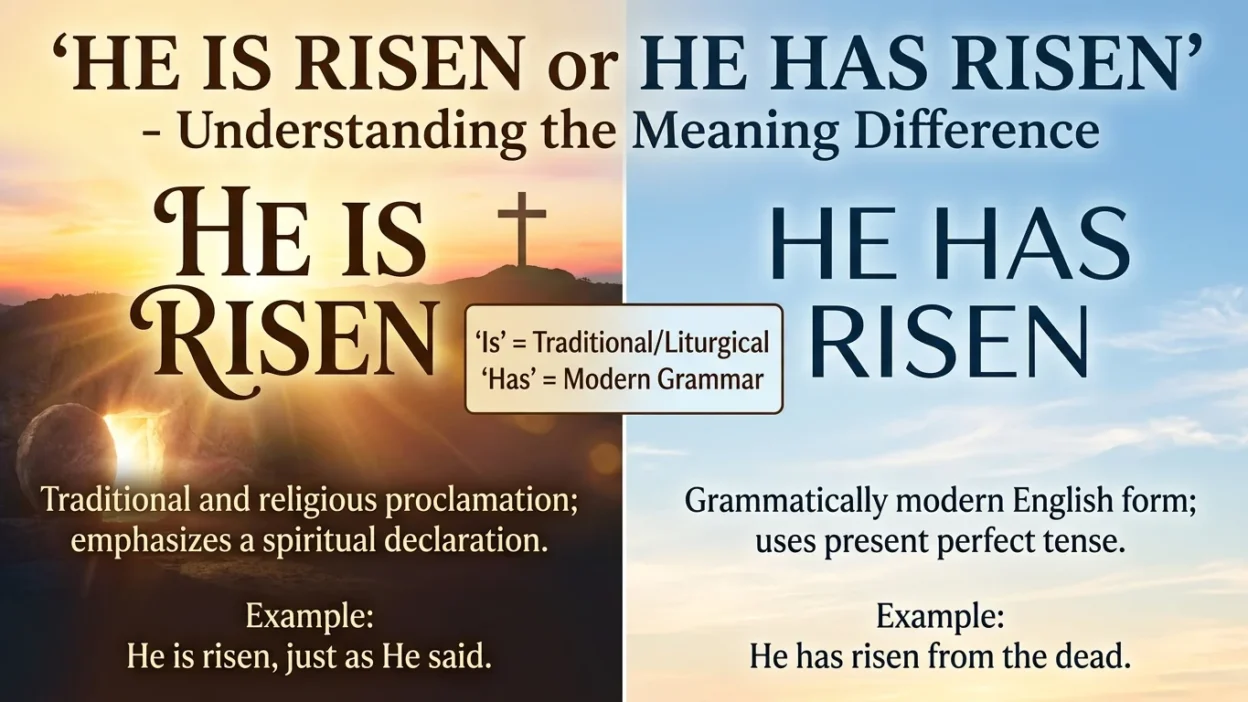
Both “He is risen” and “He has risen” are grammatically correct, but they are used differently in tone and tradition.
- “He is risen” → Traditional, biblical, and often used in religious or liturgical contexts
- “He has risen” → Modern English, more commonly used in everyday speech
The difference is mainly stylistic and historical, not about right or wrong grammar.
Meaning of He Is Risen or He Has Risen
The phrase refers to the resurrection of Jesus Christ, a central belief in Christianity. It expresses the idea that Jesus rose from the dead after crucifixion, symbolizing victory over death, sin, and despair.
- “He is risen” emphasizes a state of being it suggests that Jesus is alive and remains risen
- “He has risen” emphasizes a completed action it highlights that the resurrection has already happened
Both phrases carry the same core meaning: the resurrection is complete and celebrated.
In religious language, especially in hymns and Easter greetings, the phrase is more than grammar it is a declaration of faith, hope, and renewal.
Why Do We Say He Is Risen Instead of He Has Risen?
The phrase “He is risen” comes from older English grammar, particularly from biblical translations like the King James Version.
In earlier English, the verb “to be” was often used as an auxiliary verb in passive or perfect constructions. So instead of saying “He has risen,” people said “He is risen,” meaning he is now in the state of being resurrected.
Over time:
- Traditional churches kept “He is risen”
- Modern English shifted toward “He has risen”
This is why both forms still exist today—they reflect different stages of English evolution rather than different meanings.
Meaning Breakdown in Simple Terms
Let’s simplify it:
- He is risen → He is alive again and remains in that state
- He has risen → He rose from the dead at a specific moment in the past
Both imply resurrection, but the emphasis differs slightly.
Think of it like this:
- “He is married” (state)
- “He has married” (action completed in the past)
Examples of Usage in Sentences
Here are practical examples to help you understand how each phrase is used:
He is risen (traditional usage)
- “Christ is risen indeed, Alleluia!”
- “He is risen, just as He said.”
- “The church celebrates that He is risen today.”
He has risen (modern usage)
- “He has risen from the dead after three days.”
- “We believe He has risen and conquered death.”
- “The scripture says He has risen according to prophecy.”
Both are correct, but context decides which sounds more natural.
Common Mistakes People Make
Many learners and even native speakers get confused. Here are the most common mistakes:
- ❌ Thinking one is grammatically wrong
- ❌ Using “He is risen” in casual non-religious writing (sounds outdated)
- ❌ Using “He has risen” in formal liturgical greetings (can feel less traditional)
- ❌ Mixing both forms in the same sentence unnecessarily
The key is understanding tone, not correctness.
American vs British English Usage
Interestingly, both American and British English recognize both forms, but usage patterns differ slightly:
- American English
- More likely to use “He has risen” in modern speech and writing
- “He is risen” mainly used in churches or Easter services
- British English
- Slightly more traditional retention of “He is risen” in religious contexts
- Still uses “He has risen” in everyday conversation and writing
In both cases, the difference is cultural and stylistic, not grammatical.
Comparison Table: He Is Risen vs He Has Risen
| Feature | He Is Risen | He Has Risen |
| Grammar Type | State of being (archaic perfect) | Present perfect tense |
| Tone | Traditional, religious, poetic | Modern, neutral, descriptive |
| Usage | Church, hymns, Easter greetings | Everyday speech, writing |
| Emphasis | Ongoing state of resurrection | Completed action |
| Popularity | More in liturgy | More in modern English |
LSI Keywords and Related Phrases
To better understand search intent, here are related terms people often use:
- Jesus is risen meaning
- He has risen from the dead explanation
- Easter greeting phrases
- resurrection of Christ meaning
- is risen grammar rule
- biblical English phrases
- Easter Sunday message
FAQs
1. Is “He is risen” grammatically correct?
Yes, it is grammatically correct in traditional and biblical English usage.
2. Which is more correct: He is risen or He has risen?
Both are correct. The difference is stylistic, not grammatical.
3. Why do churches say “He is risen”?
Because it comes from older biblical English and emphasizes a spiritual state of resurrection.
4. Can I say “He has risen” in church?
Yes, but it may sound more modern and less traditional depending on the setting.
5. What is the difference in meaning between the two?
“He is risen” emphasizes a current state, while “He has risen” emphasizes a completed action.
6. Is “He is risen” old English?
Yes, it reflects older English grammar used in translations like the King James Bible.
7. Which phrase should I use in writing?
Use “He has risen” for modern writing and “He is risen” for religious or traditional tone.
8. Do both phrases mean Easter?
Yes, both refer to the resurrection of Jesus celebrated on Easter Sunday.
Summary
Understanding “he is risen or he has risen” is less about choosing a right or wrong phrase and more about understanding tone, tradition, and context. Both expressions celebrate the resurrection of Jesus Christ, a central message of hope and renewal in Christianity.
While “He is risen” carries a deeply traditional and liturgical tone, “He has risen” fits naturally into modern English communication. Knowing when to use each helps you communicate more clearly and respectfully in both religious and everyday settings.
Final Takeaway
If you want to sound traditional, poetic, or church-appropriate, use “He is risen.” If you prefer modern grammar and everyday clarity, use “He has risen.” Both are meaningful, both are correct, and both carry the same powerful message of resurrection and hope.