English grammar can feel confusing, especially when two phrases sound almost correct. One of the most common questions learners ask is whether to use “has ran” or “has run.” If you have ever paused while writing a sentence like “He has ran fast” or “He has run fast,” you are not alone.
The good news is that this grammar rule is actually simple once you understand how verb tenses work. In this guide, you will learn the correct usage, common mistakes, practical examples, and an easy trick to remember the difference forever.
Quick Answer
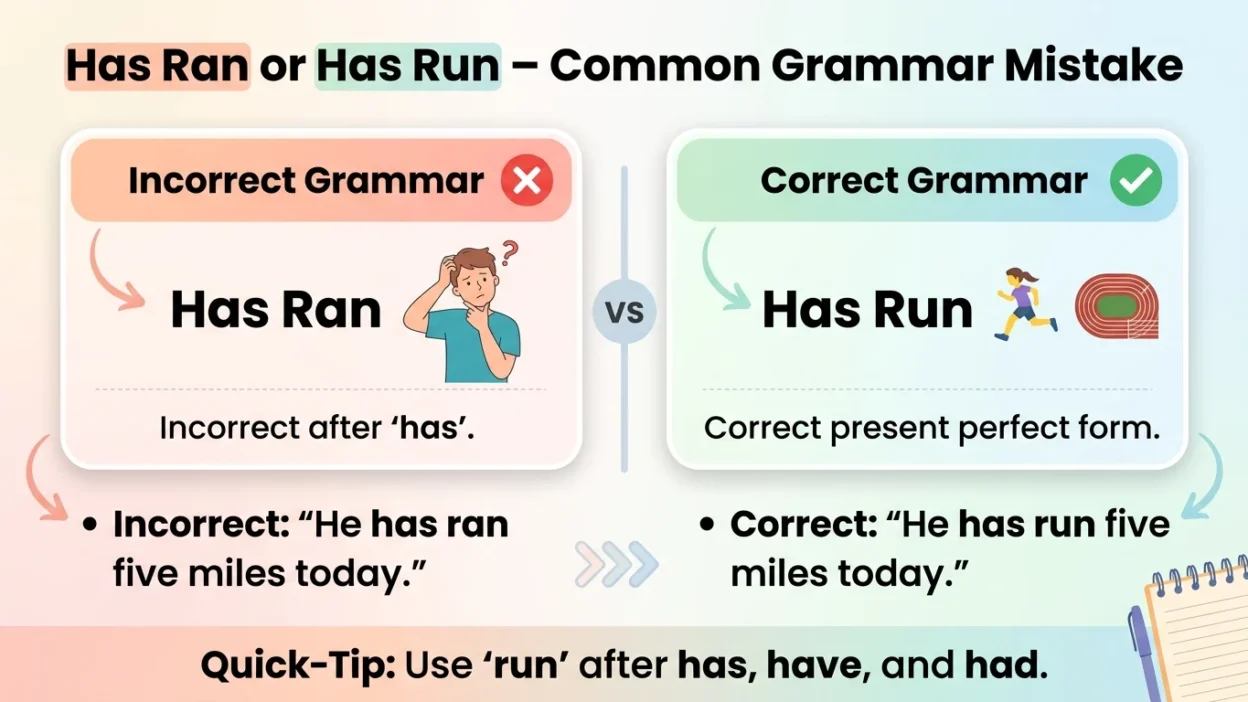
The correct phrase is “has run.”
❌ Incorrect: She has ran to the store.
✅ Correct: She has run to the store.
The word “run” is the past participle form of the verb, which is required after has, have, and had.
Understanding “Has Ran or Has Run”
The confusion happens because both ran and run are forms of the verb run. However, they belong to different tenses.
Here are the three main forms:
| Verb Form | Example |
| Base Verb | run |
| Past Tense | ran |
| Past Participle | run |
When using helping verbs like has, have, or had, you must use the past participle, which is run.
That means:
- “has run” = correct
- “has ran” = incorrect
Why “Has Run” Is Correct
The phrase “has run” uses the present perfect tense. This tense is formed like this:
has/have + past participle
For the verb run, the past participle is run.
Correct Examples
- He has run five miles today.
- She has run this business for years.
- My dog has run away twice this month.
- The athlete has run faster than ever before.
In all these examples, run follows has because it is the proper past participle.
Why “Has Ran” Is Incorrect
The word “ran” is only used as the simple past tense. It should never follow has, have, or had.
Incorrect Examples
- ❌ He has ran to school.
- ❌ She has ran every morning.
- ❌ They have ran out of time.
Corrected Versions
- ✅ He has run to school.
- ✅ She has run every morning.
- ✅ They have run out of time.
This is one of the most frequent grammar mistakes in English writing and speech.
Simple Grammar Rule to Remember
If your sentence includes:
- has
- have
- had
Then use the past participle form of the verb.
For run, the past participle is always run.
Easy Formula
\text{has/have/had} + \text{past participle}
Examples:
- has run
- have run
- had run
Never use ran after helping verbs.
Examples of “Ran” vs “Run”
Understanding both forms side by side makes the difference much easier.
| Correct Usage | Explanation |
| He ran yesterday. | Simple past tense |
| He has run today. | Present perfect tense |
| They ran in the race. | Action completed in the past |
| They have run many races. | Experience or ongoing relevance |
| She had run before breakfast. | Past perfect tense |
Common Mistakes People Make
Many English learners mix these verb forms because they sound natural in casual conversation. Here are the most common errors.
Using “Ran” After Helping Verbs
❌ I have ran there before.
✅ I have run there before.
Mixing Tenses Incorrectly
❌ She has ran yesterday.
✅ She ran yesterday.
The word yesterday usually signals simple past tense, so ran is correct without has.
Forgetting Irregular Verb Forms
The verb run is irregular, which means it does not follow standard “-ed” patterns like:
- walk → walked
- jump → jumped
Instead:
- run → ran → run
Irregular verbs often cause confusion in spoken and written English.
Has Run in Everyday English
You will often hear or read “has run” in daily communication.
Examples in Real Situations
- The company has run successfully for ten years.
- He has run out of patience.
- The machine has run continuously all night.
- She has run several marathons.
These phrases sound natural because they follow standard English grammar rules.
American vs British English Usage
In both American English and British English, “has run” is the correct form.
There is no regional difference for this grammar rule.
Both Versions Use:
- ✅ has run
- ❌ has ran
However, in informal speech, some dialects may incorrectly use “has ran.” While you may hear it casually, it is still considered grammatically incorrect in professional writing, academic English, and formal communication.
Related Grammar Terms You Should Know
Learning a few connected grammar concepts can make this rule easier to remember.
Present Perfect Tense
The present perfect connects past actions to the present.
Structure:
- has/have + past participle
Example:
- She has finished her homework.
Simple Past Tense
The simple past describes completed actions in the past.
Structure:
- past tense verb
Example:
- She finished her homework yesterday.
Past Participle
A past participle is the verb form used with helping verbs.
Examples:
| Base Verb | Past Tense | Past Participle |
| eat | ate | eaten |
| go | went | gone |
| run | ran | run |
| write | wrote | written |
Easy Memory Trick
Here is a quick trick:
If you can replace the phrase with “have”, then you probably need the past participle.
Example:
- He has run.
- They have run.
Because “have run” sounds correct, “has run” is also correct.
But:
- ❌ He has ran.
- ❌ They have ran.
These sound awkward because ran cannot function as a past participle.
Practice Sentences
Try these examples yourself.
Fill in the Blank
- She has ___ five miles today.
- They ___ to the park yesterday.
- He had ___ before sunrise.
Answers
- run
- ran
- run
Practicing sentence structure helps improve grammar accuracy naturally.
FAQs
Is “has ran” ever correct?
No. “Has ran” is grammatically incorrect in standard English.
Why do people say “has ran”?
Some regional dialects and informal speech patterns use it incorrectly. However, formal grammar rules require “has run.”
What tense is “has run”?
“Has run” is in the present perfect tense.
Is “ran” past tense?
Yes. “Ran” is the simple past tense form of run.
What is the past participle of “run”?
The past participle is “run.”
Which is correct: “have ran” or “have run”?
“Have run” is correct.
Can I use “ran” without “has”?
Yes. Example: He ran yesterday.
Is this mistake common among native speakers?
Yes. Even native English speakers sometimes misuse irregular verbs in casual conversation.
Final Summary
When deciding between “has ran or has run,” the correct choice is always “has run.” The reason is simple: after helping verbs like has, have, and had, English grammar requires the past participle form. For the verb run, the past participle is run, not ran.
Remember this quick rule:
- Use ran for simple past tense
- Use run after has/have/had
Mastering irregular verbs takes practice, but small grammar improvements can make your writing clearer, more professional, and more confident. The next time you write or speak, you will know exactly which phrase to use.

Henry Wyatt is the administrator of RizzPeak, responsible for managing site operations, content organization, and overall performance. He ensures smooth functionality, platform security, and a user-friendly experience while supporting the site’s creative direction and maintaining consistent quality across all features and updates.