Have you ever typed “to bad” and wondered if it was correct? You’re not alone. Many English learners and even native speakers occasionally mix up to, too, and two because they sound exactly the same when spoken. This common spelling confusion often appears in casual conversations, text messages, emails, and social media posts.
If you’re searching for the difference between “to bad or too bad,” you’ve come to the right place. In this guide, you’ll learn the correct phrase, its meaning, examples, common mistakes, and simple tips to remember it forever.
Quick Answer
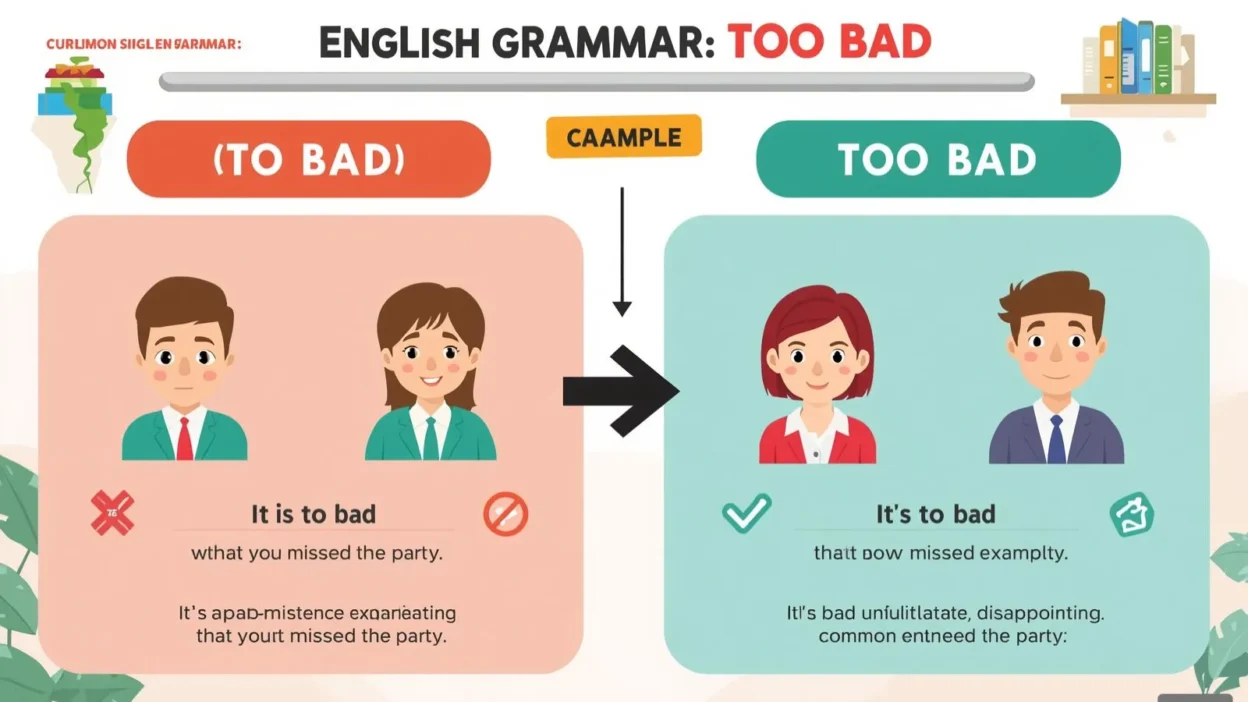
“Too bad” is the correct phrase.
❌ To bad
✅ Too bad
The phrase “too bad” means unfortunate, disappointing, regrettable, or unlucky. It is commonly used when expressing sympathy, disappointment, or mild regret about a situation.
Example:
- It’s too bad that the concert was canceled.
- That’s too bad. I was looking forward to seeing you.
What Does “Too Bad” Mean?
The phrase “too bad“ is an idiomatic expression used to describe something unfortunate or disappointing.
It can express:
- Sympathy
- Regret
- Disappointment
- Mild sadness
- Acceptance of an unfortunate situation
Examples
- It’s too bad that you missed the meeting.
- That’s too bad. I hope things improve soon.
- It’s too bad the weather ruined our picnic.
- Too bad we couldn’t spend more time together.
In everyday English, native speakers frequently use this phrase in conversations.
Why “To Bad” Is Incorrect
The word to is usually a preposition or part of an infinitive verb.
Examples of to:
- Go to school.
- Travel to London.
- I want to learn English.
Because to serves a different grammatical purpose, the phrase “to bad” does not make sense in standard English grammar.
Incorrect Examples
- To bad you missed the game.
- That’s to bad.
- It was to bad we arrived late.
Correct Versions
- Too bad you missed the game.
- That’s too bad.
- It was too bad we arrived late.
To Bad vs Too Bad: Comparison Table
| Feature | To Bad | Too Bad |
| Correct English? | ❌ No | ✅ Yes |
| Meaning | No standard meaning | Unfortunate or disappointing |
| Common Usage | Grammar mistake | Everyday expression |
| Accepted in Formal Writing | ❌ No | ✅ Yes |
| Accepted in Casual Writing | ❌ No | ✅ Yes |
Understanding the Word “Too”
The word too has several meanings in English.
Meaning 1: Also
- I want to come too.
- She likes pizza too.
Meaning 2: Excessively
- The coffee is too hot.
- The bag is too heavy.
Meaning 3: In the Phrase “Too Bad”
- It’s too bad we missed the flight.
- That’s too bad.
In this expression, too helps create the meaning of something unfortunate or regrettable.
Common Situations Where “Too Bad” Is Used
People often use too bad in everyday conversations.
Expressing Sympathy
- That’s too bad about your injury.
- It’s too bad you weren’t feeling well.
Showing Disappointment
- Too bad the event was canceled.
- It’s too bad they lost the match.
Reacting to Unfortunate News
- Too bad your vacation ended early.
- That’s too bad your phone stopped working.
Casual Conversations
- Too bad we couldn’t meet yesterday.
- It’s too bad the store closed.
Common Mistakes People Make
Many writers accidentally use to bad because English contains many homophones—words that sound alike but have different meanings and spellings.
Mistake #1: Using “To” Instead of “Too”
❌ To bad you couldn’t come.
✅ Too bad you couldn’t come.
Mistake #2: Confusing To, Too, and Two
- To = direction or infinitive marker
- Too = also or excessively
- Two = number 2
Examples:
- I went to the store.
- I want ice cream too.
- I have two dogs.
Mistake #3: Relying Only on Pronunciation
Because all three words sound identical, many people spell them incorrectly when writing.
Easy Trick to Remember the Difference
A simple memory trick can help.
The word too contains an extra “o.”
Think of the extra “o” as representing extra emotion or extra emphasis.
When something is unfortunate or disappointing, use too bad.
Example:
- Too bad you missed the movie.
The extra “o” reminds you that you’re expressing regret or disappointment.
Examples of “Too Bad” in Sentences
Here are more examples to help you understand natural usage.
- It’s too bad we didn’t arrive earlier.
- That’s too bad about your exam results.
- Too bad the restaurant was closed.
- It’s too bad they moved away.
- That’s too bad. I really wanted to attend.
- Too bad the tickets sold out.
- It’s too bad the project got delayed.
- That’s too bad you couldn’t join us.
Is “Too Bad” Formal or Informal?
The phrase too bad works in both formal and informal contexts.
Informal Examples
- Too bad you couldn’t make it.
- That’s too bad.
Formal Examples
- It is too bad that the opportunity was missed.
- It is too bad that the proposal could not be approved.
However, in highly professional writing, you may prefer alternatives such as:
- Unfortunately
- Regrettably
- Sadly
- Unfortunately enough
- It is regrettable that
American vs British English
The phrase “too bad” is used in both American and British English.
There is no spelling difference between the two varieties.
American English
- That’s too bad.
- It’s too bad we lost.
British English
- That’s too bad.
- It’s too bad the train was delayed.
While some vocabulary differs between American and British English, too bad remains the standard expression in both.
Synonyms for “Too Bad”
Depending on the situation, you can use similar expressions.
- Unfortunately
- Regrettably
- What a shame
- That’s unfortunate
- Sadly
- That’s disappointing
- What a pity
- Unluckily
Examples
- What a shame you couldn’t come.
- That’s unfortunate.
- Sadly, the event was canceled.
These alternatives can improve variety in your writing.
FAQs
Is “to bad” ever correct?
No. In standard English grammar, “to bad” is considered incorrect.
What does “too bad” mean?
It means something is unfortunate, disappointing, regrettable, or unlucky.
Why do people write “to bad”?
Because to and too sound identical when spoken, making them easy to confuse.
Is “too bad” rude?
Usually no. It is often used to express sympathy or disappointment. However, tone and context can affect how it is perceived.
Can I use “too bad” in formal writing?
Yes, but more formal alternatives like unfortunately or regrettably may be preferred.
Is “too bad” an idiom?
Yes. It functions as a common English expression with a specific meaning beyond the individual words.
Do Americans and British people use “too bad”?
Yes. The phrase is standard and widely used in both American and British English.
How can I remember the correct spelling?
Remember that too has an extra “o.” Think of it as extra emphasis for an unfortunate situation.
Summary
When choosing between “to bad or too bad,” the correct phrase is always “too bad.” It is a common English expression used to show disappointment, sympathy, regret, or acknowledgment of an unfortunate situation. The version “to bad” is a spelling mistake and should be avoided in both formal and informal writing.
Understanding the difference between to, too, and two can help improve your grammar and writing accuracy. Whenever you want to describe something unfortunate or disappointing, remember to use “too bad.” This small spelling change makes a big difference in clear and correct communication.
Actionable Takeaway
Before publishing, texting, emailing, or posting online, quickly check whether you’re writing “too bad” instead of “to bad.” Remember: if you’re expressing regret, disappointment, or sympathy, too bad is the correct choice. Saving this simple grammar rule can help you avoid one of the most common English spelling mistakes.