Many English learners and even native speakers occasionally get confused between sell vs sale. The two words look similar and are closely related, but they have different meanings and grammatical uses.
If you have ever wondered whether to write “I want to sale my car” or “I want to sell my car,” you’re not alone. Understanding the difference can help you communicate more clearly in both everyday conversations and professional writing.
This guide explains everything you need to know about sell vs sale, including definitions, examples, common mistakes, and practical tips.
Quick Answer
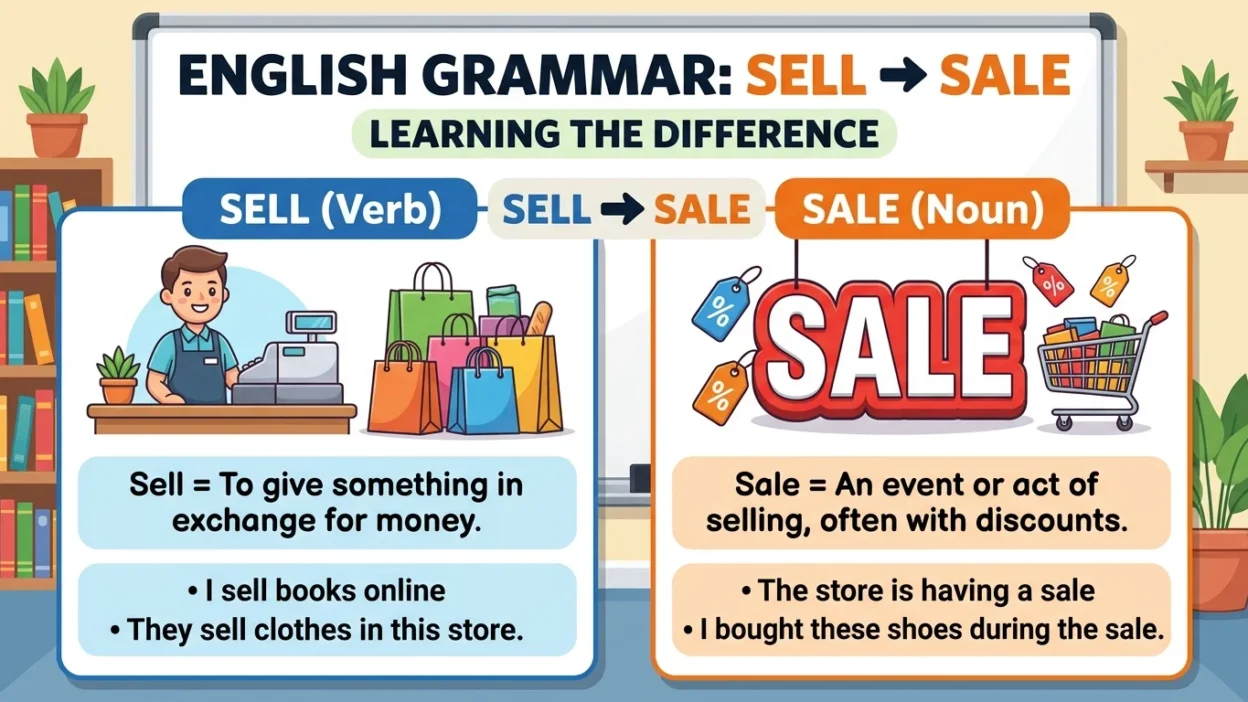
The main difference between sell and sale is:
- Sell is a verb (an action word).
- Sale is a noun (a thing or event).
Examples:
- I want to sell my old laptop.
- The laptop is for sale.
- The store will sell the product tomorrow.
- The store is having a big sale this weekend.
A simple rule to remember:
People sell things. Products are for sale.
What Does Sell Mean?
Sell is a verb that means to exchange something for money. It describes the action of giving a product or service to someone in return for payment.
Examples of Sell
- She wants to sell her bicycle.
- They sell fresh vegetables at the market.
- Our company sells software worldwide.
- He decided to sell his house.
In each example, sell describes an action being performed.
Synonyms for Sell
Some related words include:
- Market
- Trade
- Offer
- Distribute
- Promote
- Retail
Depending on the context, these words may have slightly different meanings but are often associated with selling products or services.
What Does Sale Mean?
Sale is a noun. It refers to the act of selling, a transaction, or a special event where items are sold, often at discounted prices.
Examples of Sale
- The house is for sale.
- The company reported strong sales this quarter.
- The store is having a summer sale.
- The sale of the property was completed yesterday.
In these examples, sale refers to a thing, event, or result rather than an action.
Synonyms for Sale
Related words include:
- Transaction
- Deal
- Purchase event
- Clearance
- Promotion
- Discount event
Sell vs Sale: Side-by-Side Comparison
| Feature | Sell | Sale |
| Part of Speech | Verb | Noun |
| Meaning | To exchange something for money | A transaction or selling event |
| Shows Action? | Yes | No |
| Example | I want to sell my phone. | My phone is for sale. |
| Used with “for”? | No | Yes |
| Common Context | Business, marketing, trading | Retail, discounts, transactions |
Easy Examples to Remember
Here are some simple sentence pairs that clearly show the difference.
Example 1
- I want to sell my car.
- My car is for sale.
Example 2
- They sell handmade jewelry online.
- The jewelry is on sale this week.
Example 3
- The company plans to sell more products.
- Product sales increased by 20%.
Notice how sell always expresses an action, while sale refers to the result, event, or item being sold.
Common Mistakes People Make
Many writers accidentally use these words interchangeably. Here are the most common errors.
Incorrect: I want to sale my bike.
Correct: I want to sell my bike.
Why?
Because an action is being performed, so you need the verb sell.
Incorrect: The store will have a sell tomorrow.
Correct: The store will have a sale tomorrow.
Why?
Because a discount event is a noun, so sale is the correct choice.
Incorrect: My house is sell.
Correct: My house is for sale.
Why?
When something is available to buy, we use the phrase for sale.
How to Remember the Difference
A quick memory trick can help.
Think About Action
If someone is doing something, use sell.
- I sell books.
- They sell cars.
Think About a Thing or Event
If you’re talking about an object, transaction, or promotion, use sale.
- Book sale
- Garage sale
- House for sale
A useful formula:
Sell = Action
Sale = Thing/Event
Sell vs Sale in Business and Marketing
In business English, both words appear frequently but serve different purposes.
Using Sell
- Companies sell products.
- Sales representatives sell services.
- Online stores sell merchandise.
Using Sale
- End-of-season sale
- Flash sale
- Holiday sale
- Annual sales report
Understanding the distinction is especially important in marketing, e-commerce, retail, and professional communication.
American vs British English
When it comes to sell vs sale, there is virtually no difference between American and British English.
Both varieties use:
- Sell as a verb
- Sale as a noun
Examples:
- American English: The store is having a sale.
- British English: The shop is having a sale.
The grammar and meaning remain the same in both versions of English.
Popular Phrases Using Sell
Here are some common expressions that use the word sell:
- Sell online
- Sell quickly
- Sell products
- Sell a house
- Sell a car
- Sell services
- Hard sell
- Soft sell
Example
The company sells products directly to customers.
Popular Phrases Using Sale
Common expressions containing sale include:
- For sale
- On sale
- Garage sale
- Clearance sale
- Final sale
- Summer sale
- Holiday sale
- Sales promotion
Example
All winter clothing is on sale this weekend.
FAQs
Is sell a verb or noun?
Sell is primarily a verb. It describes the action of exchanging something for money.
Is sale a verb?
No. Sale is a noun and refers to a transaction, event, or result of selling.
Which is correct: sell my car or sale my car?
The correct phrase is sell my car because you are describing an action.
What does for sale mean?
For sale means something is available to be purchased.
Example:
- The house is for sale.
What does on sale mean?
On sale usually means an item is being offered at a reduced price.
Example:
- These shoes are on sale today.
Can I use sell and sale interchangeably?
No. They have different grammatical functions and cannot be swapped in most sentences.
What is the plural form of sale?
The plural form is sales.
Example:
- Monthly sales increased significantly.
Why do people confuse sell and sale?
They are closely related words with similar spelling and pronunciation, but they serve different roles in a sentence.
Summary
Understanding sell vs sale is easier once you remember that sell is a verb and sale is a noun. Whenever you’re talking about an action, such as exchanging a product for money, use sell. Whenever you’re referring to a transaction, discount event, or item available for purchase, use sale.
To avoid mistakes, remember the simple rule: people sell things, and things are for sale. If you’re writing emails, business documents, social media posts, or everyday messages, using these words correctly will make your English clearer and more professional.
Actionable Takeaway
Before choosing between sell and sale, ask yourself one question: Am I describing an action or a thing? If it’s an action, use sell. If it’s a transaction, event, or item available to buy, use sale. Practice with a few examples, and the difference will quickly become second nature.