If you’ve ever paused mid-sentence wondering whether to say “what kind of” or “what kinds of,” you’re not alone. It’s one of those small grammar choices that can make a big difference in clarity and confidence.
The good news? The rule is actually simple once you see it in action. In this guide, you’ll learn exactly when to use each phrase, avoid common mistakes, and sound more natural in both writing and conversation.
Quick Answer
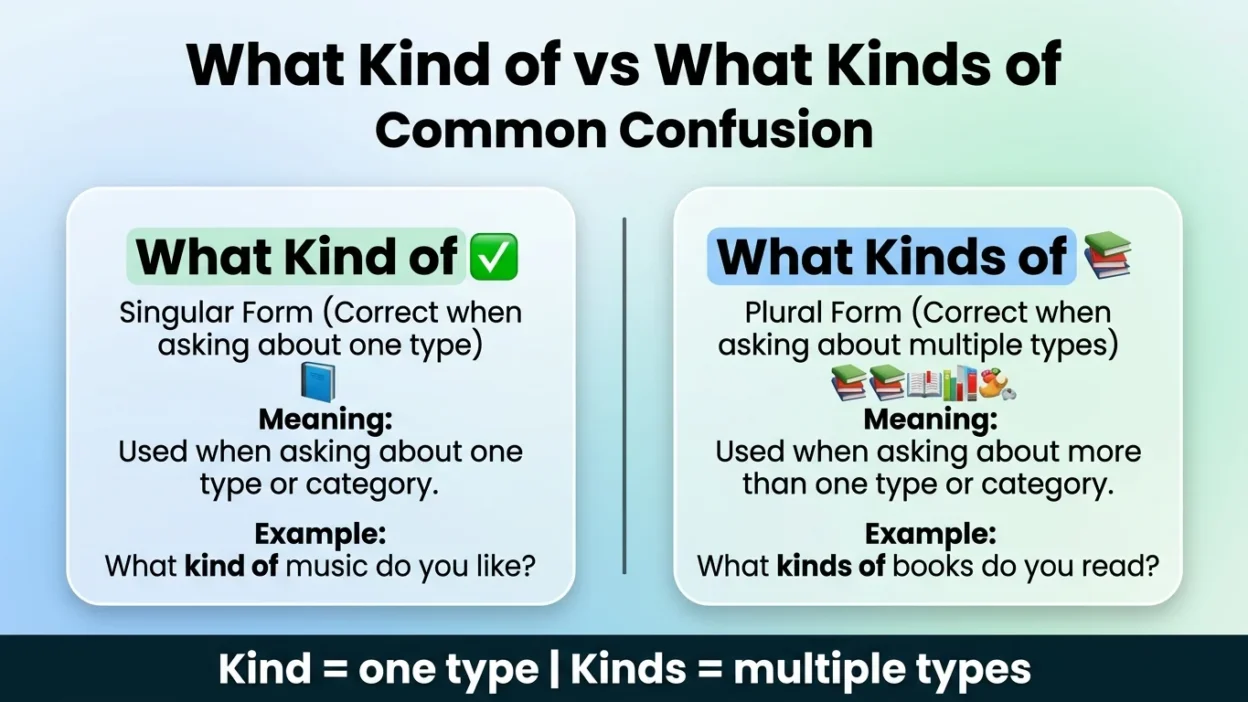
Use “what kind of” when you’re asking about one type or category.
Use “what kinds of” when you’re asking about multiple types or categories.
- Singular → What kind of music do you like?
- Plural → What kinds of movies do you watch?
What Does “What Kind of” Mean?
“What kind of” is used when you’re referring to a single category, type, or class of something. Even if the noun itself is uncountable or collective, the focus stays on one general type.
Examples:
- What kind of food do you prefer?
- What kind of job are you looking for?
- What kind of weather do you enjoy?
In these sentences, the speaker is asking for one general answer, not a list of different types.
What Does “What Kinds of” Mean?
“What kinds of” is used when you’re asking about multiple categories or types. It opens the door for variety or a list of options.
Examples:
- What kinds of books do you read?
- What kinds of skills are required for this role?
- What kinds of problems have you faced?
Here, the speaker expects more than one answer different types, varieties, or examples.
Key Difference Between “What Kind of” and “What Kinds of”
The difference comes down to singular vs plural meaning and scope of answers.
| Phrase | Usage Type | Meaning Focus | Example |
| What kind of | Singular | One general category | What kind of car do you want? |
| What kinds of | Plural | Multiple categories/types | What kinds of cars do you like? |
Simple Trick to Remember
- If you expect one answer, use kind
- If you expect multiple answers, use kinds
Real-Life Examples for Better Understanding
Everyday Conversation
- What kind of music do you like? (One general taste)
- What kinds of music do you enjoy? (Different genres)
At Work
- What kind of experience do you have? (Overall experience)
- What kinds of projects have you worked on? (Various types)
In Education
- What kind of course are you taking? (One subject)
- What kinds of subjects interest you? (Multiple areas)
Common Mistakes to Avoid
1. Mixing Singular with Plural Meaning
❌ What kind of books do you like? (Not wrong, but less precise)
✔ What kinds of books do you like?
👉 While the incorrect version is sometimes used casually, the corrected version is clearer and more natural.
2. Overusing “Kinds of”
Some learners use “kinds of” even when only one type is needed.
❌ What kinds of job are you looking for?
✔ What kind of job are you looking for?
3. Ignoring Context
Sometimes both forms can work but the meaning changes.
- What kind of food do you like? → One general preference
- What kinds of food do you like? → Multiple cuisines or dishes
American vs British English Differences
There is no major grammatical difference between American and British English when it comes to “what kind of” vs “what kinds of.”
However, in informal speech, especially in American English, you may hear:
- “What kind of things…” used instead of “what kinds of things…”
This is more about casual usage than strict grammar rules. In formal writing or professional communication, it’s better to stick to the correct singular/plural distinction.
Related Phrases and Synonyms (LSI Keywords)
To strengthen your understanding, here are similar expressions:
- Type of / Types of
- Sort of / Sorts of
- Category of / Categories of
- Form of / Forms of
- Variety of / Varieties of
These follow the same singular vs plural rule:
- Type → one
- Types → more than one
When Both Can Be Used (Subtle Nuance)
In some cases, both phrases are grammatically correct but they shift the meaning slightly.
Example:
- What kind of movies do you like? → Asking for your overall preference (e.g., action)
- What kinds of movies do you like? → Asking for a range (e.g., action, comedy, drama)
👉 This nuance is important for natural communication.
FAQs
1. Is “what kind of” always singular?
Yes, it refers to a single category or general type, even if the noun is uncountable.
2. Can I use “what kind of” with plural nouns?
You can, but it’s less precise. “What kinds of” is usually better for plural nouns.
3. Is it wrong to say “what kind of books”?
Not completely wrong, but “what kinds of books” is clearer and more natural.
4. Which is more formal: “kind” or “kinds”?
Both are equally formal. The choice depends on whether you mean singular or plural.
5. Do native speakers always follow this rule?
Not always in casual speech, but in writing and formal contexts, the rule is important.
6. Can I replace “kind of” with “type of”?
Yes, they are interchangeable in most contexts.
7. Why do people confuse these phrases?
Because both are commonly used in conversation, and the difference is subtle but important.
8. Is this rule important for exams?
Yes, especially in grammar tests, academic writing, and professional communication.
Final Summary
Understanding the difference between “what kind of” and “what kinds of” comes down to one simple idea: singular vs plural meaning. Use “what kind of” when you’re asking about one general category, and “what kinds of” when you want multiple types or examples. Once you start noticing this pattern, it becomes second nature.
This small grammar shift can make your English sound more natural, precise, and confident. If you’re writing an email, preparing for an exam, or just having a conversation, choosing the right phrase helps you communicate exactly what you mean.
Actionable Takeaway
Next time you use these phrases, pause and ask yourself:
- Am I expecting one answer or many?
If it’s one → use what kind of
If it’s many → use what kinds of
Practice with real-life examples, and you’ll master this rule faster than you think.