Have you ever paused while writing an email, scheduling a meeting, or creating an appointment calendar and wondered whether to write timeslot or time slot? You’re not alone. Many people use these terms interchangeably, but uncertainty about the correct spelling often leads to confusion.
If you’re a student, professional, content writer, or business owner, understanding the proper usage of timeslot or time slot can help you communicate more clearly and professionally.
In this guide, you’ll learn the meaning, correct spelling, examples, common mistakes, regional differences, and practical tips to use the term confidently.
Quick Answer
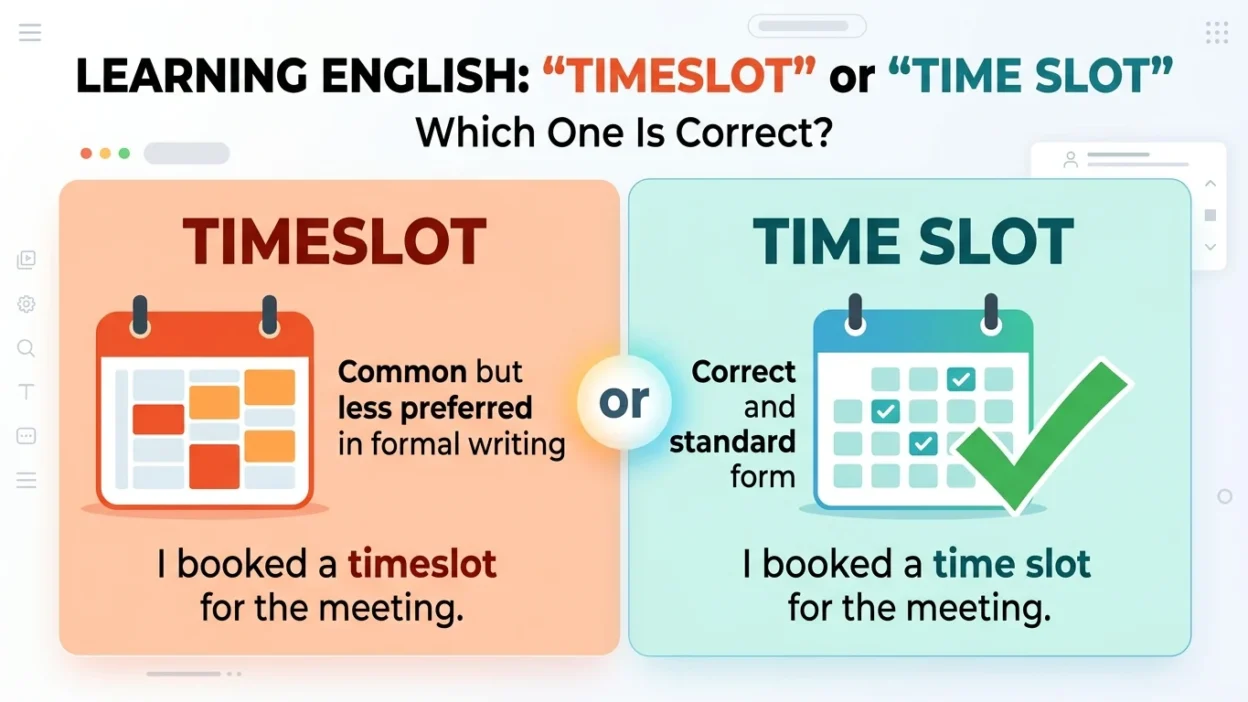
Both “timeslot” and “time slot” are used in English, but “time slot” (two words) is generally considered the standard and more widely accepted form.
- Time slot = Preferred spelling in most dictionaries and style guides.
- Timeslot = A less common variant often seen in digital platforms, software interfaces, and informal writing.
- For formal, academic, and professional writing, use time slot unless a company, platform, or style guide specifically prefers timeslot.
What Does Time Slot Mean?
A time slot is a specific period of time reserved or allocated for a particular activity, event, appointment, broadcast, meeting, or task.
In simple terms, a time slot is a designated window of time assigned for something to happen.
Examples
- Please choose a convenient time slot for your interview.
- The doctor has an available time slot at 3 PM.
- Our presentation is scheduled in the morning time slot.
- Customers can book a delivery time slot online.
- The television network changed its prime-time time slot.
The phrase is commonly used in scheduling systems, event planning, appointment booking, broadcasting, and project management.
Time Slot vs Timeslot: What’s the Difference?
The meaning of both terms is exactly the same. The difference lies only in spelling and usage preferences.
| Feature | Time Slot | Timeslot |
| Meaning | Designated period of time | Designated period of time |
| Grammar Status | Standard form | Variant form |
| Dictionary Preference | Preferred | Less common |
| Formal Writing | Recommended | Usually avoided |
| Software & Apps | Common | Also common |
| Professional Documents | Best choice | Less preferred |
For most situations, time slot is the safer and more widely accepted option.
Why Do People Write “Timeslot”?
English often combines two separate words into one compound word over time. Examples include:
- Website
- Notebook
- Keyboard
- Smartphone
As language evolves, some writers naturally combine time and slot into timeslot.
Many online booking systems, scheduling tools, and digital platforms use the single-word version because it looks cleaner in menus, buttons, and interface labels.
However, language authorities and major dictionaries still tend to favor time slot as the standard spelling.
American English vs British English
One common question is whether Americans and British speakers use different spellings.
American English
In American English, time slot is generally the preferred form.
Examples:
- Select a time slot for your appointment.
- We have several available time slots tomorrow.
British English
British English also typically prefers time slot.
Examples:
- Choose your preferred time slot online.
- The programme moved to a later time slot.
Which Version Should You Use?
Regardless of whether you’re writing for an American or British audience, time slot is usually the safest and most professional choice.
Common Situations Where Time Slot Is Used
You’ll encounter the term in many everyday and professional settings.
Appointment Scheduling
- Medical appointments
- Dental visits
- Interviews
- Consultations
Event Planning
- Conference sessions
- Workshops
- Seminars
- Training programs
Broadcasting
- Television schedules
- Radio programming
- Streaming content
Business Operations
- Delivery scheduling
- Customer support bookings
- Team meetings
- Resource allocation
Education
- Class schedules
- Exam schedules
- Student advising appointments
Examples of Time Slot in Sentences
Here are some natural examples to help you understand usage.
Professional Examples
- Please reserve a time slot before Friday.
- Each participant will receive a 30-minute time slot.
- The meeting time slot has been moved to the afternoon.
Everyday Examples
- I booked a delivery time slot for tomorrow morning.
- Which time slot works best for you?
- All available time slots are displayed online.
Broadcasting Examples
- The show earned high ratings in its new time slot.
- Prime-time slots attract larger audiences.
Common Mistakes People Make
Many writers unintentionally misuse the term. Here are some mistakes to avoid.
Using Inconsistent Spellings
Incorrect:
- Please choose a timeslot.
- Available time slots are listed below.
- Our booking system shows timeslots.
While not always grammatically wrong, switching between spellings in the same document can look unprofessional.
Choosing the Less Common Form in Formal Writing
Academic papers, business reports, and professional communications generally benefit from the standard spelling:
✔ Time slot
Adding Unnecessary Hyphens
Incorrect:
- Time-slot
- Times-slot
Correct:
- Time slot
Related Words and LSI Keywords
To better understand the concept, here are related terms often associated with time slot:
- Scheduling window
- Appointment slot
- Booking slot
- Reserved period
- Scheduled time
- Availability window
- Meeting slot
- Calendar slot
- Appointment time
- Time allocation
- Scheduling period
- Available slot
These related terms frequently appear in scheduling, booking, and calendar management contexts.
When Should You Use “Time Slot”?
Use time slot when:
- Writing professional emails
- Creating business documents
- Producing academic content
- Publishing articles
- Writing formal reports
- Communicating with clients
Examples:
- Please select your preferred time slot.
- The interview time slot lasts 45 minutes.
- We will confirm your chosen time slot shortly.
When Is “Timeslot” Acceptable?
The one-word version may be acceptable when:
- Following a company’s branding style
- Using software terminology
- Matching interface labels
- Following a specific editorial guide
Examples:
- Click the available Timeslot button.
- Select a Timeslot from the booking menu.
Even in these cases, consistency remains important.
How Dictionaries and Style Guides View It
Most dictionaries recognize time slot as the primary spelling.
Professional editors, content marketers, educators, and business writers generally recommend the two-word version because it aligns with established usage patterns and improves readability.
FAQs
Is it time slot or timeslot?
Both exist, but time slot is the more widely accepted and recommended spelling in formal and professional writing.
Is timeslot one word?
Yes, some people write it as one word. However, it is less common than time slot.
Which spelling is correct for business writing?
Time slot is generally preferred for business emails, reports, presentations, and official documents.
Do Americans use time slot or timeslot?
Most American English publications and style guides favor time slot.
Do British writers use time slot?
Yes. British English commonly uses time slot as the standard form.
Can I use timeslot in software applications?
Yes. Many apps and scheduling tools use timeslot for interface design and branding purposes.
Is time-slot correct?
Usually no. The hyphenated form is uncommon and generally unnecessary.
Which version is better for SEO?
Both can rank in search engines, but using time slot as the primary term while naturally mentioning timeslot can help capture broader search intent.
Conclusion
The debate over timeslot or time slot is mostly about spelling preference rather than meaning. Both terms refer to a designated period reserved for a specific activity, appointment, event, or task.
However, the two-word form, time slot, remains the most widely accepted choice across professional, academic, American, and British English contexts.
If you’re unsure which version to use, choose the timeslot. It aligns with standard dictionary usage, improves readability, and fits most writing situations.
The one-word variant, timeslot, may still appear in software interfaces and informal settings, but consistency and audience expectations should guide your decision.
Actionable Takeaway
Before publishing content, sending an email, or creating a schedule, use time slot as your default spelling. Reserve timeslot only when following a specific brand style, software terminology, or editorial preference. This simple choice helps your writing appear polished, professional, and easy to understand.

Henry Wyatt is the administrator of RizzPeak, responsible for managing site operations, content organization, and overall performance. He ensures smooth functionality, platform security, and a user-friendly experience while supporting the site’s creative direction and maintaining consistent quality across all features and updates.