Have you ever paused while writing and wondered whether you should use “by which” or “in which“? You’re not alone. These two phrases often confuse English learners and even native speakers because both are commonly used in formal writing, academic papers, and professional communication.
Understanding the difference between by which and in which can significantly improve your grammar, sentence structure, and writing clarity.
In this guide, you’ll learn the meaning of each phrase, when to use them, practical examples, common mistakes to avoid, and easy tips to remember the difference.
Quick Answer
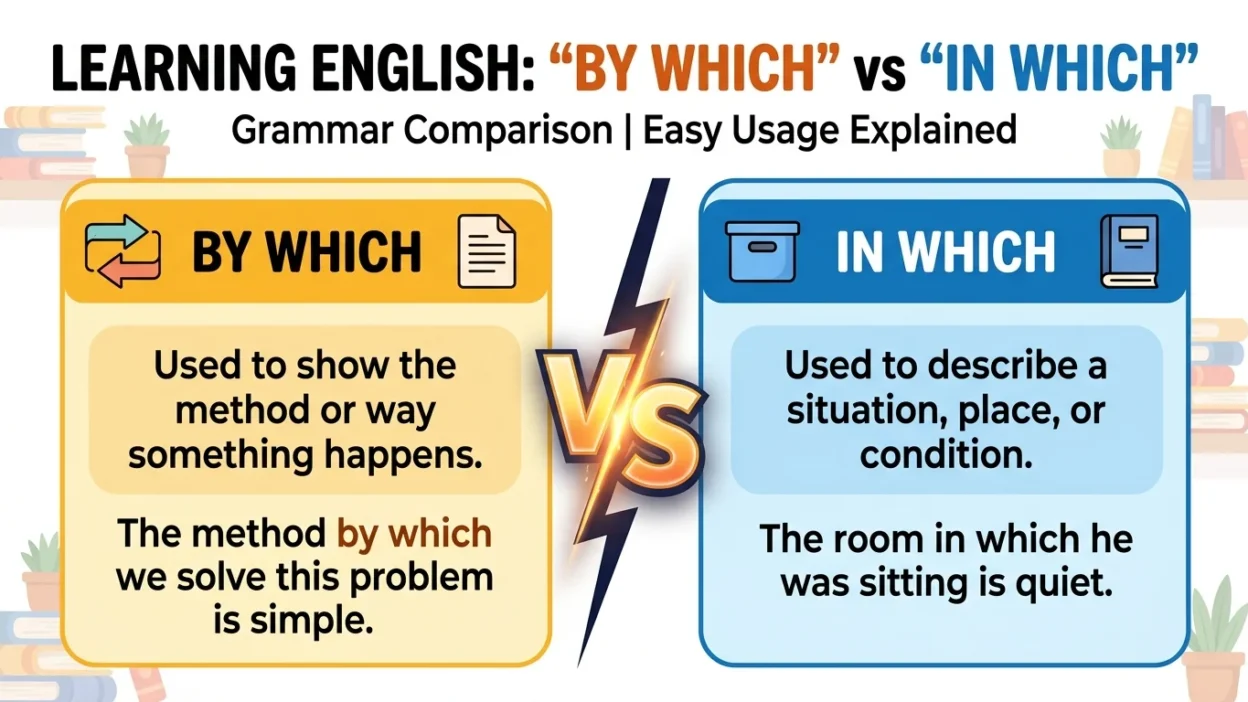
- By which refers to the method, means, process, or way something happens.
- In which refers to the place, situation, condition, or context where something happens.
Example:
- The system by which data is collected is highly secure.
- The room in which the meeting was held was spacious.
Simply remember:
- By which = how
- In which = where or within what
What Does “By Which” Mean?
The phrase by which is used when talking about the method, means, instrument, or process used to achieve something.
It often answers the question:
“How did it happen?”
Examples of “By Which”
- The procedure by which applications are reviewed has changed.
- This is the method by which the results were obtained.
- The technology by which information is shared continues to evolve.
- We explained the process by which decisions are made.
- The route by which supplies arrived was blocked.
In each example, by which describes the way or method something occurs.
What Does “In Which” Mean?
The phrase in which is used to describe a place, situation, environment, condition, or context.
It often answers the question:
“Where?” or “In what situation?”
Examples of “In Which”
- The city in which she was born is famous for its history.
- We discussed a scenario in which costs could increase.
- The classroom in which students study is newly renovated.
- This is the situation in which mistakes often occur.
- The year in which the company was founded was significant.
Here, in which identifies a location or context.
By Which vs In Which: Key Difference
Many writers struggle because both phrases connect clauses. However, their functions are different.
| Feature | By Which | In Which |
| Main Meaning | Method or means | Place or context |
| Answers | How? | Where? In what situation? |
| Focus | Process, instrument, technique | Location, condition, circumstance |
| Common Usage | Formal writing, academic texts | Formal writing, descriptions |
| Example | The method by which data is analyzed | The environment in which data is analyzed |
The easiest way to choose is to ask yourself:
- Am I describing how something happens? → Use by which.
- Am I describing where or in what situation something happens? → Use in which.
When Should You Use “By Which”?
Use by which when referring to:
- Methods
- Processes
- Techniques
- Procedures
- Systems
- Means of achieving something
Examples
- The mechanism by which plants absorb nutrients is complex.
- We improved the process by which customer requests are handled.
- The strategy by which the team achieved success was innovative.
- Scientists studied the method by which the disease spreads.
These examples emphasize the means or process involved.
When Should You Use “In Which”?
Use in which when referring to:
- Places
- Situations
- Circumstances
- Conditions
- Environments
- Time periods
Examples
- The country in which they live has strict regulations.
- We encountered a situation in which quick action was necessary.
- The environment in which children learn matters greatly.
- The decade in which these changes occurred was transformative.
These examples focus on context rather than method.
Common Mistakes with By Which and In Which
Understanding common errors can help you avoid grammar mistakes in formal writing.
Mistake 1: Using “By Which” for Location
❌ The office by which the conference was held.
✅ The office in which the conference was held.
Reason: The sentence refers to a location, not a method.
Mistake 2: Using “In Which” for Method
❌ The process in which payments are verified.
✅ The process by which payments are verified.
Reason: Verification occurs through a process or method.
Mistake 3: Ignoring the Meaning of the Sentence
Many writers focus on grammar rules instead of understanding what the sentence is actually expressing.
Ask:
- Is this a method?
- Is this a location or situation?
The answer usually reveals the correct phrase.
Easy Memory Trick
A simple trick can help you remember forever.
By Which = By Means Of
Example:
- The method by which the machine operates.
Think:
- The method by means of which the machine operates.
In Which = Inside a Context
Example:
- The situation in which the problem occurred.
Think:
- Inside that situation.
This shortcut makes choosing the correct phrase much easier.
Formal and Academic Writing Usage
Both phrases are commonly used in formal English.
Academic Example
- Researchers analyzed the process by which cells communicate.
Legal Example
- The circumstances in which the agreement may be terminated are outlined below.
Business Example
- We improved the system by which orders are processed.
Formal documents often prefer these structures because they sound professional and precise.
Can You Replace Them with Simpler Words?
Yes. In everyday English, people often use simpler alternatives.
Alternatives to “By Which”
- How
- Through which
- Using which
Example:
Formal:
- The method by which data is collected.
Informal:
- How data is collected.
Alternatives to “In Which”
- Where
- During which
- In that
Example:
Formal:
- The city in which he grew up.
Informal:
- The city where he grew up.
Both versions are grammatically correct, but the formal versions are more common in academic and professional writing.
American vs British English
There is no significant grammatical difference between American and British English regarding by which and in which.
Both forms are accepted and widely used in:
- American English
- British English
- Academic writing
- Legal documents
- Professional communication
The main difference is stylistic preference. Modern American English sometimes favors simpler constructions such as how or where, while British academic writing may retain formal structures more frequently.
Examples in Everyday Sentences
Here are additional examples to strengthen your understanding.
By Which Examples
- The formula by which profits are calculated is confidential.
- The technique by which artists create depth is fascinating.
- The procedure by which complaints are addressed is transparent.
- The system by which employees are evaluated has improved.
In Which Examples
- The building in which they work is over a century old.
- The condition in which the product arrived was disappointing.
- The situation in which we found ourselves was unexpected.
- The period in which the company expanded rapidly was remarkable.
FAQs
Is “by which” grammatically correct?
Yes. It is a correct and widely accepted phrase used to describe a method, process, or means.
Is “in which” grammatically correct?
Yes. It is used to describe a location, circumstance, situation, or context.
What is the easiest way to remember the difference?
Remember:
- By which = how
- In which = where or in what situation
Can I replace “in which” with “where”?
Often, yes.
- The city in which she lives.
- The city where she lives.
Both are correct.
Can I replace “by which” with “how”?
In many cases, yes.
- The method by which it works.
- How it works.
The second version is more conversational.
Which is more formal, “by which” or “how”?
By which is generally more formal and commonly used in academic, legal, and professional writing.
Which is more formal, “in which” or “where”?
In which is usually considered more formal than where.
Are these phrases common in academic writing?
Yes. Academic writers frequently use both expressions because they create precise and structured sentences.
Summary
Understanding the difference between by which and in which becomes easy once you focus on meaning rather than memorizing rules. Use by which when referring to a method, process, system, or means of doing something. Use in which when referring to a place, circumstance, environment, or situation.
Whenever you’re unsure, ask a simple question: Does the sentence describe how something happens or where/in what context it happens? If it’s about the method, choose by which.
If it’s about the location or circumstance, choose in which. Mastering this distinction will make your writing clearer, more professional, and grammatically accurate.
Actionable Takeaway
Before choosing between by which and in which, identify whether the sentence describes a method or a context.
This one-step check will help you select the correct phrase every time and improve the quality of your English writing instantly.