Have you ever written “sweeped” and wondered if it was actually correct? You’re not alone. Many English learners and even native speakers get confused when choosing between sweeped vs swept because English verbs don’t always follow predictable patterns.
If you’ve searched for the difference between sweeped and swept, you’re likely looking for the correct past tense of the verb sweep.
This guide explains everything in simple language, including meanings, examples, common mistakes, and practical tips to help you use the right word confidently.
Quick Answer
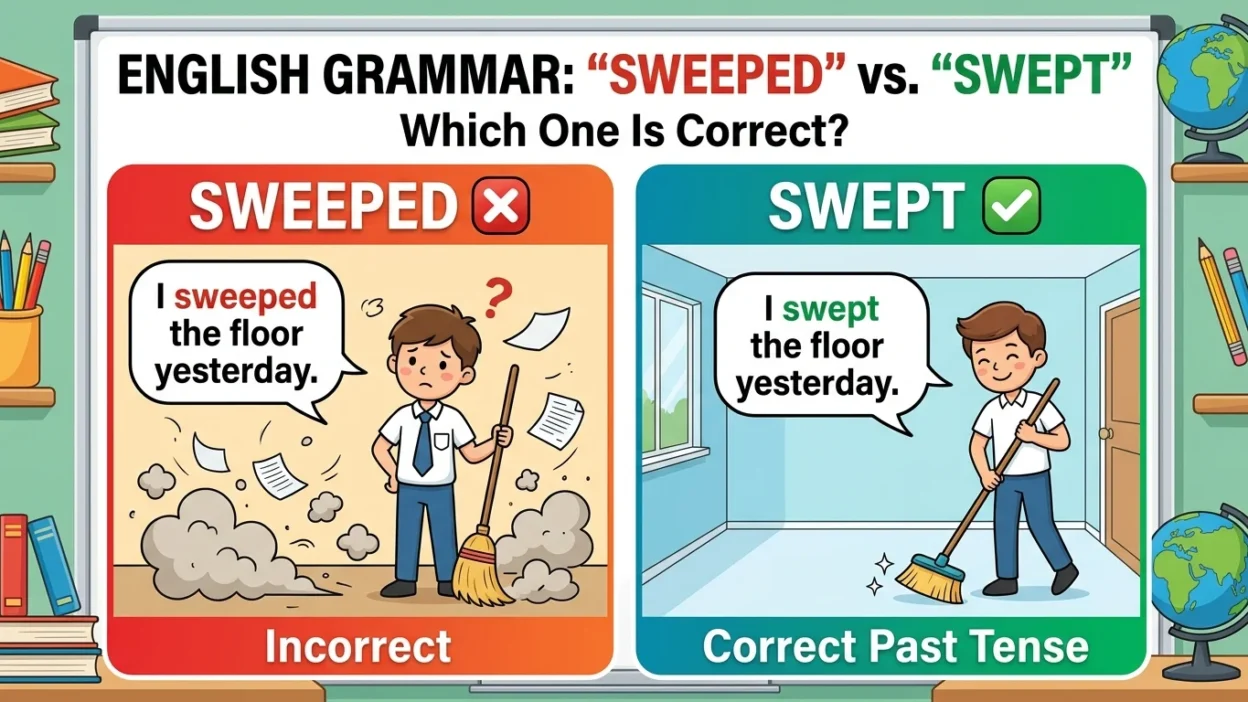
Swept is the correct past tense and past participle of sweep.
❌ Sweeped the floor yesterday.
✅ Swept the floor yesterday.
The word sweeped is considered incorrect in standard English grammar. Whether you’re writing in American English or British English, swept is the accepted form.
What Does “Sweep” Mean?
The verb sweep means to clean a surface by moving dirt, dust, or debris away using a broom or brush. It can also be used figuratively to describe moving quickly across an area or achieving a complete victory.
Examples:
- I sweep the kitchen every morning.
- Strong winds sweep across the valley.
- The team swept the championship series.
Because sweep is an irregular verb, its past tense does not simply add -ed.
Sweeped vs Swept: What’s the Difference?
The difference is straightforward:
| Word | Correct? | Usage |
| Sweep | ✅ Yes | Present tense |
| Swept | ✅ Yes | Past tense and past participle |
| Sweeped | ❌ No | Incorrect form |
English contains many irregular verbs that change spelling in the past tense.
For example:
- Keep → Kept
- Sleep → Slept
- Sweep → Swept
Since sweep follows this irregular pattern, swept is the only correct past-tense form.
Why Do People Say “Sweeped”?
Many people naturally assume that adding -ed creates the past tense because that’s how regular verbs work.
Examples of regular verbs:
- Walk → Walked
- Clean → Cleaned
- Open → Opened
However, sweep belongs to a group of irregular verbs that change internally rather than simply adding -ed.
This is why learners often write:
❌ I sweeped the porch.
Instead of:
✅ I swept the porch.
The mistake is understandable, but it should be avoided in formal and informal writing.
Examples of “Swept” in Sentences
Here are examples showing the correct usage of swept.
Cleaning Context
- She swept the living room before guests arrived.
- I swept the garage on Saturday morning.
- They swept the sidewalk after the storm.
Weather Context
- A cold wind swept through the town.
- Heavy rain swept across the coast.
- Dust storms swept over the desert.
Figurative Context
- Excitement swept through the crowd.
- The company swept the industry awards.
- Happiness swept over her when she heard the news.
These examples show how versatile the word swept can be.
Verb Forms of Sweep
Understanding all verb forms helps avoid confusion.
| Verb Form | Word |
| Base Form | Sweep |
| Third Person Singular | Sweeps |
| Present Participle | Sweeping |
| Past Tense | Swept |
| Past Participle | Swept |
Examples:
- I sweep the floor daily.
- She sweeps the hallway every evening.
- They are sweeping the driveway.
- We swept the house yesterday.
- The floor has been swept already.
Common Mistakes With Sweeped vs Swept
Many writers make similar errors when using irregular verbs.
Mistake 1: Using Sweeped as the Past Tense
❌ He sweeped the classroom.
✅ He swept the classroom.
Mistake 2: Using Sweeped After “Have”
❌ I have sweeped the floor.
✅ I have swept the floor.
Mistake 3: Mixing Tenses
❌ Yesterday, I sweep the kitchen.
✅ Yesterday, I swept the kitchen.
Mistake 4: Overcorrecting
Some learners avoid using swept because it sounds unusual.
However, swept is completely correct and widely used in everyday English.
Is There Any Difference Between American and British English?
No. Both American English and British English use swept as the correct past tense and past participle of sweep.
Examples:
American English:
- The janitor swept the hallway.
British English:
- The caretaker swept the corridor.
The vocabulary may differ, but the verb form remains the same.
Similar Irregular Verbs
Learning related irregular verbs can help you remember swept.
| Present Tense | Past Tense |
| Keep | Kept |
| Sleep | Slept |
| Sweep | Swept |
| Weep | Wept |
| Creep | Crept |
Notice the common spelling pattern where -eep often changes to -ept in the past tense.
This pattern makes swept easier to remember.
Memory Trick to Remember Swept
A simple trick is to group sweep with other familiar irregular verbs.
Think:
- Keep → Kept
- Sleep → Slept
- Weep → Wept
- Sweep → Swept
Since these verbs follow a similar pattern, remembering one helps you remember the others.
Another easy sentence:
“I kept sleeping while the janitor swept.”
This sentence connects multiple irregular verbs together for better recall.
When Should You Use Swept?
Use swept whenever you’re talking about an action that happened in the past or when using the past participle.
Past Tense:
- She swept the floor yesterday.
Present Perfect:
- She has swept the floor already.
Past Perfect:
- She had swept the room before dinner.
Passive Voice:
- The floor was swept this morning.
In all these cases, swept is correct.
Why Correct Grammar Matters
Using the correct past tense improves:
- Writing clarity
- Professional communication
- Academic assignments
- Business emails
- Search engine content quality
Grammar mistakes like sweeped can distract readers and reduce credibility, especially in professional or educational settings.
By using swept, your writing sounds more natural and polished.
FAQs
Is sweeped a real word?
No. Sweeped is generally considered incorrect in standard English grammar. The correct form is swept.
What is the past tense of sweep?
The past tense of sweep is swept.
Is it swept or sweeped the floor?
The correct phrase is swept the floor.
Why isn’t the past tense sweeped?
Because sweep is an irregular verb that changes to swept instead of adding -ed.
Is swept a past participle?
Yes. Swept functions as both the past tense and past participle of sweep.
Do Americans say sweeped?
No. American English uses swept, just like British English.
Can I use sweeped in informal writing?
No. Even in casual writing, swept is the correct form.
What are similar words to swept?
Similar irregular verbs include kept, slept, wept, and crept.
Summary
The debate over sweeped vs swept is actually quite simple once you understand how irregular verbs work. The correct past tense and past participle of sweep is swept, while sweeped is considered grammatically incorrect in standard English. This rule applies in both American and British English.
Whenever you’re describing a completed sweeping action, use swept. Remember the pattern shared by verbs like keep → kept and sleep → slept.
With a little practice, you’ll naturally choose the correct form every time and avoid one of the most common English grammar mistakes.
Actionable Takeaway
Before submitting any piece of writing, quickly check whether you’ve used swept instead of sweeped. If you’re unsure, remember this simple rule: Sweep → Swept, never Sweeped. Keeping this pattern in mind will instantly improve your grammar accuracy and writing confidence.