English can be confusing, especially when two words look almost identical but carry completely different meanings. One common mix-up people search for is acception vs exception. At first glance, these terms may seem interchangeable, but they are not. In fact, one is rarely used in modern English, while the other is extremely common in both writing and conversation.
If you have ever paused while typing and wondered whether to use acception or exception, you are not alone. This guide explains the meaning, usage, pronunciation, examples, and key differences in a simple and human-friendly way so you can use the correct word confidently.
Quick Answer
- Exception is the correct and commonly used English word.
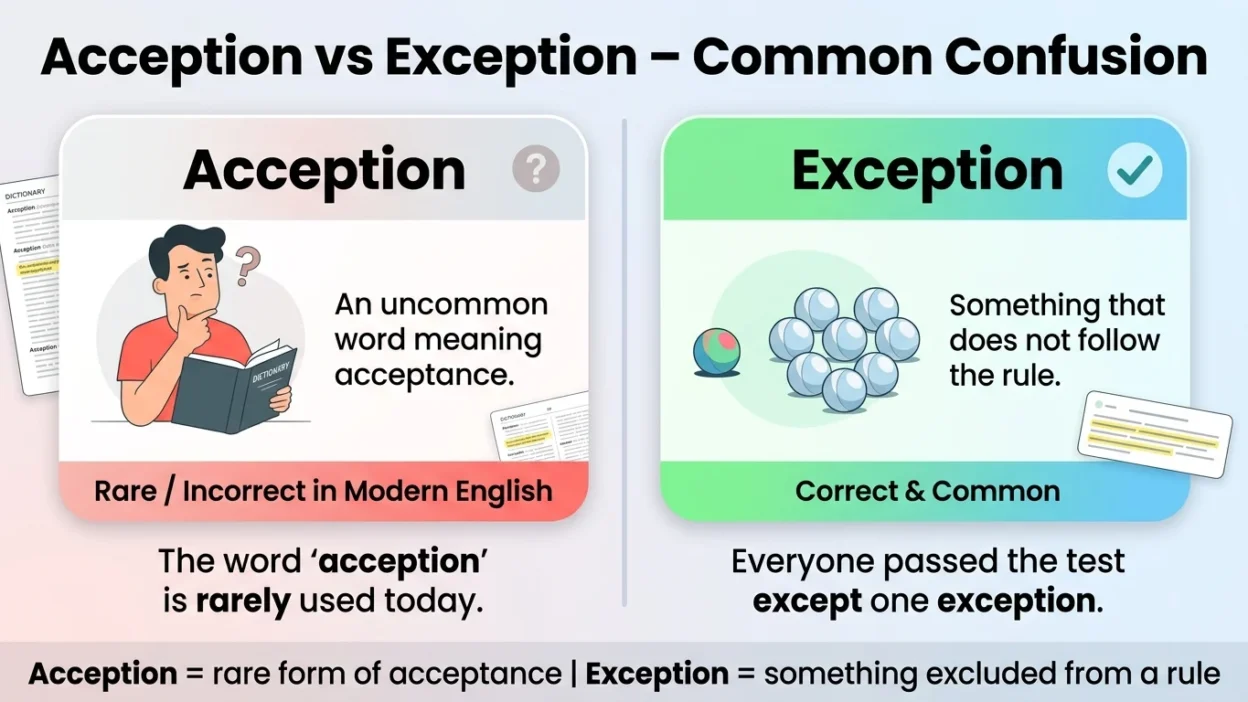
- Acception is a rare and outdated term that refers to a specific meaning or interpretation of a word.
- In everyday English, you almost always need exception.
Example:
- Correct: Everyone attended the meeting with one exception.
- Rare/technical: The word has several acceptions in historical texts.
What Does “Exception” Mean?
An exception is something or someone that does not follow a general rule. It refers to a case that is excluded from a statement or situation.
Simple Definition:
An exception is something left out from the usual pattern.
Examples of Exception
- Everyone passed the exam except John; he was the only exception.
- The restaurant opens daily with no exception.
- There is an exception to every rule.
- Children under five are an exception to the ticket policy.
Common Contexts Where “Exception” Is Used
You will often see this word in:
- Grammar rules
- School policies
- Legal writing
- Workplace instructions
- Everyday conversations
Popular Phrases
- With the exception of
- No exception
- An exception to the rule
Because of its frequent use, “exception” is considered a high-frequency English vocabulary word.
What Does “Acception” Mean?
The word acception exists, but it is very rare in modern English. It refers to the meaning or accepted sense of a word or phrase.
Simple Definition:
Acception means a specific interpretation or definition of a word.
Examples of Acception
- The ancient manuscript uses the term in a different acception.
- Scholars debated the acception of the phrase in medieval literature.
This term is mostly found in:
- Linguistics
- Historical studies
- Old dictionaries
- Academic language analysis
In daily communication, most native English speakers never use “acception.”
Acception vs Exception: Key Differences
| Feature | Acception | Exception |
| Meaning | Interpretation or sense of a word | Something excluded from a rule |
| Usage Frequency | Very rare | Extremely common |
| Context | Academic or linguistic | Everyday English |
| Modern Usage | Limited | Widely used |
| Part of Speech | Noun | Noun |
Why People Confuse Acception and Exception
There are several reasons why these words get mixed up:
Similar Spelling
Both words share many letters, making typing mistakes easy.
Similar Pronunciation
Their pronunciation sounds somewhat alike, especially for English learners.
Autocorrect Errors
Sometimes spelling tools fail to detect misuse because both words technically exist.
Confusion With “Acceptance”
Many users accidentally type “acception” when they actually mean “acceptance” or “exception.”
Exception vs Acceptance vs Acception
This is where many learners get confused. Let’s simplify it.
| Word | Meaning | Example |
| Exception | Something excluded | Everyone came with one exception. |
| Acceptance | Approval or agreement | Her acceptance into college was exciting. |
| Acception | Meaning of a word | The old acception differs from the modern one. |
How to Remember the Difference
A quick memory trick can help you avoid mistakes.
Exception = Exit From the Rule
Think of the “ex” in exception as “excluded.”
Example:
- One student was excluded from the rule = exception.
Acception = Accepted Meaning
Think of “acception” as the accepted interpretation of language.
This trick makes the distinction easier to remember during writing.
Common Mistakes to Avoid
Here are the most frequent errors people make with these words.
Mistake 1: Using “Acception” Instead of “Exception”
❌ There are no acceptions to this policy.
✅ There are no exceptions to this policy.
Mistake 2: Confusing “Acception” With “Acceptance”
❌ Her acception letter arrived yesterday.
✅ Her acceptance letter arrived yesterday.
Mistake 3: Assuming Both Words Are Common
Many learners believe “acception” is a normal alternative spelling. It is not.
Is “Acception” Wrong?
Not exactly. It is a legitimate English word, but it is considered:
- Archaic
- Rare
- Technical
- Academic
In modern communication, using “acception” may confuse readers because most people are unfamiliar with it.
Unless you are discussing language meanings, historical texts, or semantics, you probably should not use it.
American vs British English Differences
There is no major difference between American and British English regarding these words.
In American English
- “Exception” is extremely common.
- “Acception” is almost never used outside academic contexts.
In British English
- The situation is basically the same.
- “Acception” remains rare and specialized.
So whether you write for a US or UK audience, “exception” is the standard word for everyday use.
Synonyms and Related Words
Using related terms naturally improves readability and SEO value.
Synonyms for Exception
- Exclusion
- Irregularity
- Special case
- Deviation
- Anomaly
Related Terms
- Acceptance
- Exemption
- Restriction
- Rule
- Condition
- Interpretation
- Definition
- Meaning
These related words help readers better understand context and vocabulary usage.
Real-Life Examples of “Exception”
In School
- Every student must wear a uniform without exception.
In Business
- Refunds are not allowed except under special exceptions.
In Law
- The judge made an exception in this particular case.
In Daily Conversation
- She never eats sweets, but birthdays are an exception.
Real-Life Examples of “Acception”
Because the word is uncommon, it mainly appears in scholarly writing.
In Linguistics
- The dictionary listed an older acception of the term.
In Literature
- Shakespeare used the word in a unique acception.
In Historical Research
- Researchers examined the medieval acception of justice.
When Should You Use “Exception”?
Use “exception” when talking about:
- Rules
- Policies
- Conditions
- Exclusions
- Special cases
Correct Examples
- There are exceptions to the policy.
- He is an exception to the rule.
- Weather delays are an exception.
When Should You Use “Acception”?
Use “acception” only when discussing:
- Word meanings
- Linguistics
- Historical language usage
- Semantic interpretation
Correct Example
- The philosopher used the term in its classical acception.
FAQs
Is acception a real word?
Yes, acception is a real English word, but it is very rare and mostly used in academic or linguistic contexts.
Which is more common: acception or exception?
Exception is far more common and widely used in modern English.
Can I use acception instead of exception?
No. In most situations, replacing “exception” with “acception” would be incorrect.
What does exception mean in simple words?
It means something that does not follow the general rule.
Why is acception rarely used?
Because modern English speakers typically use words like “meaning,” “definition,” or “sense” instead.
Is acception outdated?
It is considered archaic or highly specialized in contemporary English.
Are there British and American spelling differences?
No. Both forms are spelled the same in American and British English.
What word do people usually confuse with acception?
People often confuse it with “acceptance” or “exception.”
Final Thoughts :
Understanding the difference between acception vs exception can instantly improve your writing clarity and vocabulary confidence. Although both words exist in English, they serve completely different purposes.
“Exception” is the everyday word people use when talking about exclusions or special cases, while “acception” belongs mostly to academic discussions about language and meaning.
For most writers, students, bloggers, and professionals, “exception” is the word you will need almost every time. If you remember that an exception is something excluded from a rule, you will avoid one of the most common English vocabulary mistakes.
Actionable Takeaway
Before using “acception,” ask yourself whether you are discussing the meaning of a word. If not, you probably mean “exception.” Keeping this simple rule in mind will help you write more naturally, professionally, and accurately in both formal and casual English.

Henry Wyatt is the administrator of RizzPeak, responsible for managing site operations, content organization, and overall performance. He ensures smooth functionality, platform security, and a user-friendly experience while supporting the site’s creative direction and maintaining consistent quality across all features and updates.