Words like affirm and confirm may seem similar at first glance, but they carry different meanings and are used in different situations. Many English learners, writers, and even native speakers mix them up because both words involve agreement or certainty.
Understanding the difference between affirm vs confirm can improve your writing, speaking, and professional communication. In this guide, you’ll learn the exact meanings, practical examples, common mistakes, grammar tips, and when to use each word naturally in everyday English.
Quick Answer
The main difference between affirm and confirm is this:
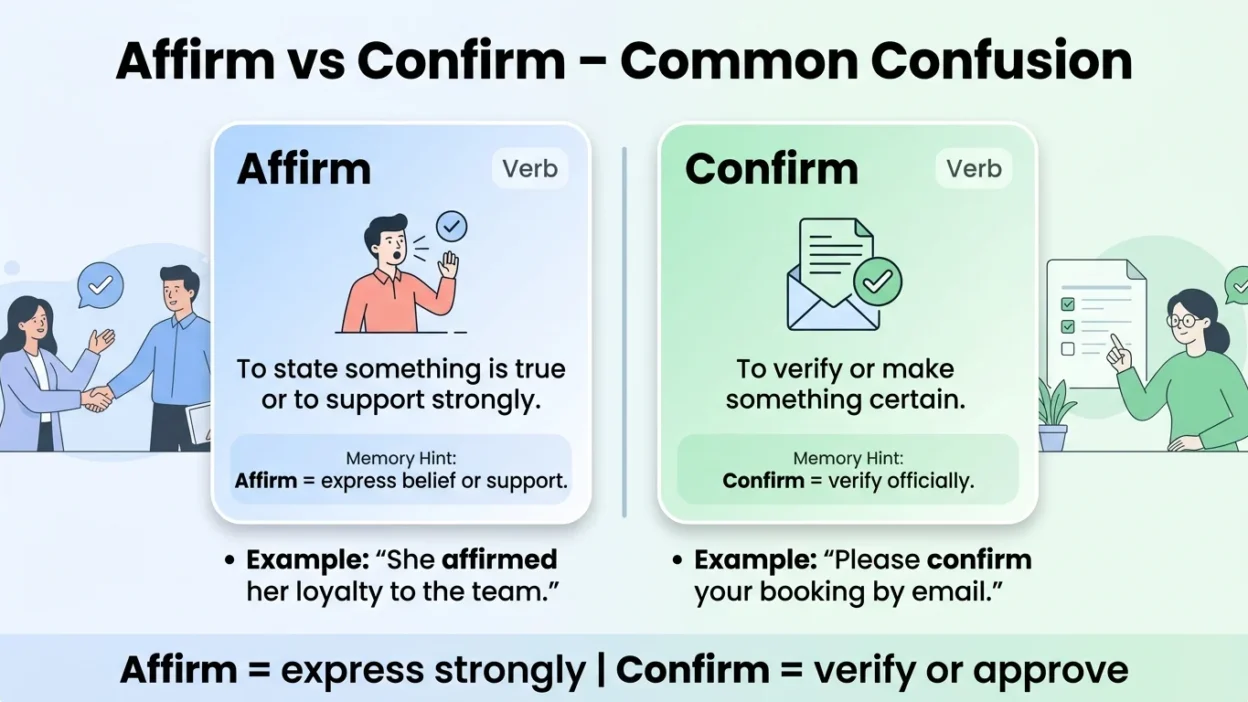
- Affirm means to state something strongly, positively, or publicly.
- Confirm means to verify, prove, or establish that something is true.
Simple Example
- She affirmed her support for the project.
→ She openly declared or expressed support. - The doctor confirmed the diagnosis.
→ The doctor verified that the diagnosis was correct.
In short:
- Affirm = express confidently
- Confirm = verify with evidence
What Does “Affirm” Mean?
The word affirm means to declare, support, or state something with confidence. It often involves emotional strength, belief, or personal assurance.
People use affirm when they:
- Express support
- Make a strong statement
- Encourage positivity
- State beliefs or opinions confidently
Examples of Affirm
- The teacher affirmed the student’s talent.
- She affirmed her commitment to the company.
- He affirmed that honesty matters most.
- Daily affirmations can improve confidence.
Common Contexts for “Affirm”
You’ll often hear this word in:
- Personal development
- Motivation
- Legal settings
- Public speeches
- Emotional encouragement
Related Words and Synonyms
LSI keywords and related phrases include:
- declare
- support
- reassure
- assert
- validate emotionally
- positive affirmation
- express confidence
What Does “Confirm” Mean?
The word confirm means to verify or establish that something is true, accurate, or correct. It usually involves evidence, proof, or official approval.
People use confirm when they:
- Verify information
- Check facts
- Approve appointments
- Establish certainty
Examples of Confirm
- Please confirm your email address.
- The test results confirmed the suspicion.
- She confirmed the meeting time.
- Scientists confirmed the discovery after research.
Common Contexts for “Confirm”
You’ll commonly see this word in:
- Emails
- Travel bookings
- Medical reports
- Research
- Business communication
Related Words and Synonyms
Useful related phrases include:
- verify
- validate
- approve
- authenticate
- prove
- check accuracy
Affirm vs Confirm: Key Difference Explained
Although both words relate to certainty, the intention behind them is different.
| Feature | Affirm | Confirm |
| Main Meaning | Declare strongly | Verify as true |
| Focus | Expression or belief | Proof or accuracy |
| Emotional Tone | Positive or supportive | Factual or official |
| Used With | Opinions, support, values | Facts, bookings, results |
| Example | “I affirm my loyalty.” | “I confirm the reservation.” |
Easy Trick to Remember
Think of it this way:
- Affirm = emotional or personal certainty
- Confirm = factual certainty
When to Use “Affirm”
Use affirm when someone is:
- Expressing support
- Declaring beliefs
- Encouraging positivity
- Reinforcing confidence
Example Situations
- A leader affirming values
- A parent affirming a child’s confidence
- Positive affirmations in self-help routines
- A witness affirming a statement in court
Sentences Using “Affirm”
- She affirmed her belief in equality.
- The coach affirmed the team’s potential.
- I affirm my dedication to this goal.
When to Use “Confirm”
Use confirm when checking whether something is accurate or official.
Example Situations
- Confirming a hotel reservation
- Confirming medical results
- Confirming attendance
- Confirming information in research
Sentences Using “Confirm”
- Please confirm your appointment.
- The lab confirmed the infection.
- Can you confirm the delivery date?
Common Mistakes People Make
Many learners confuse these words because both involve certainty. However, replacing one with the other can sound awkward or incorrect.
Incorrect Usage Examples
❌ Please affirm your booking.
✅ Please confirm your booking.
❌ The scientist affirmed the theory with data.
✅ The scientist confirmed the theory with data.
❌ She confirmed her support emotionally.
✅ She affirmed her support emotionally.
Why These Mistakes Happen
The confusion usually comes from:
- Similar tone
- Formal writing style
- Overlapping ideas of certainty
But remember:
- Affirm is about expressing confidence.
- Confirm is about checking truth.
Affirmation vs Confirmation
The nouns also differ in meaning.
Affirmation
An affirmation is a supportive or positive statement.
Examples:
- positive affirmations
- self-affirmation
- affirmation of rights
Confirmation
A confirmation is proof, approval, or verification.
Examples:
- booking confirmation
- email confirmation
- official confirmation
American vs British English Differences
There is no major spelling difference between affirm and confirm in American and British English. Both forms are spelled the same in both regions.
However, usage style can vary slightly:
- British English may use more formal phrasing in official confirmations.
- American English often uses confirm more frequently in customer service and casual business communication.
Example
- British English: Please confirm receipt of this letter.
- American English: Please confirm you received this email.
Both are correct.
Grammar Tips for Affirm and Confirm
Verb Forms
| Base Form | Past Tense | Past Participle | Gerund |
| affirm | affirmed | affirmed | affirming |
| confirm | confirmed | confirmed | confirming |
Sentence Patterns
- affirm + belief/opinion/support
- confirm + fact/booking/result
Examples
- They affirmed their loyalty.
- The data confirmed the results.
Real-Life Examples of Affirm vs Confirm
Workplace Example
- The manager affirmed the employee’s skills.
- HR confirmed the promotion date.
Medical Example
- The therapist affirmed her feelings.
- The scan confirmed the diagnosis.
Travel Example
- He affirmed his excitement about the trip.
- The airline confirmed the ticket.
Education Example
- The teacher affirmed the student’s creativity.
- The school confirmed admission.
Why Understanding the Difference Matters
Using the correct word improves:
- Professional communication
- Writing clarity
- Confidence in English
- Academic accuracy
Choosing the wrong word may confuse readers or make sentences sound unnatural.
For example:
- “Confirm your attendance” sounds natural.
- “Affirm your attendance” sounds overly formal and unusual.
Small word choices can make a big difference in communication quality.
FAQs
Is affirm the same as confirm?
No. Affirm means to declare or support something strongly, while confirm means to verify that something is true.
Can I use affirm instead of confirm?
Usually no. These words are not interchangeable in most contexts.
What is an example of affirm?
“She affirmed her commitment to the team.”
What is an example of confirm?
“The company confirmed my interview schedule.”
Is affirmation positive?
Often yes. Affirmations are commonly positive statements used for encouragement and confidence.
Does confirm always require proof?
Generally yes. Confirmation usually involves evidence, verification, or official approval.
Which word is more formal?
Both can sound formal, but affirm is often used in legal, motivational, or emotional contexts, while confirm is common in professional and everyday communication.
What is the easiest way to remember affirm vs confirm?
Remember:
- Affirm = express belief
- Confirm = verify truth
Final Thoughts
Understanding the difference between affirm vs confirm helps you communicate more naturally and accurately in English. While both words relate to certainty, they serve different purposes. Affirm focuses on expressing support, belief, or confidence, while confirm focuses on checking facts and verifying truth.
In everyday communication, choosing the right word can improve professionalism, clarity, and tone. If you’re writing emails, speaking professionally, or improving your grammar skills, knowing when to use affirm and confirm will make your English stronger and more precise.
Actionable Takeaway
Before using either word, ask yourself:
- Am I expressing confidence or support? → Use affirm
- Am I verifying something as true? → Use confirm
That one simple question can help you choose the correct word every time.

Henry Wyatt is the administrator of RizzPeak, responsible for managing site operations, content organization, and overall performance. He ensures smooth functionality, platform security, and a user-friendly experience while supporting the site’s creative direction and maintaining consistent quality across all features and updates.