English can be confusing, especially when two words look almost identical but only one is usually correct. If you’ve ever typed “payed” and wondered whether your spellchecker was right to flag it, you’re not alone. The debate around paid vs payed is one of the most common grammar and spelling questions online.
The good news is that the rule is actually simple once you understand it. In most everyday situations, paid is the correct spelling. However, there is a rare exception where payed is still used correctly. This guide will explain everything clearly with examples, mistakes to avoid, grammar tips, and usage differences.
Quick Answer
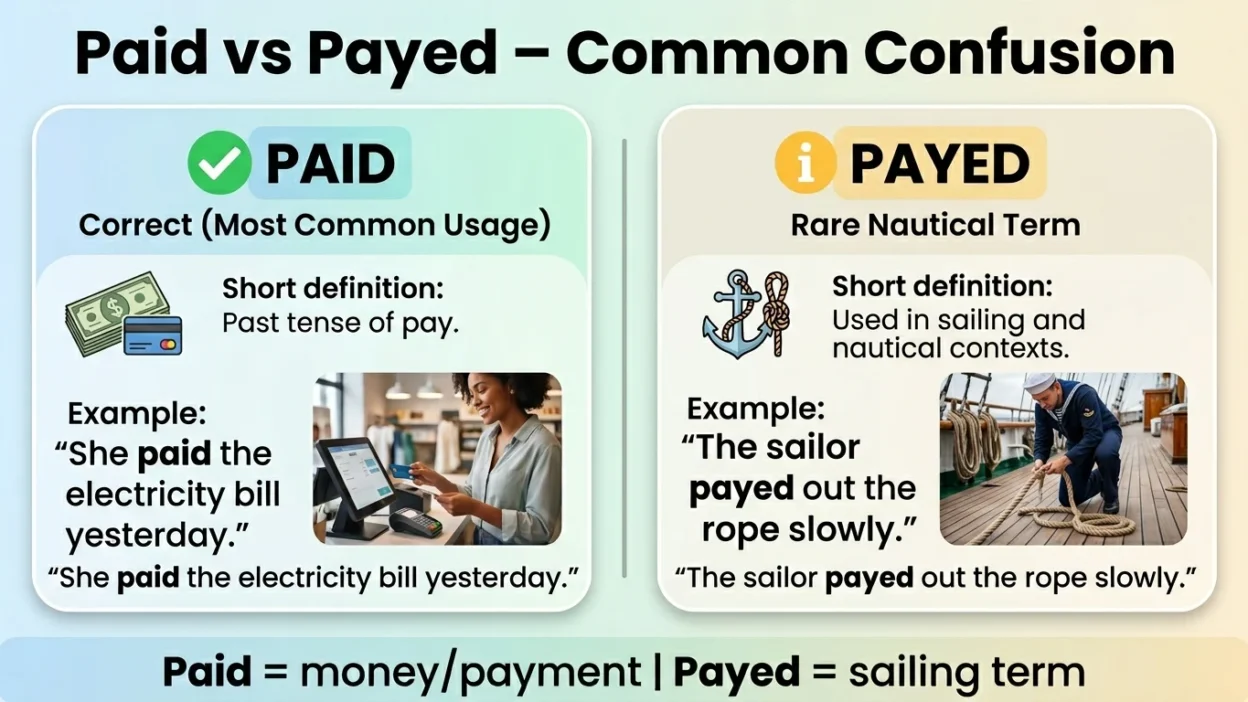
- Paid is the correct past tense and past participle of the verb pay in almost all situations.
- Payed is a rare nautical term used in sailing and maritime contexts.
Correct Examples:
- I paid the bill yesterday.
- She has already paid for the tickets.
Rare Correct Use of “Payed”:
- The sailors payed the deck seams with tar.
If you are talking about money, wages, invoices, bills, or payments, always use paid.
What Does “Paid” Mean?
The word paid is the standard past tense of the verb pay. It refers to giving money for goods, services, debts, salaries, or obligations.
Common Uses of “Paid”
- Paid a bill
- Paid rent
- Paid for dinner
- Paid employees
- Paid attention
Example Sentences
- I paid my electricity bill this morning.
- They paid cash for the car.
- She finally paid back the loan.
- He paid attention during the lecture.
Even though “pay” usually becomes “paid” in the past tense, many learners mistakenly assume it should follow the regular “-ed” pattern and become “payed.” That’s where confusion starts.
What Does “Payed” Mean?
The word payed is technically a real English word, but it is extremely rare. It is mostly used in maritime or nautical language.
Meaning of “Payed” in Sailing
In sailing terminology, payed means:
- To coat a ship or deck with tar, resin, or waterproof material
- To let rope or chain out slowly
Examples
- The crew payed the ship’s seams to prevent leaks.
- The sailors carefully payed out the rope.
Unless you work in shipping, sailing, or maritime history, you will almost never need to use “payed.”
Paid vs Payed: Key Difference
| Word | Meaning | Common Usage | Correct in Financial Context? |
| Paid | Past tense of pay | Everyday English | Yes |
| Payed | Nautical term | Rare maritime language | No |
This comparison makes the difference easy to remember:
- Money = paid
- Ships and ropes = payed
Why Do People Confuse Paid and Payed?
The confusion happens because English usually forms the past tense by adding “-ed” to verbs.
Examples of Regular Verbs
- Walk → Walked
- Jump → Jumped
- Talk → Talked
Naturally, many people expect:
- Pay → Payed
But English contains many irregular verbs, and “pay” is one of them.
Similar Irregular Verbs
| Present | Past Tense |
| Say | Said |
| Lay | Laid |
| Pay | Paid |
These irregular spellings developed historically and became the accepted standard in modern English grammar.
Is “Payed” Ever Correct?
Yes, but only in specialized maritime contexts.
If you are writing:
- Emails
- Academic papers
- Blog posts
- Social media captions
- Business documents
- School assignments
You almost certainly need paid, not “payed.”
Rare Correct Examples of “Payed”
- The sailors payed the rope carefully.
- Workers payed the wooden hull with tar.
Outside these niche situations, using “payed” is considered a spelling mistake.
American vs British English Usage
There is no major difference between American and British English when it comes to paid vs payed.
In Both American and British English:
- Paid is the standard spelling for financial transactions.
- Payed remains a rare nautical term.
Examples
- American English: She paid the invoice yesterday.
- British English: He paid the rent on time.
So no matter where you are writing, “paid” is almost always correct.
Common Mistakes to Avoid
Many writers accidentally use “payed” because it looks logical. Here are the most common mistakes and corrections.
Incorrect:
- I payed my phone bill.
- She payed for dinner.
- They payed attention in class.
Correct:
- I paid my phone bill.
- She paid for dinner.
- They paid attention in class.
A helpful trick is this:
If money, cost, salary, debt, or attention is involved, use paid.
Memory Trick to Remember the Correct Word
Here’s a simple way to remember it:
“Money is paid.”
Both words are short and commonly connected in daily life:
- Paid rent
- Paid bills
- Paid workers
If you think about finances or transactions, your brain should automatically choose paid.
Examples of “Paid” in Everyday Sentences
Using examples can make grammar rules easier to understand.
Financial Context
- I paid the tuition fee online.
- We paid extra for faster shipping.
- She paid her credit card balance early.
Figurative Context
- Hard work finally paid off.
- He paid attention to every detail.
- Their kindness paid dividends later.
Workplace Context
- Employees are paid every Friday.
- The company paid compensation to customers.
Examples of “Payed” in Rare Contexts
These examples show the limited use of “payed.”
Nautical Usage
- The fishermen payed out the anchor rope.
- The old ship was payed with sealant.
- Sailors payed the deck seams before the storm.
You can see why most people never encounter this version in normal writing.
Grammar Tip: Why “Paid” Is Irregular
English evolved from multiple language influences, including Germanic and French roots. Because of this history, many verbs developed unusual past-tense forms.
Examples of Irregular Verbs
| Base Verb | Past Tense |
| Make | Made |
| Say | Said |
| Keep | Kept |
| Pay | Paid |
Learning these irregular forms improves grammar, spelling, and professional writing skills.
When Spellcheck Can Save You
Modern grammar tools usually flag “payed” as incorrect unless the sentence relates to sailing or ropes.
Helpful tools include:
- Grammarly
- Microsoft Word Editor
- Google Docs Grammar Check
Still, understanding the rule yourself is better than relying entirely on software.
FAQs
Is “payed” a real word?
Yes, but it is a rare nautical term related to ships, ropes, and sealing decks.
Which is correct: paid or payed?
For nearly all everyday situations, paid is correct.
Can I say “I payed the bill”?
No. The correct sentence is “I paid the bill.”
Why is “paid” spelled differently?
“Pay” is an irregular verb, so its past tense does not follow the normal “-ed” pattern.
Is “payed attention” correct?
No. The correct phrase is “paid attention.”
Do British people use “payed”?
Only in rare maritime contexts. British English still uses “paid” for money-related meanings.
Is “paid off” correct?
Yes. “Paid off” is a common phrase meaning something produced successful results.
How can I remember the difference?
Think: money equals paid, ships and ropes equal payed.
Final Thoughts :
Understanding the difference between paid vs payed is easier than it first appears. In modern English, paid is the correct spelling in almost every common situation involving money, bills, salaries, purchases, or attention. It is the accepted standard in both American and British English.
Meanwhile, payed survives only in specialized nautical language connected to ships, ropes, and sealing materials. Unless you are writing about maritime topics, you should avoid using it. Keeping this simple distinction in mind will improve your grammar, spelling accuracy, and overall writing confidence.
Actionable Takeaway
Before using “payed,” ask yourself one question:
Am I talking about money or payment?
If the answer is yes, always use paid. Save “payed” for rare sailing-related situations only.

Henry Wyatt is the administrator of RizzPeak, responsible for managing site operations, content organization, and overall performance. He ensures smooth functionality, platform security, and a user-friendly experience while supporting the site’s creative direction and maintaining consistent quality across all features and updates.