Have you ever stopped while writing and wondered whether you should use passerbyers, passersby, or passerby? You’re not alone. These words often confuse English learners and even native speakers because the plural form doesn’t follow the pattern most people expect.
If you’ve searched for “passerbyers or passersby or passerby,” you’re likely trying to find out which spelling is correct and when to use each term.
In this guide, we’ll break down the meanings, grammar rules, examples, and common mistakes so you can use the right word confidently every time.
Quick Answer
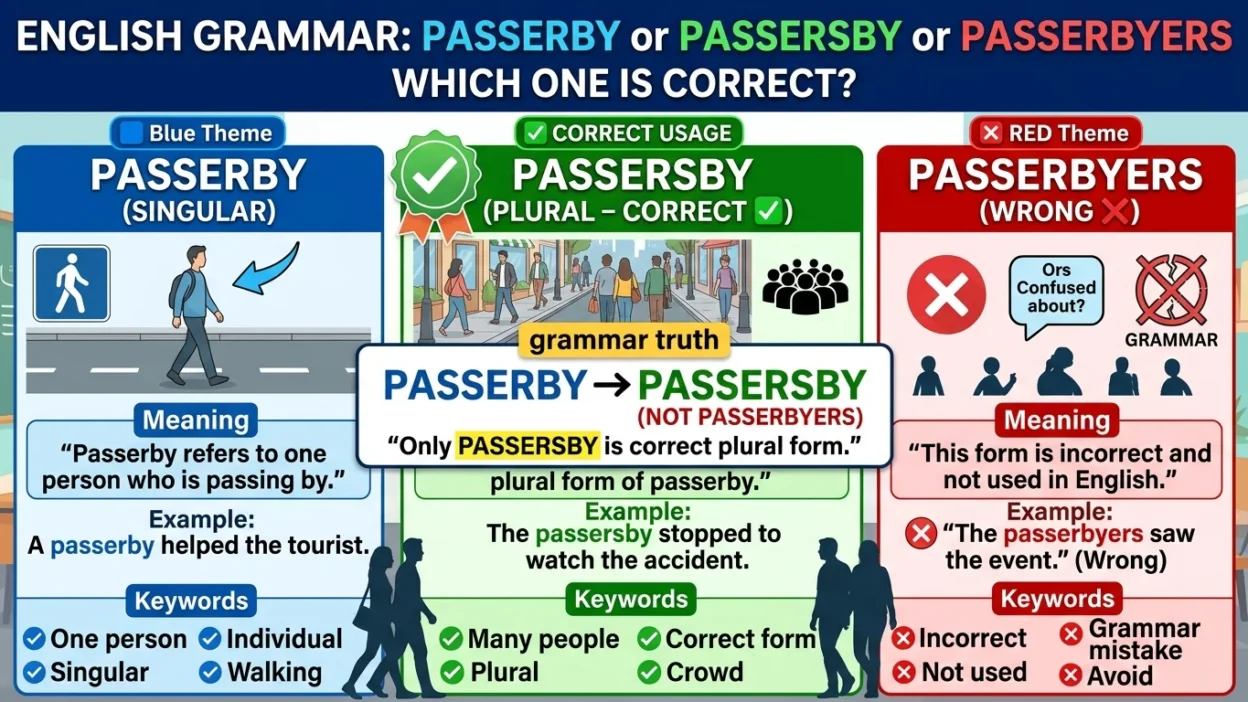
- Passerby = Singular form (one person passing by)
- Passersby = Correct plural form (more than one person passing by)
- Passerbyers = Incorrect word and should not be used
Example:
✅ A passerby witnessed the accident.
✅ Several passersby stopped to help.
❌ Several passerbyers stopped to help.
What Does Passerby Mean?
The word passerby refers to a person who is walking or moving past a particular place, often without stopping.
It is commonly used when describing someone who happens to witness an event, notice something unusual, or simply pass through an area.
Examples
- A passerby found the lost wallet.
- The passerby asked for directions.
- A passerby witnessed the street performance.
- The injured dog was rescued by a kind passerby.
In each example, only one person is being referred to, making passerby the correct choice.
Why Is Passersby the Correct Plural?
Many English nouns become plural by adding -s or -es at the end. However, passerby is a compound noun, and compound nouns sometimes follow different pluralization rules.
The word consists of:
- Passer = person who passes
- By = adverb indicating movement past something
Since passer is the main noun, it becomes plural while by remains unchanged.
Therefore:
- Passerby → Passersby
This pattern is similar to:
- Mother-in-law → Mothers-in-law
- Attorney general → Attorneys general
- Runner-up → Runners-up
Examples of Passersby
- Several passersby witnessed the parade.
- Curious passersby gathered around the performer.
- The police interviewed nearby passersby.
- Passersby stopped to admire the artwork.
Is Passerbyers a Real Word?
No. Passerbyers is not considered a standard English word.
People often create this form because they assume the plural should be made by adding -ers or -s to the entire word. However, English grammar does not recognize passerbyers as the plural of passerby.
Incorrect Examples
❌ The passerbyers watched the event.
❌ Many passerbyers took photographs.
Correct Versions
✅ The passersby watched the event.
✅ Many passersby took photographs.
If you want grammatically correct English, always use passersby instead of passerbyers.
Passerby vs Passersby vs Passerbyers
| Word | Correct? | Meaning | Usage |
| Passerby | Yes | One person passing by | Singular |
| Passersby | Yes | Multiple people passing by | Plural |
| Passerbyers | No | Not a standard English word | Avoid |
This simple comparison makes it easy to remember which version belongs in your writing.
Example Sentences for Each Form
Using Passerby
- A passerby called emergency services.
- The passerby noticed smoke coming from the building.
- One passerby offered assistance.
Using Passersby
- Passersby gathered to watch the fireworks.
- Several passersby reported the incident.
- The street musician entertained dozens of passersby.
Incorrect Usage
- Passerbyers gathered around the accident. ❌
- Many passerbyers were curious. ❌
The correct replacement is always passersby.
Common Mistakes People Make
Understanding common errors can help you avoid them.
Adding “-ers” to the End
Many writers assume:
- Passerby → Passerbyers
This is incorrect because the plural belongs on the noun passer, not the entire compound.
Treating Passerby as Already Plural
Some people mistakenly think passerby refers to multiple people.
Incorrect:
❌ Several passerby were watching.
Correct:
✅ Several passersby were watching.
Mixing Singular and Plural Verbs
Incorrect:
❌ The passerby were standing nearby.
Correct:
✅ The passerby was standing nearby.
Or:
✅ The passersby were standing nearby.
Why This Word Confuses So Many People
English contains many irregular plural forms that don’t follow standard patterns.
Examples include:
- Child → Children
- Person → People
- Mouse → Mice
- Passerby → Passersby
Because most nouns simply add -s, unusual compound nouns can feel unnatural at first.
The confusion becomes even greater because many people rarely encounter the word in everyday conversation. As a result, forms like passerbyers occasionally appear online, even though they are grammatically incorrect.
American vs British English Differences
Good news: there is no difference between American and British English for this word.
Both varieties use:
- Passerby (singular)
- Passersby (plural)
Examples:
American English
- Several passersby witnessed the accident.
British English
- Several passersby witnessed the accident.
The spelling and grammar remain exactly the same on both sides of the Atlantic.
Synonyms for Passerby
If you want variety in your writing, consider these related words:
- Pedestrian
- Bystander
- Onlooker
- Observer
- Witness
- Spectator
- Walker
- Stranger
- Member of the public
- Viewer
Keep in mind that these words may carry slightly different meanings depending on the context.
Example
Instead of:
- A passerby saw the event.
You could write:
- A bystander saw the event.
- An onlooker saw the event.
- A pedestrian saw the event.
When Should You Use Passerby?
Use passerby when talking about one individual who happens to be passing a location.
Examples include:
- News reports
- Crime stories
- Accident descriptions
- Human-interest articles
- Everyday conversations
Example
“A passerby discovered the missing dog and contacted its owner.”
The term is especially useful when the person’s identity is unknown or unimportant.
Memory Trick to Remember the Correct Plural
A simple trick is to focus on the word passer.
Ask yourself:
“Who is doing the passing?”
The answer is the passer.
Since the noun is passer, that’s the part that becomes plural:
- Passer → Passers
- Passerby → Passersby
Remember:
The people become plural, not the word “by.”
FAQs
Is passersby a real word?
Yes. Passersby is the correct plural form of passerby and is widely accepted in standard English.
Is passerbyers correct?
No. Passerbyers is not a recognized English word and should be avoided.
What is the singular form of passersby?
The singular form is passerby.
Why isn’t the plural passerbys?
English compound nouns often form plurals differently. The noun portion (passer) becomes plural, creating passersby.
Can I use passerby in formal writing?
Yes. It is commonly used in journalism, academic writing, legal reports, and everyday English.
Do Americans and British people use different forms?
No. Both American and British English use passerby and passersby.
Is a passerby the same as a bystander?
Not always. A passerby is someone passing through an area, while a bystander is someone present at an event. Sometimes one person can be both.
How do you pronounce passersby?
It is typically pronounced as:
PASS-erz-bye
with emphasis on the first syllable.
Summary
When comparing passerbyers or passersby or passerby, the answer is straightforward. Passerby is the singular form used for one person passing by, while passersby is the correct plural form used for multiple people.
The word passerbyers is not recognized in standard English and should be avoided in both formal and informal writing.
Understanding this distinction can instantly improve your grammar and make your writing sound more natural.
Whenever you’re unsure, remember that the noun is passer, so that is the part that changes when forming the plural. Using passerby and passersby correctly will help you communicate clearly and confidently.
Actionable Takeaway
The next time you write about someone passing by:
- Use passerby for one person.
- Use passersby for multiple people.
- Never use passerbyers.
A quick mental reminder “the passer becomes plural” will help you get it right every time.