Have you ever paused while writing and wondered whether you should say interested in or interested on? You are not alone. This is one of the most common English grammar questions for learners, writers, students, and even native speakers.
The confusion usually happens because many English expressions use different prepositions depending on the context. But when it comes to the phrase “interested in,” there is one standard and grammatically correct choice in most situations.
In this guide, you’ll learn the correct usage, real-life examples, common mistakes, grammar tips, and simple ways to remember the difference.
Quick Answer
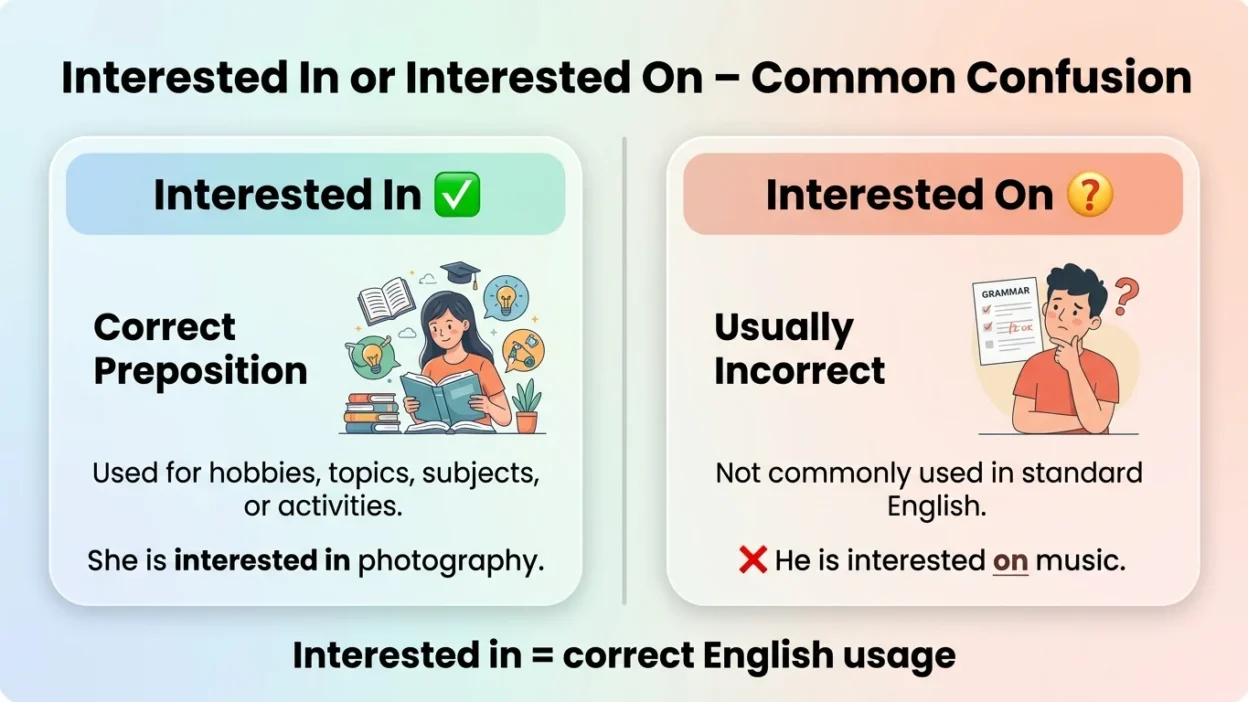
The correct phrase is almost always “interested in.”
✅ Correct: I am interested in music.
❌ Incorrect: I am interested on music.
Use “interested in” when talking about curiosity, attraction, attention, hobbies, subjects, activities, or opportunities.
The phrase “interested on” is generally incorrect in modern English grammar.
What Does “Interested In” Mean?
The phrase “interested in” means:
- Curious about something
- Wanting to learn more
- Emotionally or mentally engaged
- Attracted to a topic, activity, or idea
It is commonly used in both spoken and written English.
Examples
- She is interested in photography.
- I’m interested in learning Spanish.
- They are interested in the new project.
- Are you interested in sports?
- He became interested in history at a young age.
In all these examples, “in” connects the person’s interest with the subject or activity.
Is “Interested On” Ever Correct?
In standard English grammar, “interested on” is considered incorrect in most situations.
Incorrect Examples
- ❌ I am interested on this topic.
- ❌ She is interested on art.
- ❌ We are interested on joining the club.
Correct Versions
- ✅ I am interested in this topic.
- ✅ She is interested in art.
- ✅ We are interested in joining the club.
English speakers naturally use “interested in” because the adjective “interested” traditionally pairs with the preposition “in.”
Why Do People Confuse “In” and “On”?
Many English learners confuse these prepositions because other expressions use “on.” For example:
- Focus on
- Depend on
- Work on
- Concentrate on
Because of these patterns, some people accidentally say “interested on.”
Another reason is direct translation from other languages. In several languages, the equivalent phrase may use a different preposition.
Interested In vs Interested On: Comparison Table
| Phrase | Correct? | Meaning | Example |
| Interested in | ✅ Yes | Curious or engaged with something | I’m interested in science. |
| Interested on | ❌ No | Grammatically incorrect in standard English | Incorrect usage |
| Interested about | ⚠️ Rare/Informal | Sometimes used casually, but less natural | She’s interested in the story. |
| Interested to | ⚠️ Limited use | Used before actions in some contexts | I’d be interested to know more. |
When to Use “Interested In”
Talking About Hobbies
- I’m interested in painting.
- He is interested in football.
- They are interested in cooking.
Talking About Learning
- She is interested in biology.
- We are interested in improving our English.
- Are you interested in taking classes?
Talking About Career Opportunities
- I’m interested in the job opening.
- They are interested in working remotely.
- She is interested in marketing.
Talking About People or Relationships
- He seems interested in her.
- She is interested in meeting new people.
Can “Interested To” Be Used?
Yes, but the meaning changes slightly.
Use “interested to” when talking about reactions to information or discovering something.
Examples
- I’d be interested to hear your opinion.
- She was interested to learn about the event.
- We were interested to see the results.
This structure is grammatically correct, but it is different from “interested in.”
Common Grammar Mistakes
Using “Interested On”
❌ I’m interested on technology.
✅ I’m interested in technology.
Forgetting the Verb Form
❌ She is interested in learn English.
✅ She is interested in learning English.
After “interested in,” use:
- a noun
- a pronoun
- or a gerund (-ing form)
Using the Wrong Preposition in Formal Writing
Formal English strongly prefers “interested in.” Using “interested on” can make writing sound unnatural or incorrect.
Real-Life Example Sentences
Here are practical examples you can use in conversations, emails, and essays.
Everyday Conversation
- I’m interested in traveling this year.
- Are you interested in joining us?
- My brother is interested in technology.
Workplace English
- We are interested in your proposal.
- The company is interested in hiring experienced workers.
- She is interested in management roles.
Academic English
- Researchers are interested in climate change.
- Students are interested in online learning.
- He became interested in psychology after college.
American vs British English Usage
Both American English and British English use “interested in” as the standard form.
American English
- I’m interested in sports analytics.
- She’s interested in applying for the role.
British English
- He’s interested in studying abroad.
- They are interested in local history.
There is no major difference between American and British English in this case. Both consider “interested on” incorrect.
Related Phrases and Synonyms
Using related words naturally improves your English fluency and SEO relevance.
Similar Expressions
- Curious about
- Passionate about
- Engaged in
- Keen on
- Fascinated by
- Attracted to
- Focused on
- Enthusiastic about
Example Comparisons
- I’m interested in music.
- I’m passionate about music.
- I’m keen on music.
These expressions are similar but may sound more formal, casual, or emotional depending on the context.
Easy Trick to Remember the Correct Form
A simple memory trick:
Think of “interest” going inside your mind.
That is why English uses “in.”
✅ Interested in books
✅ Interested in sports
✅ Interested in learning
This small trick can help you avoid mistakes in speaking and writing.
How Native Speakers Use It
Native English speakers almost always say:
- Interested in
- Interested in doing something
- Interested in someone or something
If you use “interested on,” it may sound unnatural or confusing to fluent speakers.
That’s why mastering this phrase is important for:
- IELTS and TOEFL preparation
- Academic writing
- Professional emails
- Daily conversation
- SEO writing
- Content creation
FAQs
Is it correct to say “interested on”?
No. The correct phrase is usually “interested in.”
Why do we say “interested in”?
Because English grammar pairs the adjective “interested” with the preposition “in.”
Can I say “interested to know”?
Yes. “Interested to know” is correct when reacting to information.
Example:
I’d be interested to know your thoughts.
Which is more formal: interested in or interested about?
“Interested in” is far more natural and standard in formal English.
Is “keen on” similar to “interested in”?
Yes. “Keen on” has a similar meaning, especially in British English.
Example:
She’s keen on tennis.
Do native English speakers use “interested on”?
Very rarely. It is generally considered incorrect grammar.
Can I use “interested in” before a verb?
Yes, but use the -ing form of the verb.
✅ Interested in learning
❌ Interested in learn
Is “interested in” used in business English?
Absolutely. It is very common in emails, interviews, and professional communication.
Example:
We are interested in discussing your proposal.
Summary
The phrase “interested in” is the correct and standard expression in English grammar. If you are talking about hobbies, education, relationships, work, or ideas, the preposition “in” is the natural choice. On the other hand, “interested on” is generally incorrect and should be avoided in both formal and informal English.
Understanding this small grammar rule can greatly improve your writing clarity and speaking confidence. The next time you describe curiosity or enthusiasm, remember to use “interested in” followed by a noun or an -ing verb form. With regular practice and exposure to real examples, this usage will quickly become natural.
Actionable Takeaway
Whenever you write or speak, use this simple formula:
Interested + in + noun/gerund
Examples:
- Interested in music
- Interested in traveling
- Interested in learning English
Avoid using “interested on” unless you are quoting incorrect usage for teaching purposes. Reading English articles, listening to native speakers, and practicing example sentences will help reinforce the correct structure naturally.