Have you ever paused while writing and wondered whether you should use shown or showed? You’re not alone. Many English learners and native speakers alike get confused by these two words because they both come from the verb show and seem similar at first glance.
The good news is that understanding the difference between shown vs showed is actually quite simple. Once you learn how each word functions in a sentence, you’ll be able to use them confidently in both speaking and writing. This guide explains their meanings, grammar rules, examples, common mistakes, and more.
Quick Answer
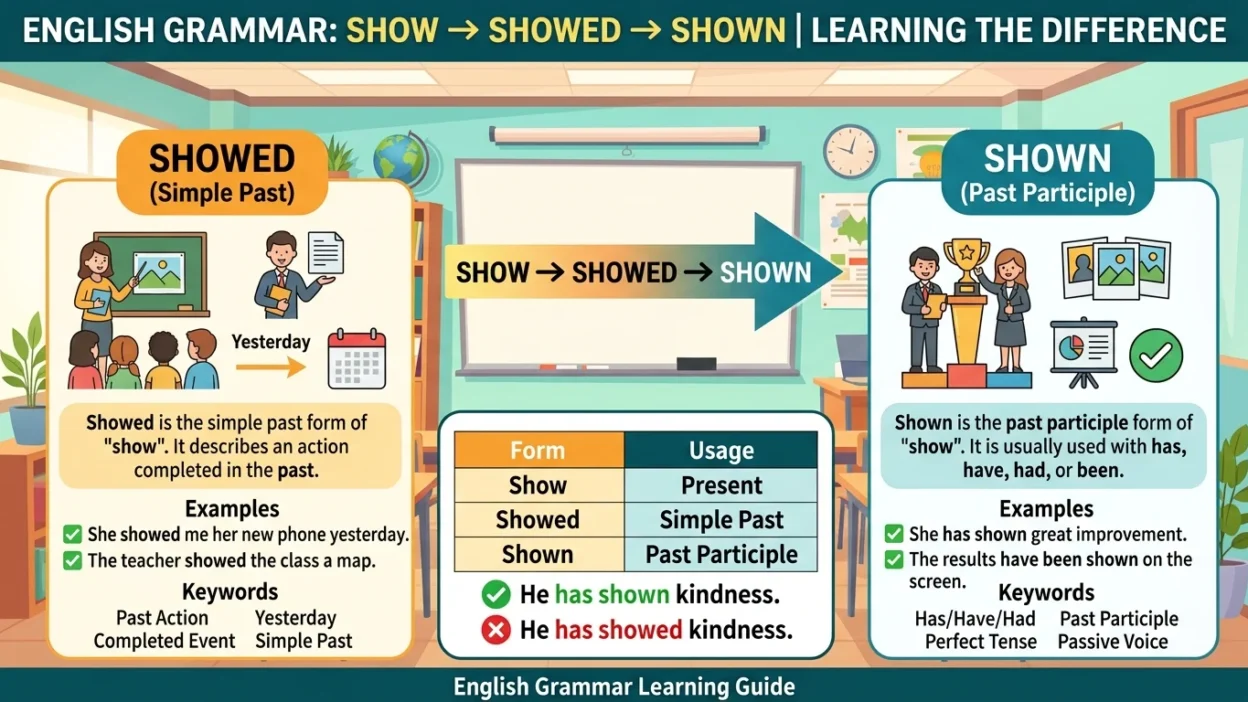
Showed is the simple past tense of the verb show.
Shown is the past participle form of show and is usually used with helping verbs such as has, have, had, was, were, or been.
✅ Correct: She showed me her new car.
✅ Correct: She has shown me her new car.
❌ Incorrect: She shown me her new car.
In short:
- Showed = Simple past tense
- Shown = Past participle
What Does “Showed” Mean?
Showed is the simple past tense of the verb show. It describes an action that happened and was completed in the past.
Examples of Showed
- My teacher showed us how to solve the problem.
- He showed his passport at the airport.
- Sarah showed me her vacation photos.
- They showed great courage during the competition.
- The report showed positive results.
In each example, the action happened in the past and is already complete.
What Does “Shown” Mean?
Shown is the past participle form of show. It cannot usually stand alone as the main verb. Instead, it works with helping verbs to create perfect tenses or passive voice constructions.
Examples of Shown
- I have shown the document to my manager.
- She has shown remarkable improvement.
- The results were shown on the screen.
- We had shown our tickets before entering.
- The evidence has been shown to the jury.
Notice how shown appears alongside helping verbs such as have, has, had, was, and were.
Shown vs Showed: Key Difference
The main difference between shown vs showed lies in their grammatical function.
| Word | Verb Form | Usage | Example |
| Showed | Simple Past Tense | Describes a completed action in the past | He showed me the way. |
| Shown | Past Participle | Used with helping verbs | He has shown me the way. |
Think of it this way:
- If no helping verb is present, you typically need showed.
- If a helping verb is present, you usually need shown.
Easy Trick to Remember
A simple memory trick can help:
Ask yourself:
Is there a helping verb before the word?
If the answer is yes, use shown.
- Has shown
- Have shown
- Had shown
- Was shown
- Were shown
If the answer is no, use showed.
- She showed me.
- They showed us.
- He showed the evidence.
This quick check can prevent most grammar mistakes.
Examples of Shown and Showed in Sentences
Using Showed
- The guide showed us around the museum.
- My friend showed me a useful website.
- The survey showed interesting trends.
- He showed kindness to everyone.
- They showed the product during the presentation.
Using Shown
- The company has shown steady growth.
- The movie was shown in theaters worldwide.
- She had shown interest in the project earlier.
- The findings have been shown repeatedly.
- The chart has shown significant progress.
Common Mistakes People Make
Many writers accidentally use shown when they should use showed.
Mistake 1: Using Shown Without a Helping Verb
❌ She shown me the report.
✅ She showed me the report.
Why? Because there is no helping verb.
Mistake 2: Using Showed After Has or Have
❌ He has showed great improvement.
✅ He has shown great improvement.
Why? After has, have, or had, use the past participle form.
Mistake 3: Confusing Passive Voice
❌ The results were showed yesterday.
✅ The results were shown yesterday.
Passive voice requires the past participle.
Is “Showed” Ever Wrong?
No. Showed is a completely correct English word when used as the simple past tense.
Some people mistakenly believe that shown should always replace showed, but that’s not true.
Compare:
- Yesterday, she showed me her artwork. ✅
- She has shown me her artwork before. ✅
Both are correct because they serve different grammatical purposes.
American vs British English
When comparing shown vs showed, there is no significant difference between American and British English.
Both varieties follow the same grammar rules:
- Showed = simple past tense
- Shown = past participle
Examples:
American English:
- He showed me the document.
- He has shown me the document.
British English:
- He showed me the document.
- He has shown me the document.
The usage remains identical.
Why Do People Confuse Shown and Showed?
There are several reasons:
- Both words come from the same base verb (show).
- They sound similar.
- English irregular verbs can be confusing.
- Some speakers hear the forms used interchangeably in casual conversation.
However, standard grammar treats them differently, and understanding the distinction improves writing accuracy.
Related Verb Forms of Show
Understanding all forms of the verb can help.
| Verb Form | Word |
| Base Form | Show |
| Present Tense | Show / Shows |
| Past Tense | Showed |
| Past Participle | Shown |
| Present Participle | Showing |
Examples:
- I show my work.
- She shows great talent.
- He showed me the answer.
- He has shown me the answer.
- They are showing the results.
When to Use Showed
Use showed when:
- Talking about a completed past action.
- No helping verb is present.
- Writing in simple past tense.
Examples:
- The teacher showed the lesson yesterday.
- My brother showed me his new phone.
- The graph showed an increase in sales.
When to Use Shown
Use shown when:
- A helping verb is present.
- Forming perfect tenses.
- Creating passive voice sentences.
Examples:
- We have shown our support.
- The image was shown on television.
- She had shown exceptional leadership.
FAQs
Is shown grammatically correct?
Yes. Shown is the past participle form of show and is grammatically correct when used with helping verbs.
Is showed a real word?
Absolutely. Showed is the standard simple past tense of show.
Which is correct: has shown or has showed?
Has shown is correct.
Example: She has shown remarkable progress.
Can I say “I shown him”?
No. The correct sentence is:
I showed him.
Or:
I have shown him.
Is shown past tense?
Not exactly. Shown is the past participle, not the simple past tense.
Why is “shown” used with have and has?
Because perfect tenses require a past participle.
Examples:
- Have shown
- Has shown
- Had shown
Which is more common, shown or showed?
Both are common, but they appear in different grammatical situations. Neither is inherently more correct or more formal.
Can shown be used in passive voice?
Yes.
Example:
The results were shown during the meeting.
Summary
Understanding shown vs showed becomes easy once you remember their grammatical roles. Showed is the simple past tense used for actions completed in the past, while shown is the past participle used with helping verbs and in passive voice constructions. Although they come from the same verb, they cannot always replace one another.
When writing or speaking, look for helping verbs such as has, have, had, was, or were. If one is present, shown is usually the correct choice. If you’re simply describing a past action without a helping verb, showed is the word you need.
Actionable Takeaway
Remember this simple rule: Showed = past action, Shown = helping verb required. Before choosing between the two, check whether your sentence contains a helping verb. This quick grammar check will help you avoid mistakes and use English more confidently.