Have you ever come across words like their, there, and they’re and wondered what category they belong to? Or perhaps you’ve seen a word like lead and realized it can be pronounced differently depending on its meaning. These language quirks often confuse learners and even native English speakers.
Understanding homophone vs homograph vs homonym is essential for improving your writing, reading comprehension, spelling, and communication skills.
While these terms may seem similar, each has a unique meaning. In this guide, you’ll learn the differences, see practical examples, avoid common mistakes, and gain confidence in using these word types correctly.
Quick Answer
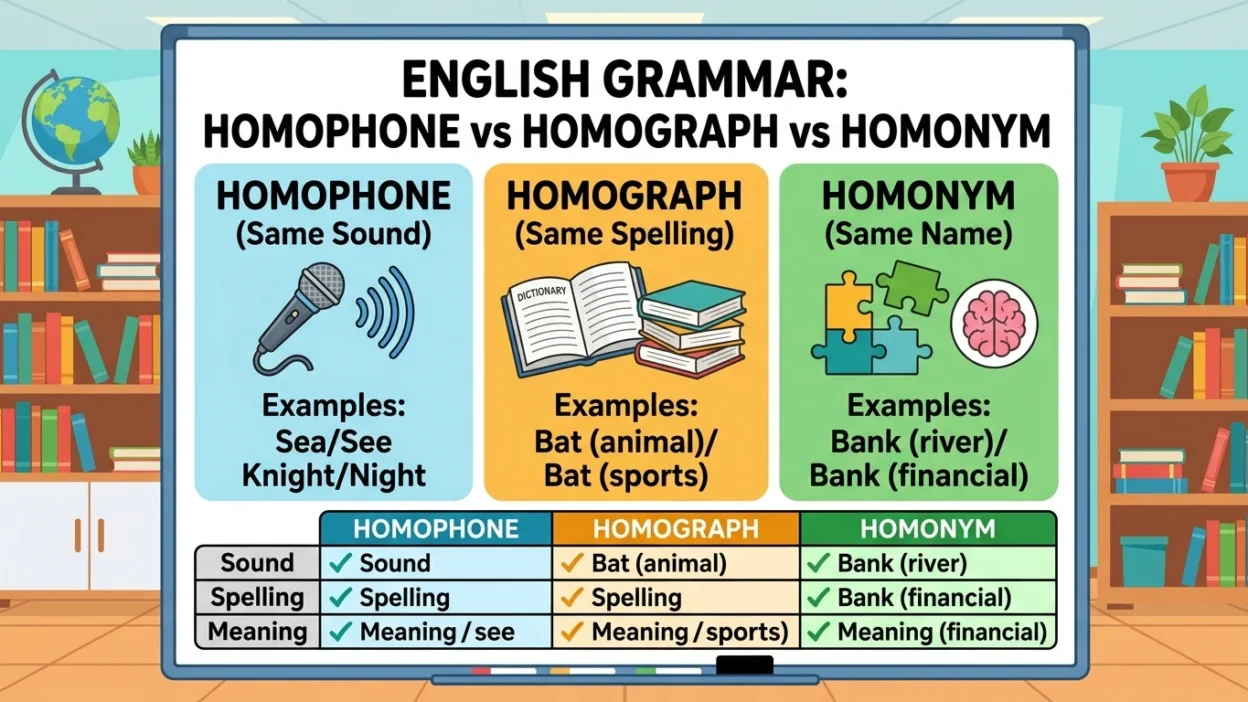
The main difference between homophone, homograph, and homonym is how the words relate in spelling, pronunciation, and meaning:
| Term | Same Spelling | Same Pronunciation | Different Meaning |
| Homophone | No (usually) | Yes | Yes |
| Homograph | Yes | Sometimes | Yes |
| Homonym | Yes or No | Yes | Yes |
Homophones sound alike but have different meanings and spellings.
Homographs share the same spelling but have different meanings and sometimes different pronunciations.
Homonyms are words that sound the same and have different meanings. In many grammar references, homonyms can include both homophones and homographs.
What Does Homophone Mean?
A homophone is a word that sounds exactly like another word but has a different meaning and often a different spelling.
The word comes from Greek roots meaning “same sound.”
Homophone Examples
- Their – There
- Two – Too
- Sea – See
- Flour – Flower
- Knight – Night
Example Sentences
- I left their books on the table.
- Please put the bag over there.
- I need two tickets.
- I want too much chocolate.
Homophones are common causes of spelling mistakes because the words sound identical when spoken.
What Does Homograph Mean?
A homograph is a word that shares the same spelling as another word but has a different meaning. Sometimes the pronunciation changes as well.
The term comes from Greek words meaning “same writing.
Homograph Examples
- Lead (to guide) / Lead (a metal)
- Tear (rip) / Tear (drop from the eye)
- Wind (moving air) / Wind (to twist)
- Bow (front of a ship) / Bow (bend forward)
Example Sentences
- She will lead the team tomorrow.
- The pipe contains lead.
- Please tear the paper carefully.
- A tear rolled down her cheek.
Homographs can be challenging because context determines the correct meaning and pronunciation.
What Does Homonym Mean?
A homonym refers to words that have the same pronunciation but different meanings. In some dictionaries and linguistic resources, homonyms are used as an umbrella term that includes both homophones and homographs.
Homonym Examples
- Bat (animal) / Bat (sports equipment)
- Bark (tree covering) / Bark (dog sound)
- Bank (financial institution) / Bank (side of a river)
- Match (contest) / Match (fire starter)
Example Sentences
- The bat flew out of the cave.
- He swung the bat during the game.
- The dog began to bark loudly.
- The tree’s bark was rough.
The exact definition of homonym can vary slightly depending on the grammar guide being used.
Homophone vs Homograph vs Homonym: Key Differences
Understanding these terms becomes easier when viewed side by side.
| Feature | Homophone | Homograph | Homonym |
| Same Sound | Yes | Sometimes | Yes |
| Same Spelling | Usually No | Yes | Sometimes |
| Different Meanings | Yes | Yes | Yes |
| Example | See / Sea | Wind / Wind | Bat / Bat |
| Context Needed | Yes | Yes | Yes |
The biggest distinction is that homophones focus on pronunciation, homographs focus on spelling, and homonyms focus on shared forms with different meanings.
Simple Examples to Remember
A quick way to remember these concepts is through familiar word pairs.
Homophones
- Brake / Break
- Mail / Male
- Right / Write
Homographs
- Minute (tiny) / Minute (60 seconds)
- Object (thing) / Object (oppose)
- Present (gift) / Present (to show)
Homonyms
- Ring (jewelry) / Ring (sound)
- Well (healthy) / Well (water source)
- Park (recreation area) / Park (stop a vehicle)
Practicing these examples can help reinforce the differences.
Why Do People Confuse Homophones, Homographs, and Homonyms?
There are several reasons these terms often get mixed up.
Similar Terminology
All three words start with the prefix “homo,” which means “same.” This makes them appear nearly identical at first glance.
Overlapping Definitions
Some educational resources define homonyms broadly enough to include homophones and homographs, creating confusion for learners.
Dependence on Context
The correct interpretation often depends on the sentence rather than the word alone.
Pronunciation Variations
Certain homographs change pronunciation depending on their meaning, making them harder to identify.
Common Mistakes and How to Avoid Them
Many English learners accidentally misuse these terms.
Mistake 1: Calling Every Similar Word a Homophone
Not all similar words are homophones.
❌ Lead (metal) and Lead (guide) are homophones.
✅ They are homographs because they share spelling but may be pronounced differently.
Mistake 2: Thinking Homographs Must Sound the Same
Some homographs have different pronunciations.
❌ Wind and Wind always sound identical.
✅ Their pronunciation changes depending on meaning.
Mistake 3: Assuming All Grammar Books Use the Same Definition
Different dictionaries and linguistic references may define homonyms differently.
Always check how the source defines the term.
Mistake 4: Ignoring Context
Words with multiple meanings can only be understood through context.
Reading the entire sentence usually reveals the correct meaning.
American vs British English Differences
The concepts of homophones, homographs, and homonyms remain largely the same in both American and British English. However, pronunciation differences can affect whether certain words are considered homophones.
Example
In some British accents:
- Pour
- Poor
may sound different.
In many American accents:
- Pour
- Poor
often sound identical.
Similarly, pronunciation variations may change how speakers perceive certain homophone pairs.
Despite accent differences, grammar rules and definitions remain consistent across American and British English.
Tips for Mastering Homophones, Homographs, and Homonyms
If you want to improve your English vocabulary and avoid mistakes, try these strategies:
- Read extensively to see words in context.
- Keep a notebook of confusing word pairs.
- Practice spelling exercises regularly.
- Learn word meanings instead of memorizing definitions alone.
- Use example sentences for every new word.
- Listen to native speakers from different regions.
- Review common homophone lists frequently.
These habits can significantly improve both written and spoken English.
FAQs
What is the difference between a homophone and a homonym?
A homophone focuses on words that sound the same but have different meanings. A homonym generally refers to words with the same pronunciation and different meanings and may include other related categories depending on the source.
Can a word be both a homograph and a homonym?
Yes. Words like bat and bat have the same spelling and pronunciation but different meanings, making them examples of homonyms and homographs under some classifications.
Are all homographs pronounced differently?
No. Some homographs share the same pronunciation, while others have different pronunciations.
Why are homophones important?
Homophones are important because they affect spelling accuracy, reading comprehension, and clear communication.
Is “their,” “there,” and “they’re” a homophone set?
Yes. These words sound alike but have different spellings and meanings, making them homophones.
What is the easiest way to remember homographs?
Think of the word “graph,” which relates to writing. Homographs are words with the same written form.
Do homonyms always have the same spelling?
Not always. Definitions vary among dictionaries and linguistic references.
Are homophones common in English?
Yes. English contains hundreds of homophone pairs because many words evolved from different origins but developed similar pronunciations.
Summary
Understanding homophone vs homograph vs homonym becomes much easier once you focus on what each term emphasizes. Homophones are words that share the same sound, homographs are words that share the same spelling, and homonyms are words that share pronunciation while having different meanings.
Although the definitions can overlap in some grammar resources, the core distinctions remain useful for learning and communication.
Mastering these concepts can improve your spelling, vocabulary, reading comprehension, and overall English fluency.
By studying examples, paying attention to context, and practicing regularly, you’ll become more confident in identifying and using these commonly confused word categories correctly.
Actionable Takeaway
The next time you encounter confusing words, ask yourself three simple questions:
- Do the words sound the same?
- Are they spelled the same?
- Do they have different meanings?
Answering these questions will quickly help you determine whether you’re dealing with a homophone, homograph, or homonym.