Many writers become confused when choosing between the correct phrases introduction to or introduction of, as both are used in English for different purposes and situations. One phrase is commonly associated with presenting something new for the first time, while the other focuses on explaining and familiarizing someone with a subject.
Through my experience editing articles and educational content, I have noticed that this small distinction often confuses people because the expressions appear similar. However, understanding how each one works can help you communicate more precisely. When the goal involves introducing a person, product, or idea, one option usually fits best.
When helping someone learn a topic, the better choice may be different. Knowing the difference can help you avoid common grammar mistakes, make your writing clearer, and encourage paying attention to context. This approach can improve accuracy, strengthen communication, and make information easier for readers to understand.
Quick Answer
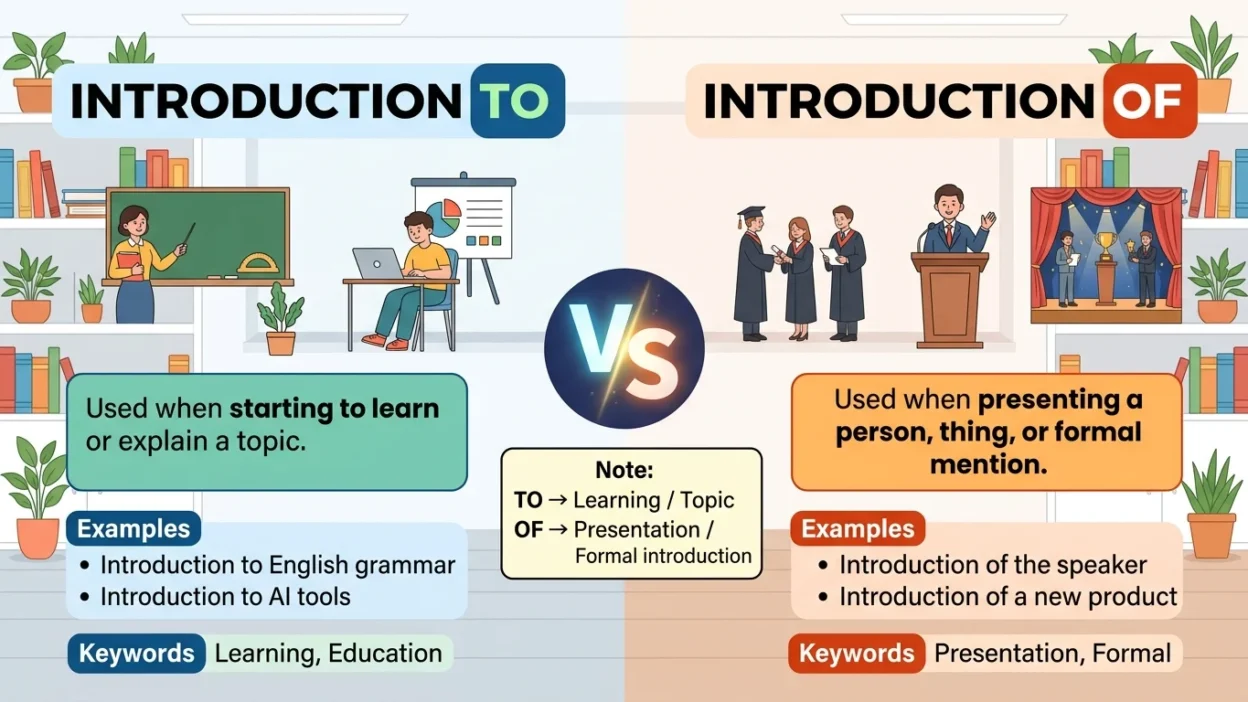
- Introduction to is used when referring to learning about, becoming familiar with, or presenting a subject, person, or concept.
- Example: This book is an introduction to psychology.
- Introduction of is used when referring to bringing something new into use, existence, or a situation.
- Example: The introduction of new technology improved productivity.
In short:
| Phrase | Main Meaning |
| Introduction to | Learning about or presenting something |
| Introduction of | Bringing something new into use or existence |
What Does “Introduction To” Mean?
The phrase introduction to usually means the beginning of learning about a topic, person, idea, or subject. It often suggests a first encounter or basic understanding.
Think of it as a gateway that helps someone become familiar with something new.
Examples of Introduction To
- This course is an introduction to computer programming.
- She gave me an introduction to classical music.
- The book serves as an introduction to economics.
- The teacher provided an introduction to world history.
- His speech was an introduction to the company’s vision.
In each example, the focus is on helping someone understand or become acquainted with a subject.
Common Contexts
You will frequently see introduction to in:
- Educational courses
- Textbooks
- Training materials
- Presentations
- Workshops
- Academic writing
Examples:
- Introduction to Biology
- Introduction to Marketing
- Introduction to Artificial Intelligence
- Introduction to Data Science
What Does “Introduction Of” Mean?
The phrase introduction of refers to bringing something into existence, use, discussion, or a particular environment.
It highlights the act of adding, launching, implementing, or presenting something new.
Examples of Introduction Of
- The introduction of electric vehicles changed the automobile industry.
- The introduction of new laws reduced pollution.
- The introduction of smartphones transformed communication.
- The introduction of online banking increased convenience.
- The introduction of modern equipment improved efficiency.
Here, the emphasis is not on learning but on introducing something new.
Common Contexts
You often find introduction of in discussions about:
- Technology
- Policies
- Products
- Regulations
- Business changes
- Historical developments
Examples:
- Introduction of a new product
- Introduction of safety measures
- Introduction of legislation
- Introduction of digital payment systems
Introduction To vs Introduction Of: Key Difference
The easiest way to remember the difference is to focus on the purpose.
| Introduction To | Introduction Of |
| Learning about something | Bringing something new |
| Familiarization | Implementation |
| Educational context | Change or innovation context |
| Often followed by a subject | Often followed by a new item or idea |
| Focuses on understanding | Focuses on creation or adoption |
Compare These Sentences
Introduction to
- This seminar is an introduction to project management.
- The article provides an introduction to climate science.
Introduction of
- The introduction of project management software improved workflow.
- The introduction of environmental regulations reduced emissions.
Notice how the meaning changes completely.
When Should You Use “Introduction To”?
Use introduction to when discussing:
- Learning
- Education
- Training
- Familiarization
- Presenting information
Examples
✅ Introduction to photography
✅ Introduction to machine learning
✅ Introduction to public speaking
✅ Introduction to digital marketing
✅ Introduction to finance
A useful rule is:
If someone is being introduced to knowledge, use “introduction to.”
When Should You Use “Introduction Of”?
Use introduction of when discussing:
- New products
- New systems
- New rules
- New technologies
- Organizational changes
Examples
✅ Introduction of a new software platform
✅ Introduction of stricter regulations
✅ Introduction of renewable energy solutions
✅ Introduction of advanced healthcare technology
✅ Introduction of automated systems
A simple rule is:
If something new is being added or launched, use “introduction of.”
Real-Life Examples
Let’s look at situations where both phrases appear but have different meanings.
Education
- The textbook is an introduction to chemistry.
- The introduction of new chemistry standards changed the curriculum.
Technology
- The course offers an introduction to cybersecurity.
- The introduction of cybersecurity protocols improved protection.
Business
- The workshop provides an introduction to leadership.
- The introduction of new leadership policies increased employee satisfaction.
Healthcare
- The seminar gives an introduction to nutrition science.
- The introduction of telemedicine expanded healthcare access.
Common Mistakes People Make
Many English learners confuse these phrases because both contain the word introduction.
Mistake 1: Using “Introduction Of” for Learning
❌ This book is an introduction of psychology.
✅ This book is an introduction to psychology.
Reason: The book teaches psychology rather than introducing psychology into existence.
Mistake 2: Using “Introduction To” for New Changes
❌ The introduction to new regulations improved safety.
✅ The introduction of new regulations improved safety.
Reason: Regulations were implemented, not studied.
Mistake 3: Translating Directly from Another Language
Some languages use one structure for both meanings. English separates the concepts clearly.
Always ask yourself:
- Am I talking about learning something? → Use to
- Am I talking about bringing something new? → Use of
Grammar Tip: Why the Preposition Matters
Prepositions often change meaning significantly in English.
With introduction to, the word to points toward a subject or area of knowledge.
With introduction of, the word of shows ownership or connection to the thing being introduced.
Examples:
- Introduction to economics = learning economics.
- Introduction of economics reforms = implementing reforms.
Understanding the role of prepositions can improve your grammar and writing accuracy.
American vs British English
The good news is that there is virtually no significant difference between American and British English regarding introduction to and introduction of.
Both varieties follow the same usage rules.
American English
- Introduction to Computer Science
- Introduction of new tax policies
British English
- Introduction to Computer Science
- Introduction of new tax policies
Writers on both sides of the Atlantic use these phrases in the same way.
Helpful Memory Trick
Remember this simple formula:
To = Toward Learning
Of = Offering Something New
Ask yourself:
- Is someone learning about something? → Introduction to
- Is something being added or implemented? → Introduction of
This quick trick helps prevent mistakes in everyday writing.
FAQs
Is it introduction to or introduction of a person?
Usually, when presenting one person to another, we say:
- An introduction to my friend Sarah.
However, when referring to the act itself:
- The introduction of the guest speaker was brief.
The context determines the correct phrase.
Can both phrases be correct in the same sentence?
Yes.
Example:
- The introduction of the new software included an introduction to its features.
Here, one phrase refers to implementation, and the other refers to learning.
Which phrase is more common?
Both are common, but they appear in different contexts. Educational materials frequently use introduction to, while business and policy discussions often use introduction of.
Is “Introduction to” used in book titles?
Yes, very often.
Examples:
- Introduction to Sociology
- Introduction to Statistics
- Introduction to Psychology
Is “Introduction of” grammatically correct?
Absolutely. It is correct when discussing the implementation or arrival of something new.
Can I say “introduction of myself”?
This sounds unnatural in most situations.
Instead, use:
- Let me introduce myself.
- A brief introduction to myself.
Why do writers confuse these phrases?
Because both contain the noun introduction, but the prepositions create different meanings. The confusion usually comes from focusing on the noun and ignoring the preposition.
Summary
Understanding the difference between introduction to and introduction of is easier once you focus on the purpose of the sentence. Introduction to refers to learning, familiarization, or presenting information about a subject. It is commonly used in education, training, books, courses, and presentations. Whenever someone is gaining knowledge about a topic, this is usually the correct choice.
On the other hand, Introduction of refers to bringing something new into existence, use, discussion, or operation. It is commonly used in business, technology, government, healthcare, and historical contexts. Whenever a new product, policy, system, or idea is being implemented, introduction of is generally the right phrase.
Actionable Takeaway
Before choosing between the two phrases, ask yourself one question:
Am I talking about learning something or adding something new?
- Learning or becoming familiar → Introduction to
- Implementing or launching something new → Introduction of
Using this simple rule will help you choose the correct phrase every time and make your writing more natural, professional, and grammatically accurate.