English can feel tricky sometimes, especially when two small words sound exactly alike but mean completely different things. One of the most common grammar mistakes people make is confusing too vs to. Even fluent English speakers occasionally type the wrong one in emails, texts, or social media posts.
If you’ve ever paused while writing and wondered whether to use to or too, you’re not alone. The good news is that the difference is actually simple once you understand the meaning and grammar behind each word. This guide will help you use both correctly with easy explanations, examples, common mistakes, and practical tips you can remember every day.
Quick Answer
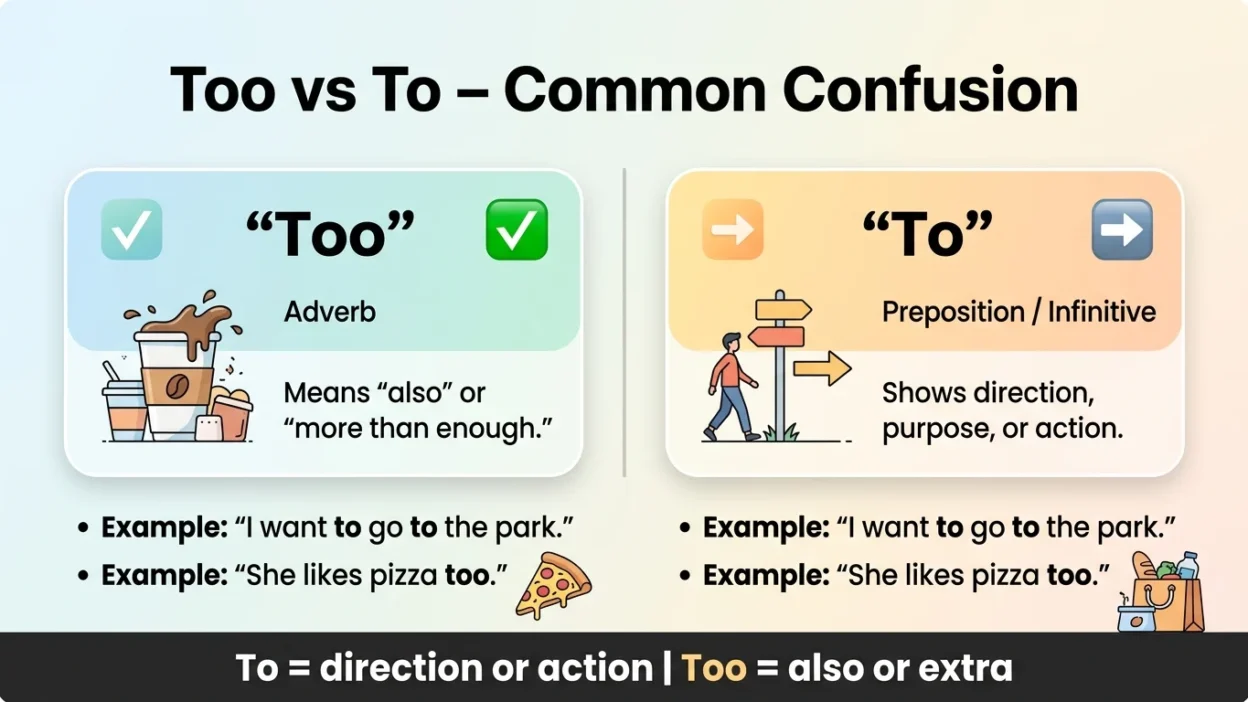
- To is usually used:
- as a preposition
- before a verb in the infinitive form
- Example:
- I want to learn English.
- We are going to school.
- Too means:
- “also”
- “excessively” or “more than enough”
- Example:
- I want to come too.
- The coffee is too hot.
A simple trick:
- Too has an extra “o,” which can remind you of “extra” or “also.”
- To is shorter and used more often in sentences.
What Does “To” Mean?
The word to is one of the most commonly used words in English. It serves several grammatical purposes.
1. “To” as a Preposition
It shows direction, movement, place, or relationship.
Examples:
- She walked to the market.
- I gave the book to my friend.
- We traveled to Lahore last weekend.
In these examples, to connects things and shows movement or direction.
2. “To” Before a Verb
“To” is also used before the base form of a verb, known as the infinitive.
Examples:
- I love to read.
- They want to travel.
- He needs to sleep.
This structure is extremely common in English grammar and writing.
What Does “Too” Mean?
The word too has two main meanings.
1. “Too” Meaning “Also”
When too means “also,” it usually comes at the end of a sentence.
Examples:
- I like pizza too.
- She is coming too.
- Can I join too?
You can often replace too with “also” without changing the meaning.
2. “Too” Meaning “Excessively”
It can also mean “more than needed” or “more than acceptable.”
Examples:
- The bag is too heavy.
- You are driving too fast.
- This movie is too long.
In these sentences, too suggests excess.
Too vs To: Key Differences
| Word | Meaning | Usage | Example |
| To | Direction, relationship, or infinitive marker | Connects nouns or verbs | I want to study. |
| Too | Also or excessively | Adds emphasis or excess | I want to study too. |
Understanding the context of the sentence makes choosing the correct word much easier.
Easy Examples of Too vs To
Here are simple sentence pairs that clearly show the difference.
Using “To”
- We went to the park.
- She likes to dance.
- I need to call my mom.
- He gave the keys to me.
Using “Too”
- I am tired too.
- This soup is too salty.
- They want to come too.
- It’s too cold outside.
Common Mistakes People Make
Many English learners confuse these words because they sound identical. These are called homophones — words with the same pronunciation but different meanings and spellings.
Here are some common grammar mistakes.
Incorrect:
- I want too go home.
Correct:
- I want to go home.
Why?
Because to comes before the verb “go.”
Incorrect:
- She likes coffee to.
Correct:
- She likes coffee too.
Why?
Because the sentence means “also.”
Incorrect:
- This bag is to heavy.
Correct:
- This bag is too heavy.
Why?
Because the sentence describes excess.
Simple Memory Tricks for Too vs To
These quick grammar tips can help you remember the difference instantly.
Trick 1: Extra “O” Means Extra
The word too has an extra “o.”
Think of it as meaning:
- extra
- also
- more than enough
Example:
- The room is too noisy.
Trick 2: “To” Is Usually About Direction or Action
Use to when:
- going somewhere
- connecting ideas
- introducing a verb
Examples:
- Go to bed.
- I want to learn.
These small memory devices are helpful for students, writers, and anyone improving English writing skills.
Too vs To in Everyday Writing
People often mix up these words in:
- text messages
- emails
- captions
- school assignments
- professional communication
Even a tiny grammar mistake can make writing look less polished.
For example:
Informal:
- I’m going too the store.
Correct:
- I’m going to the store.
In business writing, academic writing, or online content, using correct grammar improves readability and credibility.
Too vs To in American and British English
The good news is that there is no major difference between American English and British English when it comes to too vs to.
Both forms follow the same grammar rules in:
- the United States
- the United Kingdom
- Canada
- Australia
- other English-speaking countries
Examples:
- British English: I’d like to come too.
- American English: I’d like to come too.
The spelling and usage remain identical.
Related Grammar Terms and LSI Keywords
When learning too vs to, you may also encounter related English grammar concepts such as:
- homophones
- confusing words in English
- grammar rules
- English writing tips
- commonly confused words
- proper word usage
- English sentence structure
- grammar checker tips
- writing mistakes
- correct English usage
Understanding these related terms helps improve overall communication skills and writing confidence.
Practice Sentences
Try filling in the blanks with either to or too.
- I want ___ watch a movie.
- She is coming ___.
- The weather is ___ hot today.
- We drove ___ Karachi yesterday.
- Can I join you ___?
Answers:
- to
- too
- too
- to
- too
Practicing regularly makes grammar feel natural over time.
Why People Confuse Too and To
There are several reasons:
- They sound exactly the same.
- Both are very short words.
- Typing quickly causes mistakes.
- Autocorrect sometimes misses the error.
Because they are so common in daily writing, confusion happens frequently. The best solution is to pause and ask:
- Does the sentence mean “also” or “excessively”? → use too
- Is it showing direction or followed by a verb? → use to
FAQs
Is “too” always used at the end of a sentence?
No. While it often appears at the end, it can also appear before adjectives or adverbs.
Example:
- It’s too expensive.
Can “too” mean “very”?
Not exactly. “Too” means excessively or more than needed.
Example:
- The tea is too hot.
This suggests a problem.
Is “to” a verb?
No. “To” is usually a preposition or part of an infinitive verb form.
Why do people confuse too and to?
Because they are homophones and sound identical in pronunciation.
How can I remember the difference quickly?
Remember:
- Too = extra “o” = extra meaning
- To = direction or action
Is it grammatically correct to say “me too”?
Yes, absolutely.
Example:
- “I love music.”
- “Me too.”
Can “too” replace “also” in every sentence?
Not always, but often.
Example:
- I like coffee too.
- I also like coffee.
Both work, though sentence structure may differ slightly.
Final Thoughts :
Understanding too vs to is an important step toward better English grammar and clearer communication. Even though these words are tiny, using the correct one can make your writing look more polished, professional, and natural. Once you learn the basic meanings, the difference becomes much easier to spot.
The simplest way to remember it is this: use too when you mean “also” or “excessively,” and use to for direction, connection, or before a verb. With regular reading, writing, and practice, choosing the right word will soon become automatic in everyday English.
Actionable Takeaway:
Before finishing any sentence, quickly check:
- Does it mean “also” or “more than enough”? → use too
- Does it show direction or come before a verb? → use to
That one-second check can instantly improve your grammar accuracy.

Henry Wyatt is the administrator of RizzPeak, responsible for managing site operations, content organization, and overall performance. He ensures smooth functionality, platform security, and a user-friendly experience while supporting the site’s creative direction and maintaining consistent quality across all features and updates.